📋 KEY TAKEAWAYS
- ALS sleep difficulty almost always comes from one of three sources: positioning that no longer matches declining muscle strength, pressure points the patient can no longer shift away from independently, and breathing difficulty that worsens when lying flat.
- The right bed addresses positioning and transfers. The right mattress addresses pressure relief. They solve different problems, and ALS care at home usually needs both.
- Mattress needs change as ALS progresses. An early-stage patient who is still mobile needs a different surface than a patient who is now fully immobile and pressure injury risk has become the primary concern.
- Browse the full Prius Healthcare USA collection to compare bed and mattress options by ALS stage.
Top Picks:
Bottom Line: ALS sleep problems change as the disease progresses. The bed and mattress that worked six months ago may not work today, and planning ahead for that change matters as much as solving today's problem.
Why Sleep Becomes So Difficult With ALS
Sleep disturbance is one of the most consistently reported problems in ALS, and it rarely comes from a single cause. According to research published in Nature and Science of Sleep, effective management of ALS-related sleep disturbance requires careful attention to non-invasive ventilation settings, mask fit, and positioning, because getting any one of these wrong can worsen sleep quality rather than improve it.
For most families, the sleep problem shows up in three overlapping ways. The patient can no longer shift their own weight to relieve pressure on the hips, shoulders, and heels. Lying flat becomes harder to tolerate as respiratory muscles weaken. And transfers in and out of bed become a safety concern as limb strength declines, for the patient and for the caregiver doing the lifting.
ALS United Rocky Mountain recommends that patients experiencing these issues consider a hospital bed, adjustable bed, or medical bed, and discuss mattress overlays and positioning support directly with a physical or occupational therapist. That guidance points to the same conclusion this article works through in more detail: the bed and the mattress solve different parts of the problem, and most ALS households eventually need both addressed.
3 Bed Features That Matter Most for ALS
1. Full Height Adjustability
As limb strength declines, the bed's height becomes a safety factor every single day. A bed that raises to a comfortable transfer height reduces the physical strain on both the patient and the caregiver during every sit-to-stand and bed-to-wheelchair transition. As ALS progresses and the patient's ability to assist with their own transfer decreases, that height adjustment range becomes the difference between a manageable transfer and a dangerous one.
Breathing becomes harder to manage as ALS affects respiratory muscles. A bed that can elevate the head independently of the rest of the body supports easier breathing and makes non-invasive ventilation more comfortable to use. Foot elevation helps with circulation during long periods spent in bed as mobility decreases.
3. Strong Side Rails
Side rails provide a stable point of contact for repositioning and reduce fall risk as the patient's ability to catch themselves declines. For ALS patients specifically, rails also give caregivers a secure reference point during transfers and repositioning, particularly as the disease progresses and assistance needs increase.
Finding a single bed that genuinely covers all three priorities at once is the real challenge most families run into. Here is the model that addresses height adjustability, head and foot articulation, and rail stability together, without turning the bedroom into a clinical space

Supernal 3 with Rails: A Bed Built for These Three Needs
The Transfer Master Supernal 3 addresses all three priorities without requiring the household to accept a clinical-looking bed in the bedroom. The height range of 10.5 to 20.5 inches accommodates safer transfers as limb strength declines, and wall-hugging technology keeps the bed close to the wall as the head elevates, so nightstand essentials, medication, and communication devices stay within reach.
Independent head adjustment to 65 degrees and foot adjustment to 35 degrees support breathing comfort and circulation. The European-style head tilt independently adjusts the neck and pillow area, which matters for ALS patients managing non-invasive ventilation at night, proper head and neck positioning affects mask seal and comfort. Half rails (head only) and bamboo rail covers are available to add the stability and fall protection many ALS patients need as the disease progresses, with rail covers specifically recommended for patients experiencing tremors or involuntary movement.
The wireless illuminated remote allows the patient to adjust their own position independently for as long as that remains possible, preserving a degree of autonomy that matters throughout the disease course.
Key Specs: Transfer Master Supernal 3
-
Height Range: 10.5" to 20.5"
-
Functions: Head (65°), Foot (35°), Hi-Low, Wall Hugging, European-style Head Tilt, Massage Chair
-
Weight Capacity: 400 lbs (Twin 80, Full 80); 500 lbs (Queen)
-
Sizes: Twin 80, Full 80, Queen, Dual King
-
Mattress Options: Ascent (cloth or vinyl), Soft Touch (cloth or vinyl), PressureGuard Span-Care Convertible Mattress
-
Add-Ons: Half Rails (head only), Bamboo Rail Covers, Battery Backup, 5" Locking Casters
-
Hoyer Compatible: No, add 5" casters for compatibility, or consider Supernal 5 for Hoyer needs
-
Warranty: Contact retailer
GET THIS IF you are managing ALS at home and need a bed that supports safe transfers, independent head and foot positioning for breathing comfort, and side rail stability, without a clinical bedroom environment.
See Price & Details
Choosing a Mattress by ALS Stage
Mattress needs in ALS are not static. The right surface for a patient who can still reposition themselves is the wrong surface for a patient who cannot. Thinking in terms of disease stage, rather than just comfort preference, leads to a better outcome.

Early-Stage ALS: Prius Ultra Convertible
For patients who are still relatively mobile, the priority is comfort that feels normal, not a mattress that signals illness before it needs to. The Prius Ultra Convertible uses a self-adjusting foam system with the Serene foam topper, continuously responding to the patient's weight, shape, and position without requiring any manual adjustment.
The multi-layer foam heel section offloads pressure from one of the highest-risk areas for skin breakdown, addressing prevention before it becomes urgent. The micro-climate top cover manages moisture and reduces friction, which matters even at this stage as mobility gradually decreases. Critically, this mattress is convertible, the powered alternating pressure control unit can be added later if passive pressure redistribution is no longer enough, without needing to replace the entire system.
This is the practical advantage for early-stage ALS: it is a mattress that works today, while the disease's typical progression is already accounted for.
Key Specs: Prius Ultra Convertible
-
Mattress Size: 36"W x 80"L x 7"H
-
Weight Capacity: 600 lbs
-
Zones: Head, Shoulder, Torso, Foot
-
Key Features: Serene foam topper, multi-layer foam heel section, full-length lower rail bolsters, micro-climate top cover, convertible to powered alternating pressure
-
Warranty: 1-year pump, 5-year mattress
GET THIS IF the patient is still mobile but you want to prepare for future changes without sacrificing a normal mattress feel today.
See Price & Details

Mostly Immobile ALS: Prius Rhythm Multi Plus
Once a patient is mostly immobile, the mattress has to do the work the body used to do on its own. The Prius Rhythm Multi Plus is a low air loss alternating pressure system covering all four ulcer stages through four therapy modes: Static, Pulsation, True Low Air Loss, and 3-1 Alternation, controlled from a single master control unit.
The Happy Heel feature offers three selectable softness settings specifically for the heel area, one of the highest-risk zones for pressure injury in patients who cannot reposition independently. Fowler detection automatically adjusts air cell pressure when the head of the bed is raised, important for ALS patients who spend extended time with the head elevated for breathing support. Auto Firm mode inflates the mattress to full firmness during transfers and caregiver care tasks, then returns automatically to therapeutic settings.
This is the mattress built for high-level clinical care at home, where the surface itself is actively managing pressure rather than waiting for someone to notice a problem.
Key Specs: Prius Rhythm Multi Plus
-
Mattress Dimensions: 80"L x 36"W x 8"H
-
Weight Capacity: 500 lbs
-
Cell Number: 18 cells, black nylon with PU coating
-
Therapy Modes: Static, Pulsation, True Low Air Loss, 3-1 Alternation
-
Comfort Settings: 8 digital adjustable levels
-
Key Features: Happy Heel (3 settings), Fowler detection, Auto Firm mode, CPR Quick Release
-
Cycle Time: 3 to 95 minutes
-
Min/Max Pressure: 15-52 mmHg ± 4 mmHg
GET THIS IF the patient is mostly immobile and you need the mattress itself to actively manage pressure across all four ulcer stages, with minimal manual intervention required.
See Price & Details
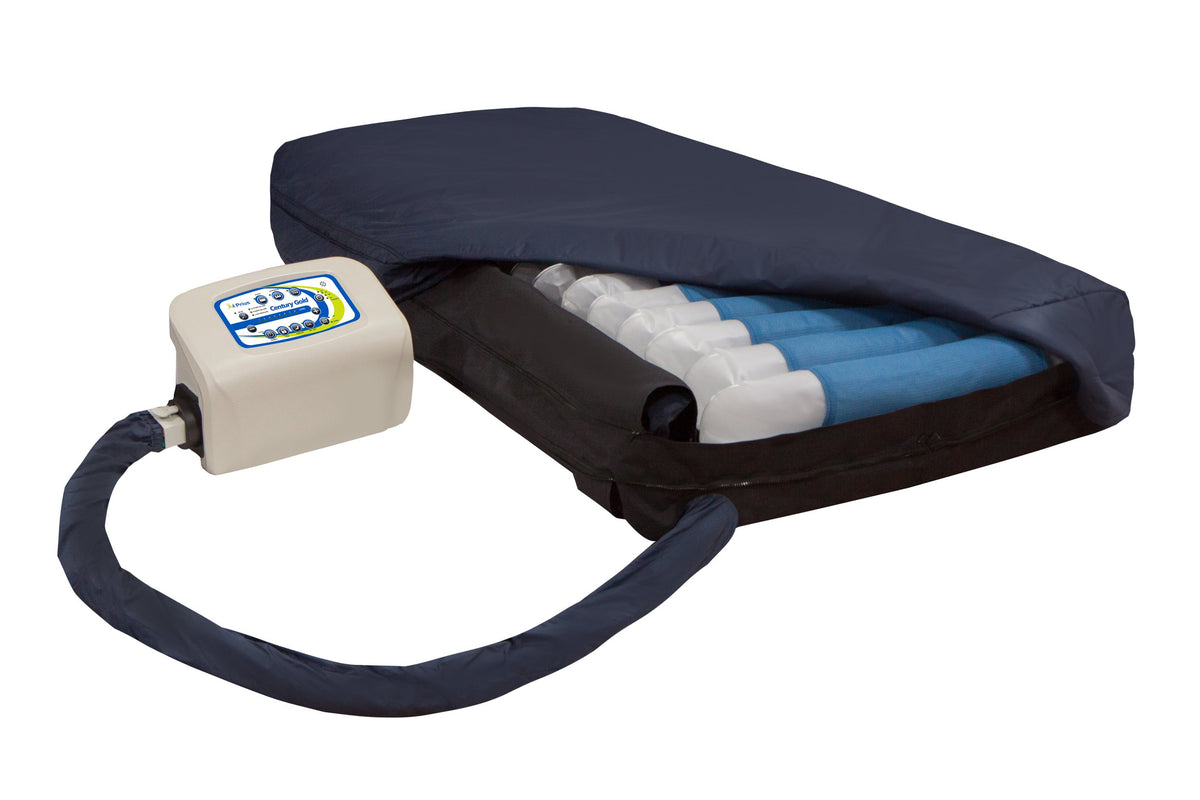
Advanced ALS: Prius Century Gold
For advanced ALS, particularly when pressure sores are already present or actively being managed, the Prius Century Gold offers aggressive wound prevention and moisture management, a positioning similar to the Rhythm Multi Plus, with some differences worth understanding.
The Century Gold uses a 21-cell system with true alternating pressure and low air loss therapy, specifically engineered for Stage 1 through Stage 4 pressure sore prevention and treatment. On-demand air-filled side rails can be raised or deflated for safer ingress and egress. The CPR Quick Release deflates the entire system in under 20 seconds for emergency access, a meaningful safety feature for advanced ALS patients with significant immobility. Power outage protection keeps air cells inflated during a power failure, which matters for a patient who cannot reposition themselves if the system loses pressure.
Where the Century Gold differs from the Rhythm Multi Plus: the Century Gold has more cells (21 versus 18), is specifically positioned for patients with existing pressure sores already requiring treatment, and includes integrated on-demand side rails. The Rhythm Multi Plus offers more therapy mode variety (four modes versus the Century Gold's static and 2-in-1 alternation) and the Happy Heel feature for targeted heel protection.
Key Specs: Prius Century Gold
-
Mattress Dimensions: 80"L x 36"W x 10"H
-
Weight Capacity: 500 lbs
-
Cell Number: 21 cells, clear TPU
-
Therapy Modes: Static function, 2-in-1 alternation
-
Cycle Time: 10, 15, 20, or 30-minute intervals
-
Key Features: On-demand air-filled side rails, CPR Quick Release (under 20 seconds), power outage protection, cable management system
-
HCPCS Code: E0277 (MedShopDirect does not bill Medicare or insurance directly)
GET THIS IF the patient has advanced ALS with existing pressure sores or significant immobility, and aggressive wound prevention and moisture management are the primary clinical priority.
See Price & Details
Comparing the 3 Prius Mattresses
| Feature |
Prius Ultra Convertible |
Prius Rhythm Multi Plus |
Prius Century Gold |
| Best ALS Stage |
Early-stage, still mobile |
Mostly immobile |
Advanced, active pressure sores |
| Mattress Width |
36" |
36" |
36" |
| Mattress Length |
80" |
80" |
80" |
| Mattress Height |
7" |
8" |
10" |
| Weight Capacity |
600 lbs |
500 lbs |
500 lbs |
| Therapy Approach |
Passive, convertible to powered alternating pressure |
Static, Pulsation, True Low Air Loss, 3-1 Alternation |
Static function, 2-in-1 alternation |
| Cover Material |
Micro-climate top cover (vapor-permeable, fluid-proof) |
Blue Nylon with PU coating finish |
Blue Nylon with PU coating finish |
Frequently Asked Questions
What is the best mattress for ALS patients?
It depends on the stage of the disease. The Prius Ultra Convertible suits early-stage ALS patients who are still mobile. The Prius Rhythm Multi Plus suits mostly immobile patients needing the mattress to actively manage pressure. The Prius Century Gold suits advanced ALS, especially when pressure sores are already present.
What bed features matter most for ALS patients at home?
Full height adjustability for safer transfers, independent head and foot articulation for breathing comfort, and strong side rails for stability and fall prevention. The Supernal 3 with Rails addresses all three.
Does ALS affect sleep quality?
Yes. ALS commonly disrupts sleep through breathing difficulty, the inability to reposition independently, and pressure discomfort. Non-invasive ventilation, when properly fitted, can meaningfully improve sleep quality for many patients.
When should an ALS patient switch from a regular mattress to a pressure relief mattress?
When repositioning independently becomes difficult or impossible, or when early signs of skin breakdown appear. Acting before a pressure sore develops is easier than treating one after it forms.
What is the difference between the Prius Rhythm Multi Plus and the Prius Century Gold?
Both serve advanced ALS care, but the Rhythm Multi Plus offers more therapy modes and a dedicated heel protection feature, while the Century Gold has more cells, integrated on-demand side rails, and is specifically positioned for patients with existing pressure sores.
Is the Prius Ultra Convertible suitable for advanced ALS?
It can be, since the powered alternating pressure control unit can be added when passive pressure redistribution is no longer sufficient. For patients with existing pressure sores, the Rhythm Multi Plus or Century Gold are the more clinically appropriate choice.
Can the Supernal 3 be used with a pressure relief mattress? Yes. The Supernal 3 supports Ascent, Soft Touch, and PressureGuard Span-Care Convertible Mattress options as listed in its catalog specifications. Confirm compatibility with your specific Prius mattress model before purchasing.


