📋 KEY TAKEAWAYS
Buying hospital mattresses in bulk for a nursing home or healthcare facility is a procurement decision, not a shopping decision. Price per unit matters less than durability over a 5 to 7 year replacement cycle, infection control compliance, pressure redistribution clinical effectiveness, and whether the supplier can reliably fulfill reorders when a mattress needs replacing three years from now.
-
Bulk procurement typically happens in four scenarios: facility-wide replacement cycles, new wing or building openings, standardization across rooms, and building backup inventory for quick replacements.
- The five criteria that determine long-term value in facility mattresses are pressure redistribution effectiveness, infection control specifications, durability and weight capacity, standardization across beds, and consistent supply availability.
-
Consistent manufacturer availability, the ability to order the same mattress from the same supplier years after the initial purchase, is one of the most underappreciated factors in facility procurement.
- The Medacure Proex is a 3-tiered European foam mattress designed for long-term care, with a 7-year limited warranty, 450 lb capacity (550 lb bariatric), Stage II pressure ulcer prevention, and CFR 16 Part 1633 fire compliance.
- Browse the Wholesale Hospital Bed Mattress collection or contact MedShopDirect directly for bulk pricing and quote requests.
Bottom Line: The facilities that manage mattress procurement most effectively treat it as an infrastructure decision rather than a supply purchase, standardizing on one mattress, establishing a relationship with a consistent supplier, and building reorder processes before they are urgently needed.
Why Facilities Buy Hospital Mattresses in Bulk
Bulk mattress procurement at nursing homes and healthcare facilities happens in predictable situations. Understanding which scenario applies shapes the entire purchasing approach.
-
Facility-wide replacement cycles. Mattresses in long-term care wear out on a predictable timeline, typically 5 to 8 years of daily use before structural integrity and pressure redistribution properties degrade meaningfully. Facilities that track this proactively replace mattresses in planned phases rather than reactively addressing failures one room at a time. Bulk purchasing at replacement cycle time is both more cost-efficient and logistically simpler than piecemeal ordering.
-
New wing or building openings. Opening a new care unit requires equipping every bed before the first resident arrives. Procurement teams need a single mattress specification that works across all beds, a supplier who can fulfill the full quantity on the required timeline, and documentation for regulatory compliance from day one.
-
Standardization across rooms. Many facilities have accumulated mattresses from multiple vendors over the years, different specifications, different cover materials, different pressure properties. Standardizing on a single mattress model simplifies staff training, laundry and cleaning protocols, documentation for infection control audits, and reorder processes.
-
Expansion to additional locations. Multi-location operators benefit enormously from cross-facility standardization. When a regional operator adds a third or fourth facility, procuring the same mattress used at existing locations means no new training, consistent infection control documentation, and a single supplier relationship rather than managing multiple vendor accounts.
-
Backup inventory management. High-occupancy facilities cannot wait 1 to 2 weeks for a replacement mattress when a bed needs to be turned over quickly. Maintaining a small buffer inventory of the same mattress model used facility-wide means a room can be made ready within hours rather than days.
5 Things Procurement Teams Should Evaluate Beyond Price
Price per unit is the most visible line item in a mattress procurement decision. It is rarely the most important one. Here is what operationally determines whether a mattress purchase delivers value over its lifespan.
1. Pressure Redistribution Effectiveness
For residents who spend extended time in bed, the mattress surface directly determines skin integrity outcomes. A mattress that does not redistribute pressure adequately across multiple zones leads to pressure ulcer development, an outcome that carries clinical, regulatory, and financial consequences for a facility.
Procurement teams should verify that a mattress specifies the pressure ulcer stages it is rated to prevent or address, how pressure is distributed across the mattress surface (zone design, foam density progression), and whether those claims are supported by material specifications rather than marketing language alone.
2. Infection Control Specifications
Every mattress in a clinical environment is at risk of fluid contamination. The cover material, sealing mechanism, and cleanability of a mattress are not comfort considerations, they are infection control requirements.
Key specifications to verify: cover material denier and coating type, whether the zipper is protected or sealed to prevent fluid ingress, waterproofing rating, flame retardancy compliance (CFR 16 Part 1633 or equivalent), and anti-shear surface properties that reduce skin damage during repositioning.
3. Durability and Weight Capacity
A mattress in a nursing home bed may support residents up to 12 to 16 hours per day. Material quality under sustained load determines whether a mattress maintains its pressure redistribution properties through year 5 the way it did in year 1.
Weight capacity is a direct safety specification. For facilities admitting bariatric residents, confirming the mattress is rated at the appropriate capacity for each bed is not optional. Using a standard-rated mattress under a bariatric resident is a safety and liability issue.
4. Standardization Across Beds
A facility that uses three different mattress models across its beds has three sets of cleaning protocols, three different staff training requirements, three reorder processes, and three separate documentation trails for infection control audits. Standardizing on a single mattress eliminates this complexity immediately and compounds benefits over time as staff become consistently familiar with one product.
5. Consistent Supply Availability
This is the factor most procurement teams under-evaluate at the time of purchase and most frequently wish they had evaluated more carefully 18 months later.
A mattress purchased in bulk today needs to be available from the same supplier in the same specification when a replacement is needed in year 3, whether that is because one mattress was damaged, a new resident requires a fresh mattress, or a second location needs to be equipped. Supplier continuity, manufacturer stability, and consistent product specifications are operational necessities for facility procurement, not vendor relationship preferences.
Why Consistent Supply Matters More Than Most Buyers Realize
Consider what happens when a facility standardizes on a mattress that becomes unavailable two years after initial purchase. The supplier has discontinued the product, changed vendors, or gone out of business. The facility now faces a choice: find a close equivalent and manage the operational complexity of two mattress specifications, or repeat the full procurement process with a new product.
Neither outcome is efficient. The first creates exactly the standardization problem the original bulk purchase was designed to solve. The second consumes procurement time and budget that was not planned for.
Facilities that have navigated this scenario consistently identify consistent supply availability as one of the most underrated criteria in their original purchase decision. The right question is not just "can this supplier fulfill my order today?", it is "can this supplier fulfill my reorder in year 3, and will the product still match what I have in my facility?"
MedShopDirect maintains consistent stock of the Medacure Proex and can accommodate both initial bulk orders and ongoing reorder needs. Facility buyers are encouraged to establish their reorder process and supplier contact at the time of initial purchase, not when urgency forces the issue.
The Medacure Proex: A Facility-Grade Mattress Built for Long-Term Care
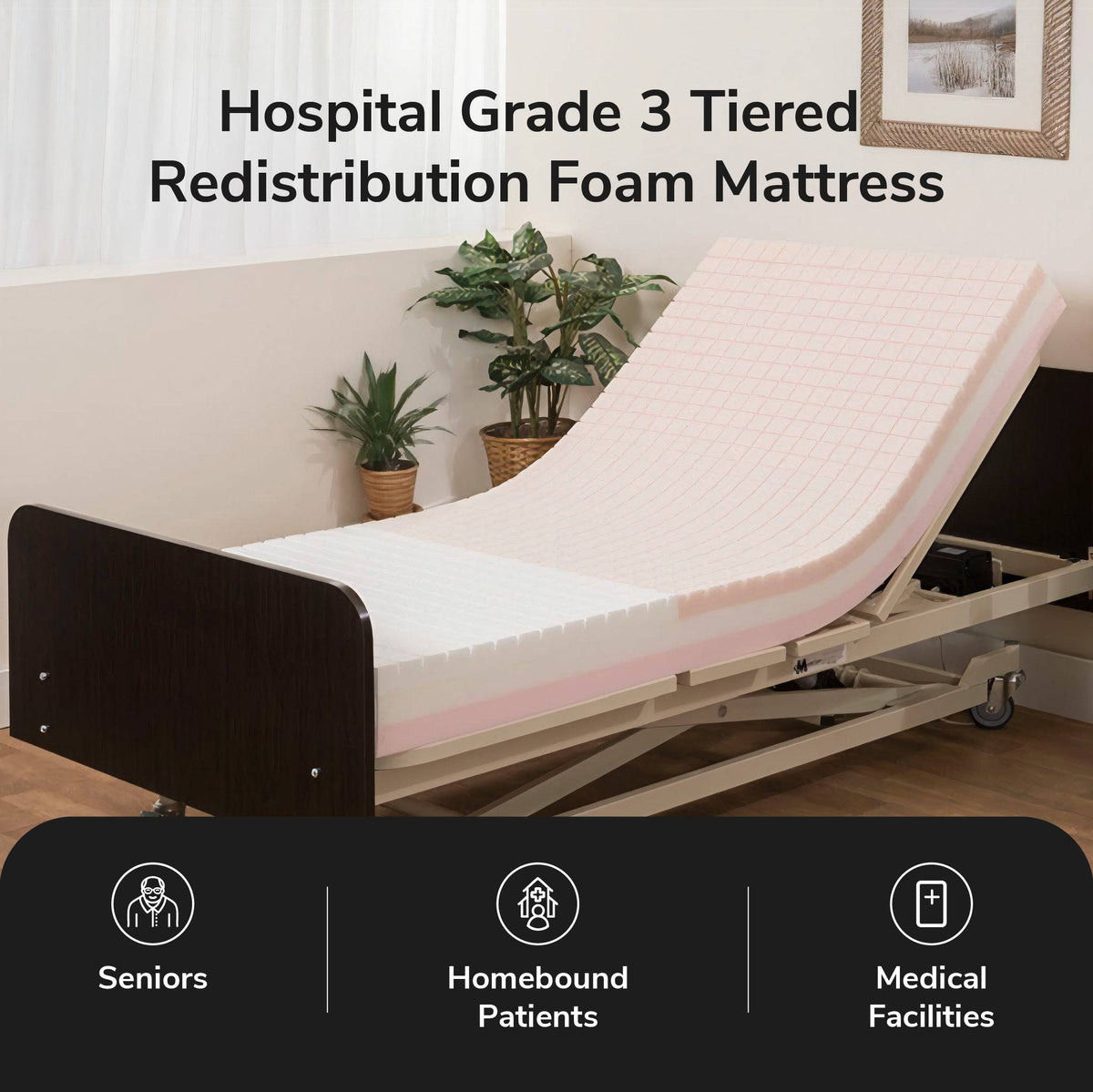
The Medacure Proex was designed for exactly the environment this article is written for, long-term care, skilled nursing, and healthcare facilities where a mattress will be in continuous daily use, cleaned repeatedly, and expected to maintain its clinical properties through a full replacement cycle.
What the 3-Tiered Design Does Clinically
The Proex uses a 3-tiered laminate progressive foam construction. The base layer is the firmest, providing structural support that prevents bottoming out under sustained weight. The middle layer transitions in density. The top layer combines convoluted foam with visco elastic memory foam, conforming to the resident's body shape to distribute weight across multiple contact zones rather than concentrating it at bony prominences.
This progression matters because a mattress that is uniform in density throughout provides neither adequate support at the base nor adequate conforming at the surface. The tiered design addresses both requirements simultaneously, the reason it is rated effective through Stage II pressure ulcer prevention.
The Heel Slope: A Specific Clinical Feature
The heel is one of the highest-risk sites for pressure injury in immobile patients. The Proex includes an integrated heel slope, a half-inch graduated reduction in mattress height at the foot end, that reduces contact pressure at the heel. The visco elastic memory foam in the heel section adds a second mechanism: softening the bony area to reduce localized pressure further. The heel slope version is standard; a version without the heel slope is also available for facilities with specific clinical protocols.
2. Infection Control Specifications
The hospital grade cover is 70 denier nylon with PVC backing, a material specification that provides waterproofing, durability against repeated cleaning, and resistance to fluid penetration. The zipper is protected with a sealed design that prevents fluid ingress at the closure point, which is one of the most common contamination failure points on clinical mattress covers. The cover base has an anti-slip coating with elastic straps that keep the mattress fixed on the bed frame during resident movement and repositioning. The mattress meets CFR 16 Part 1633 Federal Fire Code.
Capacity and Standardization Range
The standard 36-inch Proex supports 450 lbs. Bariatric widths (42" and 48") support 550 lbs. For facilities admitting residents across a range of body types and weights, the availability of bariatric widths in the same mattress specification means standardization can extend to bariatric rooms without introducing a different product.
Warranty
The Proex carries a 7-year limited warranty with lifetime support. For facility procurement planning, a 7-year warranty provides meaningful protection across the full expected replacement cycle of the mattress.
Why Standardizing One Mattress Makes Operational Sense
The operational case for standardizing on a single mattress model across a facility is substantial enough that it deserves its own section.
-
Cleaning and infection control. Staff learn one cleaning protocol, one chemical compatibility specification, and one cover removal and replacement procedure. Consistency reduces error and documentation complexity during infection control audits.
-
Inventory management. One SKU to track, one reorder process, one storage requirement. A backup inventory of a single mattress model can cover any bed in the facility.
-
Training. New staff learn one mattress specification. Patient positioning protocols, repositioning procedures, and pressure injury documentation are all applied consistently.
-
Regulatory documentation. When a surveyor asks about mattress specifications, infection control compliance, and pressure redistribution protocols, a facility with one standardized mattress answers simply and consistently. A facility with five different mattress types answers five different questions.
-
Cost visibility. Total cost of ownership is straightforward to calculate when every bed uses the same mattress. Replacement budgeting, lifecycle planning, and vendor negotiations are all simplified.
Bulk Ordering Through MedShopDirect
MedShopDirect works with nursing homes, skilled nursing facilities, hospitals, and multi-location operators on facility-level mattress procurement. The process is designed to accommodate the realities of institutional purchasing, quantity requirements, delivery coordination, and the need for a supplier who is responsive before and after the purchase.
-
Bulk pricing. Pricing for larger orders reflects the volume. Facilities interested in bulk pricing for 10 or more units are encouraged to contact MedShopDirect directly for a quote rather than processing as a standard online order.
-
Quote requests. Procurement teams can request a formal quote for the Medacure Proex in any combination of standard and bariatric widths. Quotes include per-unit pricing, total order pricing, and estimated delivery timelines.
-
Delivery coordination. White Glove Delivery is available for facilities that require mattresses to be brought to specific rooms rather than delivered to a receiving dock. White Glove orders undergo a 2-business-day intake period at the delivery facility before scheduling, with delivery appointments typically arranged within 5 to 7 business days from that point. MedShopDirect monitors every White Glove order and escalates on the facility's behalf if anything falls outside the expected timeframe.
-
Ongoing support. The same contact who handles the initial procurement order is available for reorders, replacements, and questions that arise after delivery. For facilities establishing a long-term supply relationship, this continuity is part of what makes the process work at scale.
Contact MedShopDirect at 833-499-4450 or through the Wholesale Hospital Bed Mattress collection to discuss your facility's requirements.
Frequently Asked Questions
Where can nursing homes and healthcare facilities buy hospital mattresses in bulk?
MedShopDirect supplies bulk hospital mattresses to skilled nursing facilities, nursing homes, and healthcare procurement teams nationwide. The Medacure Proex is a 7-year warranted, facility-grade option available in standard and bariatric widths. Contact 833-499-4450 or browse the Wholesale Hospital Bed Mattress collection for bulk pricing and quote requests.
What is the weight capacity of the Medacure Proex?
450 lbs for the standard 36-inch width. 550 lbs for bariatric widths at 42 and 48 inches.
What pressure ulcer stage is the Medacure Proex rated for?
The Proex is rated effective through Stage II pressure ulcer prevention.
Does the Medacure Proex meet fire safety requirements?
Yes. It meets CFR 16 Part 1633 Federal Fire Code.
How long does the Medacure Proex warranty last?
7-year limited warranty with lifetime support from MedShopDirect.
Can MedShopDirect fulfill ongoing reorders of the same mattress?
Yes. MedShopDirect maintains consistent availability of the Medacure Proex and can accommodate both initial bulk orders and future reorders in the same specification.
Is White Glove Delivery available for facility orders?
Yes. White Glove Delivery is available for facilities requiring room-level delivery. After a 2-business-day intake period, delivery is typically scheduled within 5 to 7 business days. MedShopDirect monitors all White Glove orders and escalates delays on the facility's behalf.
How do I request a bulk pricing quote?
Contact MedShopDirect at 833-499-4450 or through the Wholesale Hospital Bed Mattress collection page. For orders of 10 or more units, a formal quote with per-unit and total pricing can be provided.


