
Hospice Bed vs Hospital Bed: What to Look for in Long-Term Care Beds
📋 KEY TAKEAWAYS
Updated June 2026: This article was previously published at an earlier date and has been updated with new product information and 2026 recommendations.
-
Hospice beds and hospital beds are not the same thing, even though the terms are sometimes used interchangeably. The difference matters because choosing the wrong type for the care stage creates friction every day, either clinically or emotionally.
-
Hospice beds prioritize comfort, dignity, and a residential atmosphere. The goal is quality of life, not treatment. The features that matter most are pressure relief, ease of use for the patient, and a design that preserves the home environment.
-
Hospital beds prioritize clinical positioning, caregiver access, and medical procedure compatibility. They are the right choice when active condition management, therapeutic positioning, or evolving care needs are part of the picture.
-
The critical insight: most long-term home care situations exist somewhere between these two categories. A bed that serves both, clinical function with residential design, is the most practical choice for families navigating care that is neither purely hospice nor purely medical.
- The three beds reviewed below cover this spectrum. The iCare IC333 leads for long-term clinical care. The Transfer Master Supernal 3 leads for comfort and dignity. The Emerald Oasis 52300 leads for adaptability across changing care stages.
Browse Hospice Beds: Hospice Beds | Hospital Beds for Sale
Top Picks:
- iCare IC333 — Best overall for long-term clinical care at home
- Transfer Master Supernal 3 — Best for comfort, dignity, and residential aesthetics
- Emerald Oasis 52300 — Best for adaptable long-term care with expanding needs
Bottom Line: The right bed is determined by one question: is the priority clinical management or comfort management? If the answer is both, choose a bed designed to deliver both.
Quick Decision Guide
Choose a hospice-focused bed if:
- Active medical treatment has ended and comfort is the primary goal
- The patient is primarily bed-bound and the focus is skin protection, dignity, and ease
- The bedroom's residential atmosphere matters to the patient and visiting family
- The care plan does not require Trendelenburg, Reverse Trendelenburg, or complex clinical tilt positioning
- Caregiver tasks focus on comfort care, hygiene, repositioning, medication, rather than clinical procedures
Choose a hospital bed if:
- Active condition management continues alongside comfort needs
- Trendelenburg, Reverse Trendelenburg, or knee break positioning is part of the clinical protocol
- Hoyer lift or wheelchair access requires significant under-bed clearance
- The patient's care needs are expected to intensify and the bed must adapt to that trajectory
- Caregiver ergonomics at proper working height are essential for daily clinical care tasks
The honest middle ground: For most home long-term care situations, a full-electric hospital bed with residential design covers both priorities without compromise. The IC333 and Supernal 3 both operate in this space.
Hospice Bed vs Hospital Bed: Six Key Differences
1. Primary Goal Hospice beds are built around comfort and quality of life. Hospital beds are built around clinical function and care delivery. This single distinction flows through every feature difference that follows.
2. Positioning Range Hospital beds include Trendelenburg, Reverse Trendelenburg, and knee break positioning for active clinical management. Hospice beds focus on head and foot comfort adjustment without clinical tilt.
3. Height Range Hospital beds offer extended hi-low ranges, from ultra-low fall prevention heights to high caregiver working positions, for transfers, Hoyer lift access, and daily clinical care. Hospice beds offer moderate height adjustment appropriate for comfort repositioning.
4. Caregiver Access Hospital beds are optimized for caregivers performing wound care, hygiene, and repositioning at proper ergonomic working heights. Hospice beds provide adequate access for comfort care without the extended height range of clinical beds.
5. Aesthetics Hospice beds prioritize residential design, the bedroom should look like a bedroom, not a care unit. Modern hospital beds vary significantly on this axis. Some look institutional. Others, like the Supernal 3, are specifically designed to be visually indistinguishable from bedroom furniture.
6. Mattress Priority Hospice care prioritizes pressure relief and comfort, alternating pressure or low air loss mattresses for skin integrity management. Hospital beds prioritize clinical pressure management and positioning compatibility alongside comfort. The PressureGuard Span-Care Convertible Mattress is compatible with both the Supernal 3 and Supernal 5 for clinical-grade pressure redistribution.
Hospice Bed vs Hospital Bed: Side-by-Side Comparison
| Feature | Hospice Bed | Hospital Bed | Best for Long-Term Care |
|---|---|---|---|
| Primary Goal | Comfort and quality of life | Clinical positioning and care delivery | Hospital Bed |
| Height Range | Moderate, comfort-focused | Extended hi-low for transfers and caregiver access | Hospital Bed |
| Head Positioning | Comfort adjustment | Independent head articulation up to 60-65° | Both |
| Clinical Tilt | Not typically included | Trendelenburg and Reverse Trendelenburg | Hospital Bed |
| Knee Break | Not typically included | Standard on most full-electric models | Hospital Bed |
| Caregiver Working Height | Adequate for comfort care | Optimized for clinical tasks and wound care | Hospital Bed |
| Hoyer Lift Access | Variable by model | Designed for lift system integration | Hospital Bed |
| Aesthetics | Residential and home-like | Clinical to residential depending on model | Hospice Bed (or premium hospital bed) |
| Pressure Relief | Comfort mattress priority | Clinical pressure management compatibility | Both (mattress selection is key) |
| Patient Independence | Simple accessible controls | Full-feature electric controls | Both |
| Adaptability | Fixed to comfort stage | Adapts across care stages | Hospital Bed |
| Medicare Coverage | Hospice benefit for enrolled patients | Part B with physician prescription | Both (documentation required) |
What Features Matter Most in Long-Term Home Care
Long-term care rarely stays static. A patient who needs minimal positioning support in month one may require full clinical repositioning by month six. The features that determine whether a bed can serve the full care arc are:
Hi-low range. The wider the height range, the longer the bed remains appropriate. A bed that lowers to 7 inches and raises to 30 inches covers fall prevention at one end and caregiver working access at the other, without the bed becoming inadequate as care needs intensify.
Clinical positioning options. Reverse Trendelenburg manages aspiration risk and respiratory positioning. Trendelenburg supports circulation. Knee break prevents sacral pressure during extended head elevation. A bed that includes these functions can serve both palliative comfort care and active clinical management simultaneously.
Pressure injury prevention. Long-term bed-bound patients are at continuous pressure injury risk. The right positioning capability, combined with the right mattress, is a clinical priority from the first week, not a reactive measure after skin breakdown has begun.
Residential design. For patients living in a bed for months or years, the visual environment of the room directly affects psychological wellbeing. A bed that preserves the bedroom's residential character supports the patient's sense of identity and dignity throughout care.
iCare IC333: Best Overall for Long-Term Clinical Care

The IC333 bridges the gap between hospice comfort and hospital clinical function. For families navigating long-term care that involves both comfort management and active clinical positioning needs, it handles both without requiring two separate beds at different care stages.
Key Specs:
- Height Range: 9" to 26"
- Functions: Head/back raise (62°), knee break (42°), hi-low, Trendelenburg, Reverse Trendelenburg (4-function)
- Weight Capacity: 440 lbs (Twin XL/Full XL), 660 lbs (Full XL/Queen)
- Motors: Dual 6,000N actuators (12,000N total)
- Clearance: Unlimited under-bed, Hoyer compatible at 7"
- Hand Piece: Backlit, wired, wipeable, hook attachment
- Lead Time: 2 weeks — all orders (custom fabric standard on every IC333, applies regardless of fabric selection)
- Compatible Accessories: High Side Rail, Low Side Rail, U-Assist Rail, Slide-Out Side Rail, Over Bed Pole, Headboard/Footboard, Over Bed Tables, Bedside Folding Shelf, Bedside Tables, Blanket Cradle, External Rechargeable Battery Backup
The IC333's 9-inch minimum height supports fall prevention. Its 26-inch maximum puts caregivers at proper working height for daily clinical tasks. Trendelenburg and Reverse Trendelenburg address aspiration risk, circulation management, and edema — conditions that arise in long-term care regardless of whether the primary framing is hospice or palliative. Unlimited under-bed clearance accommodates Hoyer lift systems as care needs evolve.
Custom fabric is standard on every IC333, meaning the bed is manufactured to match the patient's bedroom environment rather than shipped in a default clinical finish.
🎯 CHOOSE THIS IF: The care situation involves both comfort needs and active clinical positioning requirements, the patient benefits from Trendelenburg or Reverse Trendelenburg, and a residential aesthetic alongside clinical function is important for long-term use.
Transfer Master Supernal 3: Best for Comfort, Dignity, and Residential Design

The Supernal 3 is the right choice when comfort, dignity, and aesthetics are the priority and clinical tilt positioning is not required. For hospice care focused on comfort management, or for palliative care patients who still have meaningful mobility and place high value on their environment, it delivers all the clinical function those situations require without any of the institutional appearance.
Key Specs:
- Height Range: 10.5" to 20.5" (deck to floor, without mattress)
- Adjustability: Independent head (65°), foot (35°), hi-low, wall-hugging, European-style head tilt, massage chair setting
- Weight Capacity: 400 lbs (Twin 80), 500 lbs (Full 80, Queen)
- Frame Weight: Twin 80 = 263 lbs, Full 80 = 335 lbs, Queen = 340 lbs
- Sizes: Twin 80, Full 80, Queen, Dual King (2 Twins)
- Remote: Wireless Illuminated Remote
- Mattress Options: Ascent Mattress (cloth or vinyl), Soft Touch Mattress (cloth or vinyl), PressureGuard Span-Care Convertible Mattress
- Compatible Accessories: Half Rails (head only), Bamboo Rail Covers, Battery Backup, 5" Locking Casters
Wall-hugging technology keeps nightstand essentials within reach as the head elevates. The wireless illuminated remote allows independent position adjustments at night without room lights. European-style head tilt adds fine-tuned airway positioning for aspiration management, COPD, and sleep apnea. The PressureGuard Span-Care Convertible Mattress is a compatible upgrade for patients at pressure injury risk. Bamboo Rail Covers maintain a residential finish while cushioning rail contact for patients with tremors or involuntary movement.
Note: The Supernal 3 does not include Trendelenburg or Reverse Trendelenburg. For patients requiring clinical tilt positioning, the Supernal 5 is the appropriate upgrade. Hoyer lift compatibility requires adding 5-inch locking casters — universal compatibility with all lift systems cannot be guaranteed. Confirm your specific lift before purchasing.
🎯 CHOOSE THIS IF: Comfort, dignity, and residential aesthetics are the priority, clinical tilt positioning is not required, and the patient values a bedroom environment that does not look or feel institutional.
Emerald Oasis 52300: Best for Adaptable Long-Term Care
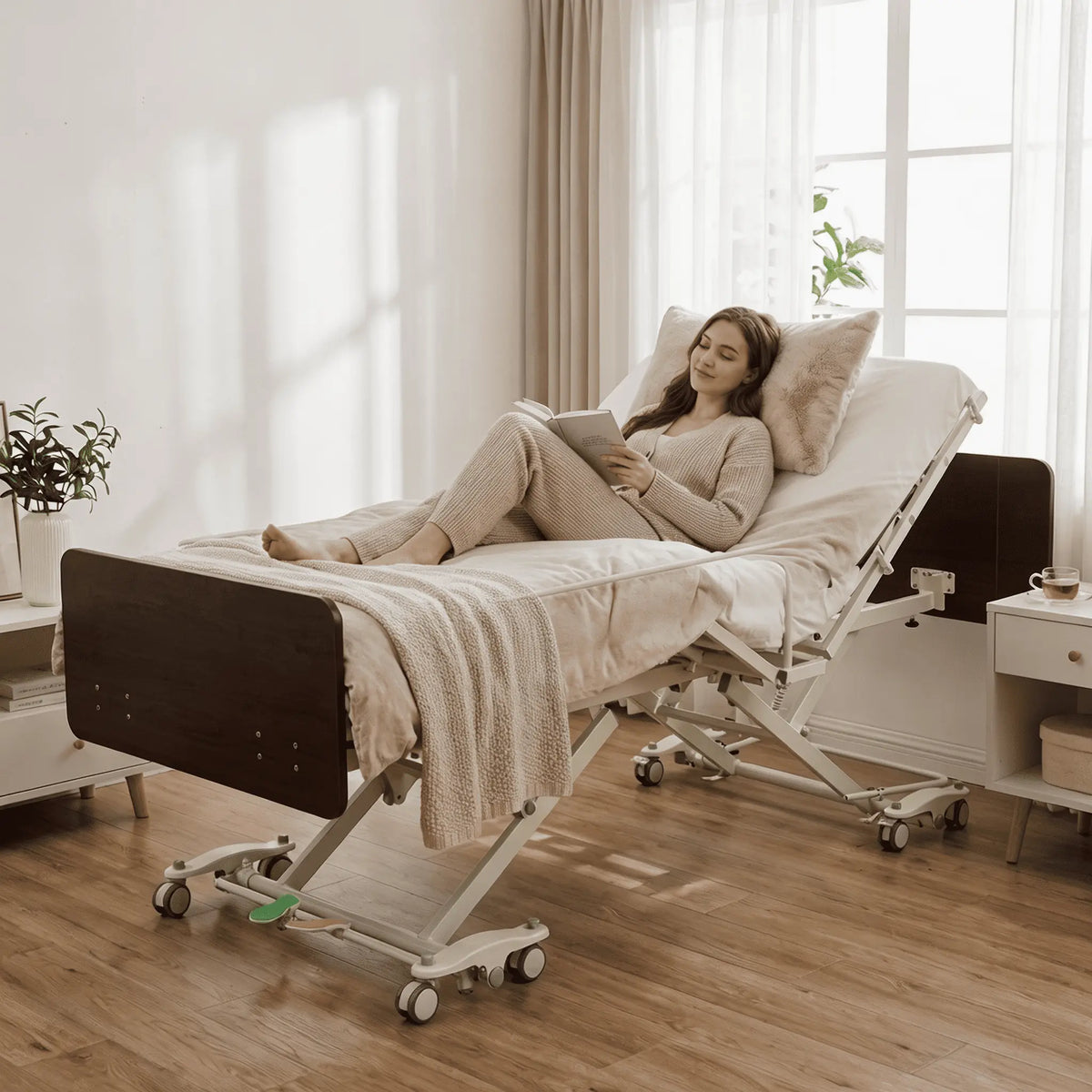
The Oasis 52300 is the right choice when the care situation is expected to change significantly over time. Its integrated width expansion from 36 to 48 inches and 7 to 30-inch height range give it the widest operational window of the three beds in this guide, making it the most adaptable single frame for long-term care with an uncertain trajectory.
Key Specs:
- Height Range: 7" to 30"
- Weight Capacity: 550 lbs
- Deck Width: 36", 42", 48" (integrated expansion)
- Deck Length: 80", 84", 88"
- Functions: Hi-low, Auto Contour, Heel Lift Extension, Mobility at Any Height, Central Locking, Under Bed Lighting, Safety Stop, Bumper Guard, 8-function hand control
- Included: Headboard, footboard, free rails (upgrade option available)
- Processing Time: 48 hours
The 7-inch minimum height is the lowest in this guide, delivering meaningful fall prevention alongside the highest caregiver working height at 30 inches. Auto Contour simultaneously adjusts head and knee to reduce sacral and heel pressure. The Heel Lift Extension specifically prevents heel pressure ulcers — one of the earliest wounds to develop in bed-bound long-term care patients.
The expandable deck accommodates positioning wedges, air mattress overlays, and changing patient size without requiring a new frame. This is the most significant long-term cost advantage the Oasis 52300 offers over fixed-width alternatives.
🎯 CHOOSE THIS IF: The care situation is expected to evolve significantly, an expanding deck width is needed for positioning or patient size changes, or the widest height range (7 to 30 inches) is the priority for combining fall prevention with maximum caregiver working height.
Essential Add-Ons for Long-Term Care Beds
The right accessories extend what each bed can do as care needs change. Every item listed below is catalog-confirmed for the respective bed.
Side Rails
Side rails serve a different function in long-term care than in short-term recovery. For a patient with hemiparesis or limited mobility, the rail on the unaffected side is a repositioning grip, a push point for sitting up, and a stability bar during edge-of-bed exercises. For a patient with dementia or nighttime confusion, rails provide a containment layer without requiring caregiver presence.
The IC333 is compatible with High Side Rail, Low Side Rail, U-Assist Rail, and Slide-Out Side Rail options. The Supernal 3 is compatible with Half Rails at the head only. Bamboo Rail Covers are available for the Supernal 3 to cushion rail contact and maintain a residential aesthetic for patients with tremors or involuntary movement. The Oasis 52300 includes free rails with an upgrade option available.
Battery Backup
Power outages during overnight care are a genuine clinical risk for patients who depend on their bed's position for breathing comfort, pressure management, or aspiration prevention. Battery backup maintains full electric function during outages without requiring manual intervention. External rechargeable battery backup is available for the IC333 and as an add-on for the Supernal 3.
Headboards and Footboards
Headboards and footboards maintain the bedroom's residential profile and signal to the patient and visiting family that the room is still a home, not a clinical space. The IC333 offers optional headboards and footboards. The Oasis 52300 includes both as standard. The Supernal 3 is available without a footboard for a cleaner profile.
Mattress Upgrades
All three beds are compatible with the PressureGuard Span-Care Convertible Mattress for clinical-grade pressure redistribution. The IC333 is also confirmed compatible with pressure-relief, memory foam, and hybrid mattresses. Mattress selection should be matched to the patient's pressure injury risk level and mobility, not treated as a secondary decision after the frame is chosen.
Over Bed Accessories (IC333 only)
The IC333 is compatible with an Over Bed Pole, Over Bed Tables, Bedside Folding Shelf, Bedside Tables, and Blanket Cradle, all catalog-confirmed. For long-term bed-bound patients, within-reach access to daily essentials reduces caregiver call frequency and supports meaningful daily independence.
Which Should You Choose?
Three questions narrow the choice:
1. Is clinical positioning part of the care plan? If yes , Trendelenburg, Reverse Trendelenburg, or complex tilt protocols , the IC333 is the appropriate choice. If no, either the Supernal 3 or Oasis 52300 serves the situation well.
2. How important is residential aesthetics? If preserving the bedroom's home environment is a priority for the patient's dignity and wellbeing, the Supernal 3 is the strongest performer on this axis. The IC333 and Oasis 52300 both maintain residential profiles but the Supernal 3 is specifically designed around that requirement.
3. How much will care needs change? If the trajectory is stable, choose the bed that best fits current needs. If care needs are expected to intensify significantly, the Oasis 52300's expandable width and widest height range provide the most room to adapt without replacement.
Call 833-499-4450 to discuss which configuration fits the specific care situation, room layout, and timeline before ordering.
Frequently Asked Questions
What is the difference between a hospice bed and a hospital bed?
Hospice beds prioritize comfort, dignity, and a home-like environment for end-of-life care. Hospital beds prioritize clinical positioning, caregiver access, and medical procedure compatibility. In long-term home care, many situations benefit from a bed that addresses both, such as the iCare IC333 or Transfer Master Supernal 3.
Can the same bed work for both hospice and palliative care?
Yes. The iCare IC333 and Emerald Oasis 52300 both deliver clinical positioning alongside residential design, making them appropriate across the palliative-to-hospice spectrum. The Supernal 3 is best suited to situations where comfort management is the primary goal and clinical tilt positioning is not required.
What mattress works best for long-term bed-bound patients?
Alternating pressure or low air loss mattresses are the clinical standard for bed-bound patients at pressure injury risk. The PressureGuard Span-Care Convertible Mattress is a compatible upgrade for both the Supernal 3 and Supernal 5, providing clinical-grade pressure redistribution in a residential frame.
Does the Supernal 3 have Trendelenburg positioning?
No. The Supernal 3 includes independent head and foot articulation and hi-low function but not Trendelenburg or Reverse Trendelenburg. For those functions, the Supernal 5 is the appropriate upgrade.
How long does the IC333 take to ship?
All IC333 orders carry a 2-week production lead time. Every bed is manufactured to order with custom fabric as standard , the lead time applies to all orders regardless of which fabric is selected.
Can Medicare cover a hospital bed for hospice care at home?
Medicare may cover hospital beds under Part B when medically necessary with a physician prescription. Hospice beds may be covered under the Medicare hospice benefit for enrolled patients. MedShopDirect does not bill Medicare or insurance directly. Confirm coverage with your provider before purchasing.
Featured collection


$3,444.77
-
$6,889.54
$3,444.77
-
$6,889.54
Current price
$3,444.77
Original price
$3,444.77
-
Original price
$6,889.54
Original price
Luxury Electric Hospital Bed - Hospital Functions Without the Hospital Look | TransferMaster Supernal 3
TransferMaster
In stock
Ships Next Day
$3,444.77
-
$6,889.54
$3,444.77
-
$6,889.54
Current price
$3,444.77
Original price
$3,444.77
-
Original price
$6,889.54
Original price
$3,444.77
-
$6,889.54
$3,444.77
-
$6,889.54
Current price
$3,444.77
Original price
$3,444.77
-
Original price
$6,889.54
Original price


$2,383.00
$2,383.00
-
$2,383.00
Current price
$2,383.00
Original price
$2,383.00
-
Original price
$2,383.00
Original price
Fully Electric Expandable Hospital Bed with Rails - Hi Low Adjustable Bed | Emerald Oasis
Emerald
Only 1 left!
Ships Next Day
$2,383.00
$2,383.00
-
$2,383.00
Current price
$2,383.00
Original price
$2,383.00
-
Original price
$2,383.00
Original price
$2,383.00
$2,383.00
-
$2,383.00
Current price
$2,383.00
Original price
$2,383.00
-
Original price
$2,383.00
Original price


Current price
$1,999.00
$1,999.00
-
$1,999.00
Current price
$1,999.00
Original price
$2,250.00
Original price
$2,250.00
-
Original price
$2,250.00
Original price
$2,250.00
Ultra Low Adjustable Electric Hospital Bed with Extendable Length for Fall Prevention | Medacure ULB7/30
Medacure
Only 1 left!
Ships Next Day
Current price
$1,999.00
$1,999.00
-
$1,999.00
Current price
$1,999.00
Original price
$2,250.00
Original price
$2,250.00
-
Original price
$2,250.00
Original price
$2,250.00
Current price
$1,999.00
$1,999.00
-
$1,999.00
Current price
$1,999.00
Original price
$2,250.00
Original price
$2,250.00
-
Original price
$2,250.00
Original price
$2,250.00
You save $251.00 (11%)


Current price
$2,399.00
$2,399.00
-
$2,399.00
Current price
$2,399.00
Original price
$2,750.00
Original price
$2,750.00
-
Original price
$2,750.00
Original price
$2,750.00
Value Bariatric Bed for Long Term Care and Home Care | ULB48-X-7/30
Medacure
In stock
Ships Next Day
Current price
$2,399.00
$2,399.00
-
$2,399.00
Current price
$2,399.00
Original price
$2,750.00
Original price
$2,750.00
-
Original price
$2,750.00
Original price
$2,750.00
Current price
$2,399.00
$2,399.00
-
$2,399.00
Current price
$2,399.00
Original price
$2,750.00
Original price
$2,750.00
-
Original price
$2,750.00
Original price
$2,750.00
You save $351.00 (13%)


$2,357.67
$2,357.67
-
$2,357.67
Current price
$2,357.67
Original price
$2,357.67
-
Original price
$2,357.67
Original price
High Low Electric Hospital Bed - Prius Descend Ultra | 36" x 80" | 2.7" Low
Prius Healthcare USA
In stock
Ships Next Day
$2,357.67
$2,357.67
-
$2,357.67
Current price
$2,357.67
Original price
$2,357.67
-
Original price
$2,357.67
Original price
$2,357.67
$2,357.67
-
$2,357.67
Current price
$2,357.67
Original price
$2,357.67
-
Original price
$2,357.67
Original price