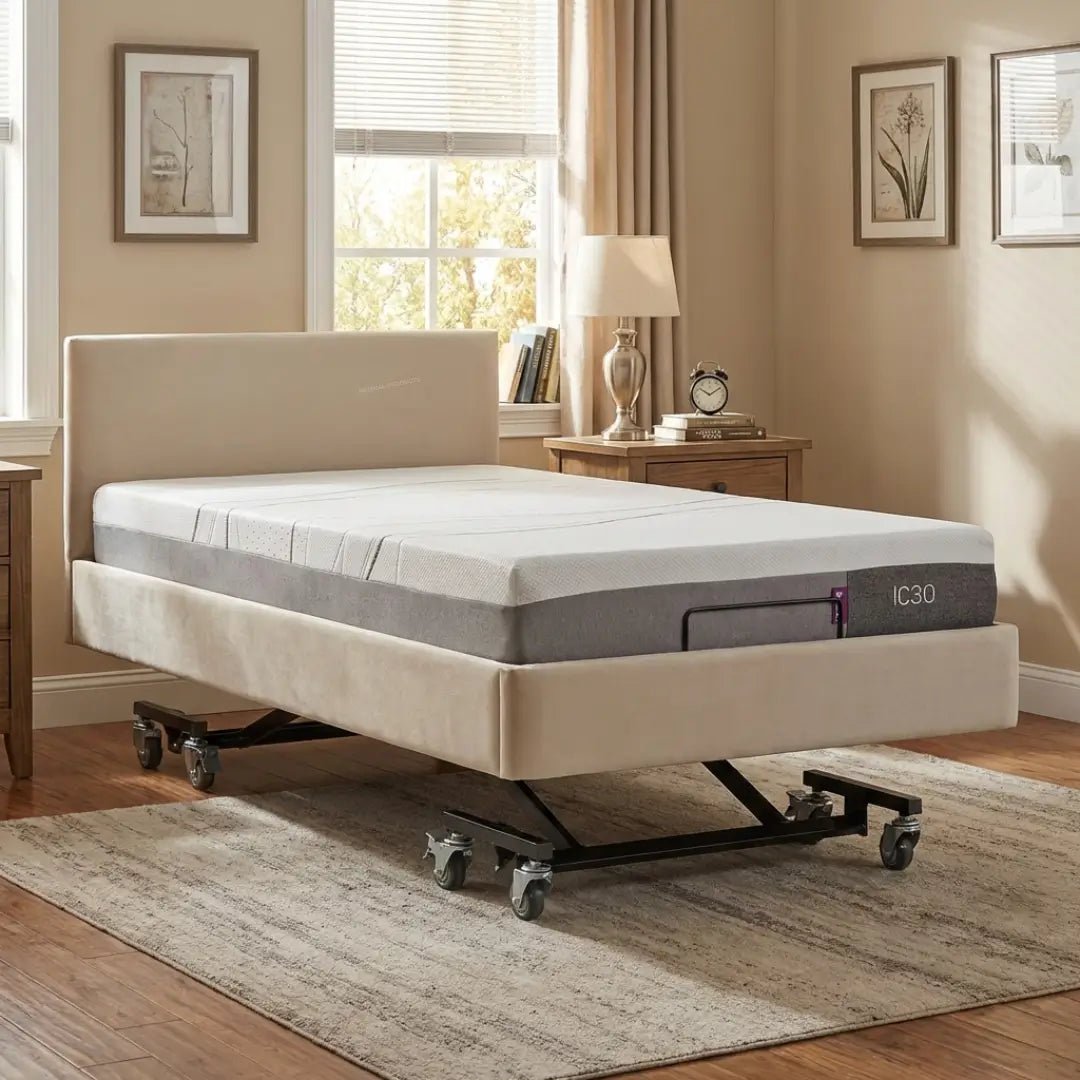
The Icare IC333 includes both Trendelenburg and Reverse Trendelenburg positioning as standard features, not upgrades.Most homecare beds do not offer either position. The IC333 offers both, built into the same bed that delivers custom fabric and a residential appearance.
Trendelenburgtilts the entire bed so the feet are higher than the head. It is used to assist venous return, facilitate caregiver repositioning, and support specific care situations, always under the guidance of a healthcare professional.
Reverse Trendelenburgtilts the entire bed so the head is higher than the feet, without bending at the waist. It is commonly used for patients with acid reflux, respiratory discomfort, and post-surgical recovery where head elevation is needed with reduced sacral pressure.
Neither position should be used without direction from the patient's healthcare team. This article explains what each position does and when it may be appropriate, not a substitute for clinical guidance.
The IC333 delivers both functions from the same backlit handpiece, in a custom-fabric homecare bed rated to 660 lbs on Queen size with a 10-year frame warranty.
Icare IC333: Homecare bed with built-in Trendelenburg and Reverse Trendelenburg as standard
Bottom Line:For families managing homecare and wanting a bed that covers every positioning need their loved one may have, the IC333 is one of the few residential-looking beds that delivers both clinical tilt positions without any upgrades.
Why Bed Positioning Matters in Homecare
When someone spends a significant portion of their day in bed, due to recovery, a chronic condition, or limited mobility, the position they rest in is not just a comfort preference. It affects breathing, circulation, skin integrity, digestion, and the ease of every care task a caregiver performs.
Standard adjustable beds raise the head section and sometimes the foot section. These are useful positions, and they cover a lot of everyday needs. But they do not tilt the entire bed platform as a unit, which is what Trendelenburg and Reverse Trendelenburg require.
Understanding the difference between raising the head section and tilting the whole bed is the starting point for understanding what the IC333 offers that most homecare beds do not.
What Is the Trendelenburg Position?
The Trendelenburg position places the patient flat on their back on a surface that is tilted so the feet are higher than the head. The angle is typically between 15 and 30 degrees, and the entire bed platform tilts as a single unit, not just the foot section.
This position is named after German surgeon Friedrich Trendelenburg, who used it in surgical settings in the 19th century to improve visibility and access during abdominal and pelvic procedures. It has since been applied in a range of clinical and homecare situations.
When Trendelenburg May Be Used
Caregiver repositioning assistance.One of the most practical homecare uses of Trendelenburg positioning is using gravity to assist with patient repositioning. When a patient slides toward the foot of the bed during head elevation, returning them toward the head of the bed typically requires significant physical effort from the caregiver, especially for heavier patients. Activating Trendelenburg briefly uses gravity to assist this movement, reducing the physical demand on the caregiver and the discomfort to the patient during repositioning.
Venous return and lower extremity circulation.In some clinical situations, a healthcare provider may recommend brief Trendelenburg positioning to support venous return from the lower extremities to the heart. The elevated feet allow blood to flow back toward the core with gravity's assistance. This is always a clinically directed decision, not something to attempt independently.
Certain hypotensive episodes.In some clinical protocols, Trendelenburg has historically been used during periods of low blood pressure to support circulation. Current clinical guidelines vary on this application, and it should only be used under direct healthcare provider instruction.
Always consult a healthcare professional before using Trendelenburg positioning for any medical purpose. It is contraindicated for patients with certain respiratory conditions, elevated intracranial pressure, and other specific diagnoses.
What Is Reverse Trendelenburg?
Reverse Trendelenburg tilts the entire bed so the head is higher than the feet, the opposite of standard Trendelenburg. Like Trendelenburg, the whole platform tilts as a unit rather than just raising the head section.
This distinction from standard head elevation matters. When only the head section of a bed rises, the patient's lower back remains flat, and the bend at the hip joint can create pressure and discomfort at the sacrum over time. Reverse Trendelenburg maintains the body in a straight line while achieving an elevated head position, reducing sacral shear force significantly.
When Reverse Trendelenburg May Be Used
Acid reflux and GERD management during sleep.Elevating the head above the stomach uses gravity to reduce the backflow of stomach acid into the esophagus. Reverse Trendelenburg achieves this elevation while keeping the body in a straight, supported alignment, preferable to stacking pillows, which can create neck strain and shift during sleep.
This is a positioning approach commonly discussed with patients who experience nighttime reflux symptoms. A healthcare provider can confirm whether and how much elevation is appropriate for a specific patient's situation.
Respiratory comfort.For patients who find it easier to breathe with the upper body slightly elevated, Reverse Trendelenburg provides that positioning while distributing pressure more evenly than head-section elevation alone. For patients with mild respiratory conditions who are not on active respiratory support, this can be a comfort measure during rest, with healthcare guidance.
Post-surgical recovery.After certain cardiac, abdominal, or spinal procedures, a care protocol may require the patient to maintain an elevated head position. Reverse Trendelenburg provides that position while reducing the shear force and skin pressure at the sacrum that can develop when only the head section is raised for extended periods.
Edema and lower extremity swelling.While leg elevation (foot raised) is the more commonly recommended position for lower extremity edema management, there are care situations where whole-body positioning adjustments are made as part of a broader care plan. A healthcare provider will determine the appropriate positioning approach for swelling management.
Comfort positioning during care.For caregivers performing upper body care tasks, oral hygiene, hair care, upper body bathing, a gentle Reverse Trendelenburg position can make the patient more accessible without the caregiver having to lean over an awkward surface angle.
Head Elevation vs. Reverse Trendelenburg: What Is the Difference?
This is one of the most common questions families ask when they first encounter both options on the IC333.
When a hospital bed raises only the head section, the articulation point is at the patient's hips, the torso folds upward from that joint. This creates a bend in the body that can concentrate pressure at the lower back and sacrum, and can cause the patient to slide toward the foot of the bed over time.
Reverse Trendelenburg tilts the entire sleeping platform as a flat inclined surface. There is no articulation at the hip. The body stays straight and aligned. The pressure distribution across the full length of the mattress is more even, and the patient is less likely to slide.
For brief head elevation to eat or read, the standard head section lift is usually sufficient and appropriate. For extended periods of elevated positioning, during sleep, during respiratory management, or during long periods of rest, Reverse Trendelenburg may be preferable because it maintains alignment without creating the hip-bend pressure point.
A healthcare professional can advise on which approach is most appropriate for a specific patient and care situation.
Caregiver Benefits of Both Positions
For the caregiver, having both Trendelenburg and Reverse Trendelenburg available on a homecare bed meaningfully changes the physical demands of daily care.
Repositioning without lifting.When a patient slides toward the foot of the bed, returning them to the correct position typically requires the caregiver to physically push or pull the patient's body. For heavier patients or caregivers with their own physical limitations, this is a genuine injury risk. Trendelenburg allows gravity to assist this movement, the caregiver guides rather than lifts.
Comfortable working angles for different care tasks.Different care tasks work better at different angles. Upper body care, bathing, and oral hygiene are often easier with the patient slightly head-elevated. Lower body care and wound management at the sacrum or lower back are often easier with the patient in a flatter or slightly foot-elevated position. Having both tilt functions means the caregiver can position the bed for the task rather than adapting every task to a fixed angle.
Single handpiece control.On the IC333, Trendelenburg and Reverse Trendelenburg are controlled from the same backlit handpiece as head lift, knee break, and hi-low height adjustment. There is no separate control panel, no additional equipment, and no setup required. The caregiver selects the position from the same interface used for all other adjustments.
Why the IC333 Stands Out
Most homecare beds, including many beds marketed as premium or luxury adjustable beds, do not include Trendelenburg or Reverse Trendelenburg at any price. These functions are typically found only in dedicated clinical hospital beds, where they are standard.
The IC333 delivers both positions as standard features in a bed that is also:
Custom-built in a designer fabric color of your choice
Available in Twin XL, Full XL, Queen, and Dual King
Rated to 440 lbs (Twin XL, Full XL) and 660 lbs (Double, Queen)
Compatible with Hoyer lift systems at 7 inches of underbed clearance
Backed by a 10-year frame warranty and 2-year component warranty
Delivered and assembled by a professional team through MedShopDirect's White Glove service
For families making a long-term homecare equipment decision, the IC333 removes the need to upgrade or replace the bed as positioning needs change over time. The full positioning range is already there.
Lead Time:2 weeks, all orders (custom built to order)
Warranty:10-year frame; 2-year actuators, control box, castors, handpiece, fabric
GET THIS IFyou want a residential-looking homecare bed with Trendelenburg and Reverse Trendelenburg as standard features, not upgrades, alongside full hi-low adjustment, designer fabric, and Hoyer compatibility.
Every IC333 ordered through MedShopDirect includes 10% off automatically at checkout, free delivery, and White Glove Assembly, a professional team delivers the bed, assembles it in the room of your choice, tests every function including both tilt positions, and walks you through operation before leaving.
For a bed this capable, having someone demonstrate Trendelenburg and Reverse Trendelenburg in person before the care team walks away is a meaningful part of the purchase experience.
Call 833-499-4450 or visit MedShopDirect.com for assistance.
A Note on Medical Guidance
The Trendelenburg and Reverse Trendelenburg positions described in this article are positional features of the IC333 homecare bed. They may support comfort or positioning needs in specific care situations.
This article is not medical advice. The appropriateness of any positioning for a specific patient depends on their individual medical history, diagnoses, medications, and care plan. Always consult a physician, physical therapist, or qualified healthcare professional before using Trendelenburg or Reverse Trendelenburg positioning for any medical purpose.
Frequently Asked Questions
What homecare bed has Trendelenburg and Reverse Trendelenburg? The Icare IC333 includes both Trendelenburg and Reverse Trendelenburg as standard features, available through MedShopDirect with 10% off at checkout and White Glove Assembly included. Browse theIcare Medical Group Hospital Beds collectionor call 833-499-4450.
What is the difference between Trendelenburg and Reverse Trendelenburg? Trendelenburg tilts the entire bed so the feet are higher than the head. Reverse Trendelenburg tilts the entire bed so the head is higher than the feet. Both tilt the full platform as a unit, which is different from standard head or foot section elevation.
Is Reverse Trendelenburg the same as raising the head of the bed? No. Raising the head section creates a bend at the hip joint and concentrates pressure at the sacrum. Reverse Trendelenburg tilts the entire platform as a flat inclined surface, maintaining body alignment and distributing pressure more evenly across the mattress.
Can I use Trendelenburg positioning to help with repositioning? Trendelenburg can assist caregiver repositioning by using gravity to help move a patient toward the head of the bed without manual lifting. However, any use of Trendelenburg positioning should be discussed with a healthcare professional to confirm it is appropriate for the specific patient.
Is the Trendelenburg position good for acid reflux? Reverse Trendelenburg, not Trendelenburg, is the position associated with head elevation for reflux management. Reverse Trendelenburg elevates the head above the stomach, using gravity to reduce acid backflow. Discuss specific positioning recommendations with a healthcare provider.
Does the IC333 require any upgrades to get Trendelenburg? No. Both Trendelenburg and Reverse Trendelenburg are included as standard features on the IC333. There are no additional modules, upgrades, or costs required to access these positions.
How long does the IC333 take to arrive? Every IC333 is custom built to order with a 2-week production lead time. This applies to all orders regardless of size or fabric selection.