📋 KEY TAKEAWAYS
- Renting a hospital bed for home use typically costs $200 to $500 per month depending on bed type and supplier, and that is before setup and delivery fees.
- The real question is not whether renting is cheaper upfront. It is how long you will actually need the bed. Beyond 6 to 10 months, buying almost always costs less in total.
- Renting makes practical sense for short recoveries, a few weeks after surgery or a temporary health setback. Buying makes more sense for chronic conditions, progressive illness, and any care situation measured in months rather than weeks.
- Browse the Hospital Beds for Sale collection to compare models before making a decision.
Bottom Line: Renting is not cheaper, it is only cheaper in the short term. The right question is how long you will actually need the bed.
How Much Does It Cost to Rent a Hospital Bed for Home Use?
Rental fees for a home hospital bed typically fall between $200 and $500 per month, depending on the type of bed and the supplier. Semi-electric models tend to sit at the lower end of that range. Full-electric models, which most home care situations actually require, cost more.
That monthly figure does not include everything. Setup and delivery fees can run $80 to $200 upfront, and return or pickup fees add another $25 to $120 at the end of the rental period.
Run the numbers over time and they add up quickly. A $300 per month rental over six months, including setup, approaches $2,000. Over a year, it crosses $3,800. That context matters because it tells you exactly when renting stops being the cheaper option.
What Does Buying a Hospital Bed Actually Cost?
Full-electric hospital beds for home use start at approximately $1,500 for entry-level models and range upward depending on features, positioning capabilities, and design. Full electric hospital beds start at around $1,195 at some suppliers, including mattress and rails, though prices vary widely based on clinical features and build quality.
Once purchased, the bed is yours. No monthly payments, no return deadline, no waiting for a repair technician who works on someone else's schedule. You choose the features that match the patient's actual condition. You own equipment that is new, not a bed that has cycled through other households.
The Break-Even Point: 3 Practical Examples
Divide the total purchase price by the monthly rental fee. That number is the month where buying becomes cheaper.
Example 1, Value bed: A full-electric bed purchased for $1,800 versus a rental at $275 per month. $1,800 ÷ $275 = approximately 6.5 months. From month 7 onward, you are saving $275 every month.
Example 2, Mid-range bed: A bed purchased for $3,200 versus a rental at $350 per month. $3,200 ÷ $350 = approximately 9 months. If the care need lasts 18 months, buying saves over $3,100 compared to renting.
Example 3, Short recovery: A patient recovering from knee replacement needs a bed for 6 weeks. At $300 per month the rental costs roughly $450. Buying an $1,800 bed for a 6-week recovery makes no financial sense. Rent.
The calculation is simple. The hard part is honestly estimating how long the bed will actually be needed.
How Long Will You Need the Bed? A Practical Guide
This is the question that determines everything. Some care situations are measured in weeks. Others are measured in years. The difference shapes the entire financial decision.
Short-term situations where renting makes sense:
- Post-operative recovery from hip or knee replacement, typically 4 to 10 weeks at home
- Short-term illness or injury where full recovery is expected within 2 to 3 months
- Trial period while evaluating longer-term care needs
Longer-term situations where buying almost always saves money:
- Progressive neurological conditions such as Parkinson's disease, ALS, or advanced dementia, these situations extend well beyond the break-even point and rarely shorten
- Chronic respiratory or cardiac conditions requiring ongoing positioning support
- Long-term home care where a caregiver is regularly performing hands-on tasks
- Hospice care at home where comfort and positioning quality matter for the duration of care
For caregivers managing a progressive condition, the answer is usually clear before the math is done. Buying delivers better financial value and better equipment quality from the start.
What Rental Beds Typically Cannot Offer
The monthly cost comparison is only part of the picture. There is also a gap in what rental equipment actually delivers.
Most rental beds from DME suppliers are semi-electric or basic manual models. Manual and semi-electric beds are typically what Medicare covers, fully electric beds may be only partially covered if medically justified. So even when insurance assists with rental costs, the equipment is limited to basic functionality.
A semi-electric bed raises the head and sometimes the knees but lacks full-electric hi-low height adjustment, the feature that matters most for caregiver safety. A caregiver who cannot raise the entire bed to a working height is bending over every care task. That accumulates into back injury over weeks and months.
There is also a hygiene factor. Rental beds cycle through multiple households. For a patient with compromised immunity or sensitive skin, a previously used frame introduces considerations that a new bed eliminates.
Finally, a standard institutional rental bed changes the bedroom environment. For patients in long-term home care, the sense of normalcy and dignity in their own space matters, and it is difficult to preserve with a chrome-rail clinical bed in the room.
4 Questions to Answer Before You Decide
-
How long is the realistic care timeline? Ask the treating physician directly. A post-surgical recovery measured in weeks points toward renting. A progressive condition measured in months or years points toward buying.
-
What is the break-even point? Divide the purchase price by the monthly rental quote. That is your decision number.
-
Does the patient need full-electric hi-low adjustment? If a caregiver is performing regular hands-on care, the answer is almost certainly yes, and most rental beds do not provide it.
-
Is there insurance, VA, or HSA coverage that changes the math? Even partial coverage shifts the break-even calculation significantly.
Hospital Beds Worth Considering for Long-Term Home Use
Once the decision to purchase is made, the next question is which bed. The right choice depends on how much clinical functionality the patient needs, the budget, and whether the bed needs to fit into a residential bedroom environment.

Transfer Master Supernal 3: When a Hospital Bed Is Needed but Aesthetics Matter
The Supernal 3 is a full hospital bed with the visual profile of upscale bedroom furniture. Hidden electrical components, a footboard-free design, wall-hugging technology, and a wireless illuminated remote make it appropriate when a clinical-looking bed is unacceptable in the home environment but genuine hospital bed functionality is needed.
Wall-hugging technology keeps the bed close to the wall as the head elevates, the patient stays within reach of their nightstand. The European-style head tilt independently adjusts the neck and pillow area for breathing comfort. The height range of 10.5 to 20.5 inches provides meaningful hi-low functionality for caregiver access and patient safety.
The Supernal 3 does not include Trendelenburg or Hoyer compatibility as standard. For those features, the Supernal 5 is the correct upgrade.
Key Specs: Transfer Master Supernal 3
-
Height Range: 10.5" to 20.5"
-
Functions: Head (65°), Foot (35°), Hi-Low, Wall Hugging, European Head Tilt, Massage Chair
-
Weight Capacity: 400 lbs (Twin 80, Full 80); 500 lbs (Queen)
-
Sizes: Twin 80, Full 80, Queen, Dual King
-
Mattress Options: Ascent (cloth or vinyl), Soft Touch (cloth or vinyl), PressureGuard Span-Care Convertible Mattress
-
Trendelenburg: No, upgrade to Supernal 5
-
Hoyer Compatible: No, add 5" casters for compatibility
-
Add-Ons: Half Rails (head only), Bamboo Rail Covers, Battery Backup, 5" Locking Casters
-
Classified as: Full hospital bed
GET THIS IF the patient needs a real hospital bed with hi-low function, but the home environment rules out anything that looks clinical.
See Price & Details
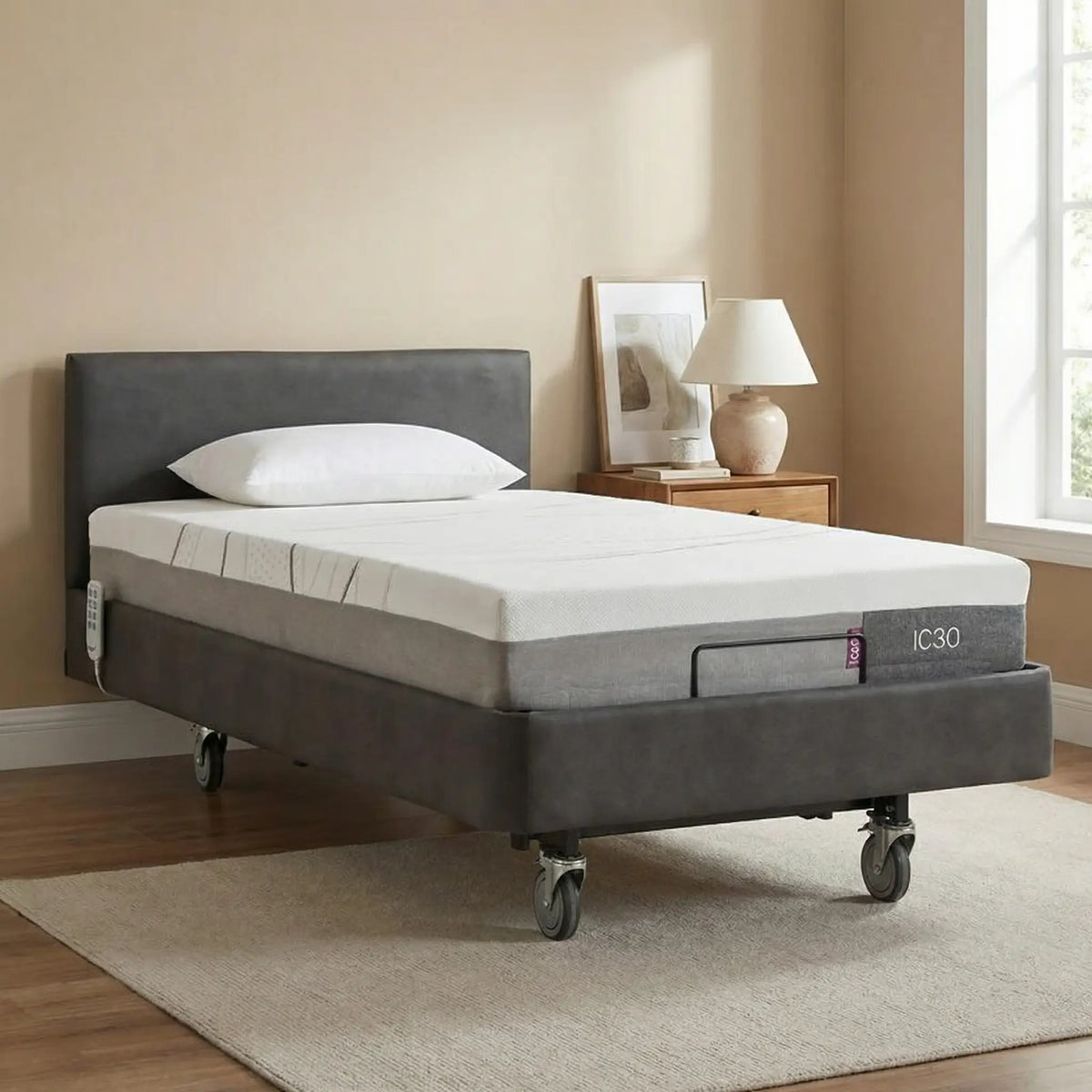
Icare IC222: Full Electric with Home Aesthetics and Hoyer Compatibility
The IC222 is a three-function full electric bed with 8 inches of underbed clearance for Hoyer lift compatibility, a significant feature for patients who cannot bear weight during transfers. The height range of 12 to 24 inches covers both fall prevention at the low end and comfortable caregiver working height at the high end.
Every IC222 is manufactured to order with custom fabric as standard. Six fabric options allow the bed to be color-matched to the bedroom rather than standing out as clinical equipment. The 2-week lead time applies to all orders regardless of fabric selection. A 5-year steel frame warranty and 2-year warranty on actuators, control box, castors, handpiece, and fabric are included.
The backlit wipeable handpiece works at night without turning on room lights. External rechargeable battery backup keeps the bed functional during power outages. End and corner mattress retainer bars prevent shifting during position changes.
Key Specs: Icare IC222
-
Height Range: 12" to 24"
-
Functions: Head Lift (62°), Knee Break (42°), Hi-Low (3-function)
-
Weight Capacity: 390 lbs
-
Castors: 4x heavy-duty lockable swivel casters
-
Hoyer Compatible: Yes, 8" clearance
-
Battery Backup: External rechargeable, included
-
Fabric Options: 6 choices, custom standard
-
Lead Time: 2 weeks, all orders
-
Warranty: 5-year steel frame; 2-year actuators, control box, castors, handpiece, fabric
GET THIS IF the patient needs Hoyer lift compatibility, a bed that fits the bedroom aesthetically, and a full electric setup with battery backup, at a value price point with a strong warranty.
See Price & Details

Proactive Protekt Akra-FE: Accessible Full Electric
The Akra-FE is a budget option, the accessible entry point into full electric hospital bed care without diminishing the clinical value it delivers. It descends to 9 inches for fall prevention and raises to 23 inches for caregiving. Three-function electric control covers head, foot, and full hi-low height adjustment. An emergency hand crank operates the bed during power outages.
The black textured vein finish is a step away from purely institutional equipment. Mattress keepers prevent shifting. Washable bed ends simplify infection control. Fast shipment means the bed arrives without a long wait.
Key Specs: Proactive Protekt Akra-FE
-
Height Range: 9" to 23"
-
Functions: 3-function electric: Head, Foot, Hi-Low; emergency hand crank
-
Weight Capacity: 450 lbs
-
Castors: 4 x 3" (2 locking, 2 swivel)
-
Warranty: 5-year motor; limited lifetime on welds and frame
-
Shipping: Fast shipment
GET THIS IF budget is the primary constraint and the patient needs full electric hi-low adjustment, fall prevention positioning, and fast delivery without advanced clinical features.
See Price & Details
Frequently Asked Questions
How much does it cost to rent a hospital bed for home use?
Hospital bed rentals typically cost $195 to $400 per month for a full-electric model, plus setup and delivery fees of $100 to $300. Semi-electric and manual beds may be available for less.
When does renting a hospital bed make more sense than buying?
Renting makes sense when the care need is short-term, typically under 6 to 10 months. For a post-surgical recovery measured in weeks, renting is the practical choice. For chronic or progressive conditions measured in months or years, buying almost always saves money beyond the break-even point.
What is the break-even point between renting and buying a hospital bed?
Divide the total purchase price by the monthly rental fee. That number is the month where buying becomes cheaper. For most bed types, the break-even falls between 6 and 12 months.
Can I use HSA or FSA funds to buy a hospital bed?
Yes. Hospital beds qualify as durable medical equipment and are HSA and FSA eligible when prescribed by a physician. MedShopDirect is partnered with Flex for direct HSA/FSA payment at checkout.
What do rental beds typically not include?
Most rental beds are semi-electric or manual models without full-electric hi-low height adjustment. They also arrive used, previously cycled through other households, which introduces hygiene considerations for immunocompromised patients.
Are hospital beds from MedShopDirect available with setup and delivery?
Yes. MedShopDirect offers setup and delivery on hospital beds. White glove delivery is available on select models.


