Published: July 14, 2025
Last Updated: July 2, 2026
Written by: Samantha Reines
Types of Patient Lifts: Guide for Patients & Caregivers 2026
📋 KEY TAKEAWAYS
Updated June 2026: This article was previously published at an earlier date and has been updated with new product information and 2026 recommendations.
There are five main types of patient lifts: floor lifts, sit-to-stand lifts, ceiling lifts, portable lifts, and bariatric lifts. Each serves a different patient and care situation.
The single most important factor before choosing any lift is weight capacity. Always select a lift rated above the patient's current weight, not exactly at it.
Sit-to-stand lifts are only appropriate when a patient can bear at least some weight on their legs. Patients with no weight-bearing ability need a full-body floor lift or ceiling lift.
Caregivers who perform daily transfers without mechanical assistance are at serious risk of back injury. A lift is not a luxury, it is protection for both the patient and the caregiver.
Bottom Line:The right patient lift matches the patient's weight, mobility level, care environment, and transfer frequency. This guide helps you work through all four.
The 5 Types of Patient Lifts Explained
Patient lifts exist because safe transfers are one of the highest-risk moments in any care environment, for both the person being moved and the person doing the moving. The type of lift that fits a situation depends on what the patient can do, how often transfers happen, and what the space allows.
Here is how each type works and who it is designed for.
1. Floor Lifts (Full-Body Hoyer Lifts)
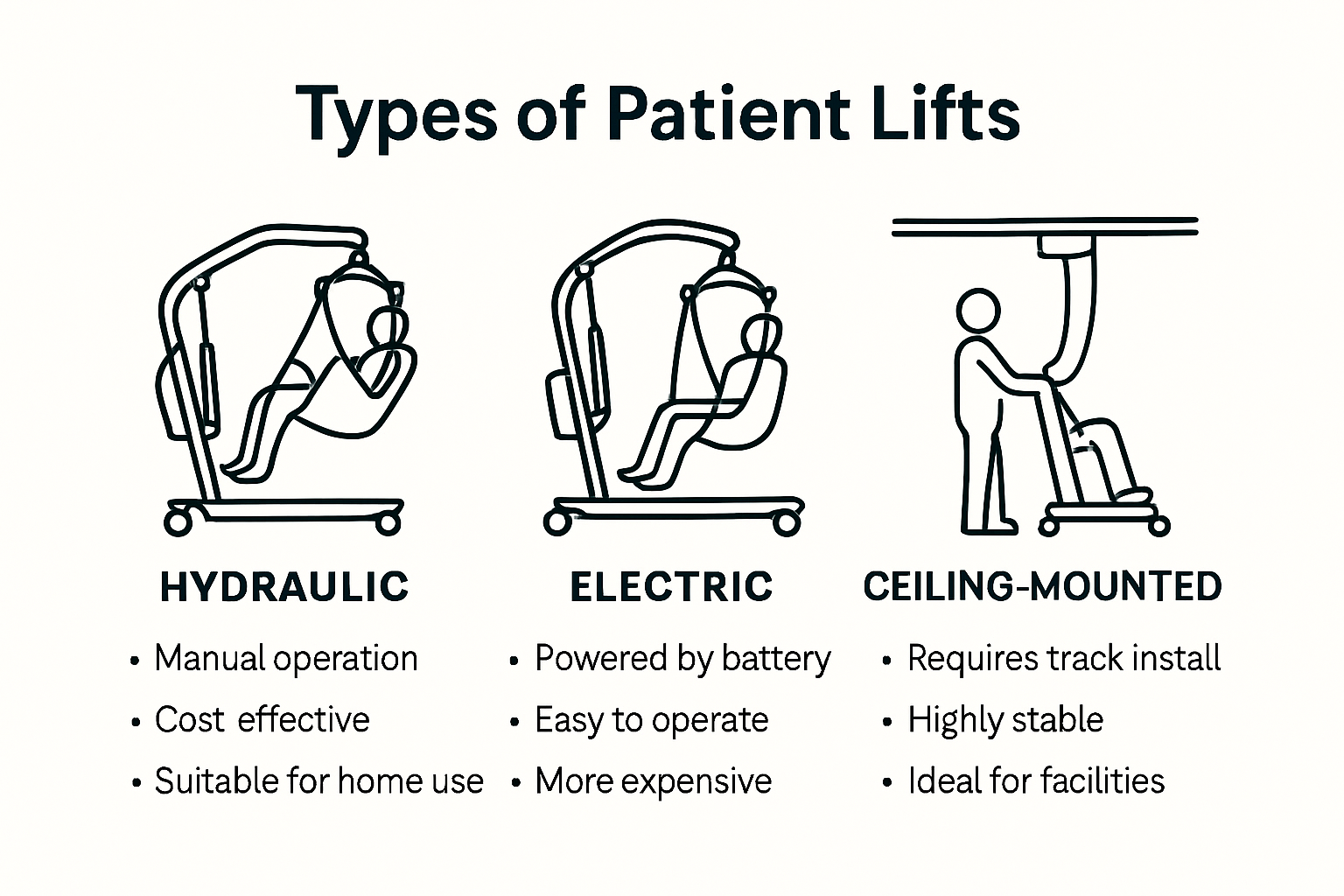
Floor lifts are the most widely used patient lift type in both home care and facility settings. They are freestanding units that roll across the floor on casters, using a sling system to support the patient's full body weight during a transfer. The patient does not need to be able to stand or bear any weight, the sling does all the work.
Floor lifts are available in both hydraulic (manual pump) and electric versions. Electric floor lifts are strongly preferred for frequent transfers: the caregiver operates the lift from a hand pendant rather than manually pumping a hydraulic mechanism, which significantly reduces physical effort over a full day of care.
Best for:
Patients who are fully non-weight-bearing
Transfers between bed, wheelchair, bath chair, or toilet
Home care settings with moderate floor space
Key considerations:Requires adequate floor clearance under furniture for the lift base. Most standard floor lifts require 24 to 30 inches of base width clearance and several feet of maneuvering room. Check that doorways and the room layout can accommodate the base before purchasing.
2. Sit-to-Stand Lifts
Sit-to-stand lifts are designed for patients who have some weight-bearing ability but cannot safely stand on their own. Instead of fully suspending the patient in a sling, a sit-to-stand lift guides the patient from a seated position to standing using a vest or chest harness. The patient places their feet on a footplate, grips a handlebar, and the lift's actuator raises them to standing while the caregiver maintains control.
These lifts are faster and less disruptive than full floor lifts for appropriate candidates. They are commonly used for patients recovering from orthopedic surgery, those with partial lower limb weakness, or patients who are deconditioned but retain enough strength to participate in the transfer.
The critical distinction: if a patient cannot bear any weight on their legs, a sit-to-stand lift is not the right tool. Attempting a sit-to-stand transfer with a fully non-weight-bearing patient risks injury to both the patient and the caregiver.
Best for:
Patients with partial weight-bearing ability
Frequent short transfers (bed to wheelchair, chair to toilet)
Home settings with limited space
Key considerations:Requires patient cooperation and some residual leg strength. Not appropriate for patients with severe cognitive impairment who cannot follow instructions during the transfer sequence.
3. Ceiling Lifts
Ceiling lifts are permanently installed on overhead tracks, either running a straight line through a room or covering an entire room with an H-track or X-Y gantry system. The patient is placed in a sling that attaches to the overhead motor, and the caregiver uses a hand pendant to move the patient along the track.
Research published in PubMedfound that ceiling lifts significantly reduce spinal loads on caregivers during patient transfers. The same research indicates that ceiling lifts require less time per transfer (averaging 156.9 seconds) compared to floor lifts (averaging 273.6 seconds), making them meaningfully more efficient for high-frequency transfer settings.
The trade-off is installation cost and permanence. Ceiling lifts require professional installation and are not easily moved. For home care settings where the patient will remain in the same room long-term, they are often the most practical long-term solution once the initial investment is made.
Best for:
Patients requiring multiple daily transfers in the same room
Facilities or home settings committed to a long-term setup
High-acuity care where minimizing caregiver injury is a priority
Key considerations:Professional installation required. Track systems must be engineered for the ceiling structure. Not suitable for temporary or frequently changing care environments.
4. Portable Lifts
Portable lifts are floor lifts or sit-to-stand lifts specifically designed to break down, fold, or travel easily. They are used when care happens across multiple locations, a patient who travels between home and a family member's house, a facility that needs to move equipment between rooms, or a caregiver who requires a lift that can be packed and transported.
Portability comes with tradeoffs. Most portable lifts sacrifice some weight capacity and stability compared to full-size floor lifts. They are appropriate for patients who need occasional lift assistance in varied settings, not for high-frequency transfers in a permanent location where a standard floor lift or ceiling lift would be safer.
Best for:
Patients who require transfers in multiple locations
Travel situations or temporary care setups
Supplemental lift for use in rooms where a permanent lift is not installed
Key considerations:Confirm weight capacity carefully, some portable lifts have lower maximums than full-size models. Check folded dimensions against vehicle trunk or travel space.
5. Bariatric Lifts
Bariatric lifts are full-body floor lifts or sit-to-stand lifts engineered specifically for patients above standard weight capacities, typically 450 to 600 lbs and above. They feature reinforced frames, wider sling attachment points, extended base widths, and higher-rated actuators.
Using a standard lift above its rated capacity is a safety failure that creates risk of structural collapse during a transfer. Patients above a lift's capacity require a purpose-built bariatric model, there is no safe workaround.
Most bariatric floor lifts also have wider bases to accommodate larger patients, which means the space clearance requirements are greater than standard models. Confirm room and doorway dimensions before purchasing.
Best for:
Patients above the weight capacity of standard lifts
Long-term care and facility settings with diverse patient weight ranges
Home care for bariatric patients where caregiver-assisted transfers are otherwise unsafe
Key considerations:Verify the specific weight rating. Bariatric lift weight capacities vary widely, confirm the exact model's rating matches the patient's weight with an adequate safety margin.
Decision Framework: How to Choose the Right Patient Lift
Working through these four questions in order narrows the field significantly.
Question 1: What Is the Patient's Weight?
This is the starting point, not an afterthought. Choose a lift rated comfortably above the patient's current weight. Patient weight can fluctuate with treatment, and a transfer that is borderline today becomes unsafe quickly.
Standard lifts typically support 350 to 450 lbs. Bariatric models range from 600 lbs to 1,000 lbs and above. Never select a lift with a maximum capacity at or below the patient's current weight.
Question 2: Can the Patient Bear Any Weight on Their Legs?
If yes, a sit-to-stand lift may be appropriate, it is faster, requires less maneuvering room, and often allows more patient participation in the transfer. If no, a full-body floor lift or ceiling lift is required. Attempting a sit-to-stand transfer with a non-weight-bearing patient creates risk of falls and injury to both parties.
When in doubt, ask the patient's physical therapist or physician. This is the single most important functional distinction between lift types.
Question 3: How Often Are Transfers Happening?
For occasional transfers (once or twice a day), a portable or hydraulic floor lift may be sufficient. For frequent transfers (multiple times daily), an electric floor lift, ceiling lift, or powered sit-to-stand lift is more appropriate. Repeated use of a hydraulic manual lift by one caregiver over months or years creates serious cumulative injury risk.
Floor lifts require clear maneuvering room and furniture clearance for the base. Ceiling lifts require professional installation and a fixed track route. Sit-to-stand lifts have smaller footprints and are more maneuverable in tight spaces.
Measure the room before buying. Specifically: doorway width, the clearance under the bed or chair the patient will be lifted from, and the turning radius available in the room.
Common Mistakes When Buying or Using a Patient Lift
1. Selecting based on cost rather than capacity.A lift that is underpowered for the patient's weight is not a bargain, it is a liability. Always start with the patient's weight and work from there.
2. Choosing a sit-to-stand lift for a non-weight-bearing patient.This is the most common clinical misfit. Sit-to-stand lifts require patient participation. Full-body floor lifts do not.
3. Skipping the sling assessment.The sling must be appropriate for the patient's body type, size, and transfer type. A universal sling is not always the right choice. Using the wrong sling type is a fall risk.
4. Ignoring caregiver training.A lift that a caregiver does not know how to operate correctly is more dangerous than no lift at all. Training is not optional, it is part of the purchase.
5. Not confirming space requirements before buying.A lift that cannot maneuver in the actual room is useless. Measure doorways, clearances, and turning radius before committing to a model.
6. Failing to inspect before each use.Sling integrity, battery charge, caster locks, and attachment points should be verified before every transfer. Equipment that fails mid-transfer creates serious fall risk.
Pre-Use Inspection Checklist
Before every transfer, check:
Sling for tears, fraying, or compromised stitching
All attachment loops and clips for secure connection
Battery level (for electric models)
All casters lock and release correctly
Mechanical components move smoothly without resistance
Weight capacity label, confirm it matches the patient
Any equipment showing signs of wear should be removed from service immediately.
Tips for Safe Use and Maintenance
Training:Every caregiver who operates a patient lift should receive hands-on training before the first independent use. Training should cover proper sling positioning, lift operation, emergency stop and manual override procedures, and what to do if a transfer goes wrong.
Battery care:Electric lifts should be charged according to manufacturer specifications after each use, not run down to empty. Keeping the battery partially charged rather than fully depleted extends battery life.
Sling management:Slings should be cleaned after each use per manufacturer instructions, inspected for wear regularly, and replaced when any signs of degradation appear. Different slings are designed for different transfer types, confirm the correct sling is matched to the lift model.
Maintenance log:Keep a written maintenance log documenting inspection dates, battery charges, and any issues observed. Schedule a professional technical inspection annually.
Staff Pick: Proactive Medical Protekt STS 500 Compact Sit-to-Stand Lift
The Protekt STS 500 Compact is the sit-to-stand lift to consider for patients with partial weight-bearing ability who need frequent, efficient transfers. At 500 lbs weight capacity in a 111 lb frame, it is one of the higher-capacity compact sit-to-stand lifts available, and the 4.9" base height slides under most standard furniture, including low bed frames and toilet surrounds.
Foot-pedal base operation allows the caregiver to open and close the base without bending down, which makes positioning the lift beside a chair, wheelchair, or toilet significantly faster. The cushioned knee pad and supportive standing platform reduce patient discomfort during the transfer sequence. The emergency quick-release function allows the patient to be safely lowered manually if power is lost mid-transfer.
Key Specs: Proactive Medical Protekt STS 500 Compact
Weight Capacity:500 lbs
Unit Weight:111 lbs
Base Height:4.9" (ultra-low for under-furniture access)
GET THIS IFyour patient has partial weight-bearing ability and needs frequent daily transfers between bed, wheelchair, or toilet, particularly in spaces where a full floor lift would be difficult to maneuver.
A patient lift solves the transfer problem. It does not solve the bed problem.
Many caregivers who invest in the right lift continue struggling because the bed itself creates unsafe conditions, a surface that is too low for the caregiver to work at, or one that cannot adjust to assist the patient in repositioning between transfers.
A hospital bed with full hi-low adjustment works alongside a patient lift rather than competing with it. At the high position, the caregiver can access the patient and attach the lift sling without bending. At the low position, the patient is closer to the floor if an uncontrolled exit occurs. Beds with Hoyer lift compatibility, specifically, models with adequate underbed clearance for the lift base, allow the floor lift to position beneath the bed during a transfer rather than requiring the patient to be moved to a separate chair first.
If the current bed is making transfers harder rather than easier, that is worth addressing separately from the lift. Browse ourhospital bed collectionto see models with confirmed Hoyer lift compatibility.
Frequently Asked Questions
What are the types of patient lifts? The five main types are floor lifts (full-body Hoyer-style lifts), sit-to-stand lifts, ceiling lifts, portable lifts, and bariatric lifts. Each serves a different patient condition and care environment.
What is the difference between a floor lift and a sit-to-stand lift? A floor lift supports the patient's full body weight in a sling and is used when a patient cannot bear any weight on their legs. A sit-to-stand lift guides a partially weight-bearing patient from sitting to standing using a vest and footplate, and requires the patient to have some residual leg strength.
How do I know which patient lift is right for home use? Start with weight capacity, then assess whether the patient can bear any weight on their legs. Then consider how often transfers happen and whether the room has adequate space. Sit-to-stand lifts suit partial weight-bearing patients with frequent short transfers. Floor lifts suit non-weight-bearing patients. Ceiling lifts suit high-frequency transfers in a permanent care room.
Can one caregiver operate a patient lift alone? Most floor lifts and sit-to-stand lifts are designed for one-caregiver operation. However, the caregiver must be trained on the specific lift model and comfortable with the procedure before operating independently. Always follow manufacturer guidance and consult a physical therapist when transitioning to solo caregiver transfers.
What is a bariatric patient lift? A bariatric patient lift is a floor lift or sit-to-stand lift engineered for patients above standard weight capacities, typically above 450 to 600 lbs. They feature reinforced frames, wider bases, and higher-rated actuators. Standard lifts should never be used above their rated capacity.
How often should a patient lift be serviced? Pre-use inspection should happen before every transfer. A professional technical inspection is recommended annually. Any equipment showing signs of wear, mechanical resistance, or structural damage should be removed from service immediately and evaluated before further use.
What is HCPCS code E0637? E0637 is the HCPCS code for sit-to-stand patient lifts, used for Medicare and insurance reimbursement claims when the lift is prescribed as medically necessary. The Protekt STS 500 Compact carries this code. MedShopDirect does not bill Medicare directly, confirm reimbursement details with your provider.