
What Size Are Home Hospital Beds for Ultimate Comfort and Safety?
📋 KEY TAKEAWAYS
- A standard home hospital bed measures 36 inches wide by 80 inches long, the same footprint as a Twin XL mattress. This is the most common size and fits the majority of home care situations for patients up to around 400 lbs and up to approximately 6 feet 2 inches tall.
-
Width matters more than length for most home care decisions. A 36-inch standard deck is appropriate for most patients. Patients who are larger, need more repositioning room, or have pressure injury risk from a narrow surface may need a 42 to 48-inch bariatric width.
-
Length can also be extended. Most home hospital beds are 80 inches long. Some extend to 84 or 88 inches for taller patients. The Emerald Oasis 52300 integrates both width and length expansion in a single adjustable frame.
-
A hospital bed fits through most standard residential doorways. Standard interior doorways are 30 to 32 inches wide. A 36-inch hospital bed frame typically disassembles or splits for delivery. Wider bariatric frames require wider doorways or a split-frame design.
-
Room size and surrounding clearance matter as much as the bed's footprint. A minimum of 36 inches of clear space on each side of the bed is needed for safe caregiver access, wheelchair positioning, and Hoyer lift operation.
- Four beds covering the full size spectrum are reviewed below, standard, luxury residential, expandable, and bariatric.
Browse All Sizes: Hospital Beds for Sale | Bariatric Beds
Top Picks:
- Transfer Master Supernal 3 — Standard footprint with residential design
- iCare IC333 — Standard 36"x80" clinical bed with full positioning
- Emerald Oasis 52300 — Expandable width and length for evolving needs
- Transfer Master Night Rider HD — 750 lb bariatric capacity in standard bed sizes
Bottom Line: Choosing the right home hospital bed size starts with measuring the patient, then the room, then the doorways, in that order. This guide covers all three.
What Is the Standard Size of a Home Hospital Bed?
The standard home hospital bed measures 36 inches wide by 80 inches long. This is the dimension most people mean when they refer to a hospital bed for home use, and it mirrors the footprint of a standard Twin XL mattress.
In practice, a small number of home hospital beds measure 38 inches wide rather than exactly 36, the Transfer Master Supernal 3 is one example, but this still falls within what is broadly considered the standard hospital bed footprint for home use. Both 36-inch and 38-inch frames are appropriate for most standard bedrooms, fit through standard doorways with proper delivery, and suit the same general patient profile.
The standard size is appropriate for:
- Patients up to approximately 400 lbs
- Patients up to approximately 6 feet 2 inches tall
- Standard residential bedrooms with doorways of 30 inches or wider
- Most general home care, recovery, hospice, and long-term care situations
Standard Hospital Bed Dimensions vs. What You Already Have at Home
One of the first questions families ask is whether a hospital bed will fit in the same space as the existing bedroom bed. The answer is almost always yes, with a few practical notes.
A Twin XL mattress measures 38 inches wide by 80 inches long. A standard 36-inch hospital bed is actually narrower than a Twin XL. Both the 36-inch and 38-inch hospital bed formats are smaller than a standard Full or Queen mattress, which means replacing a full-size residential bed with a hospital bed typically frees up floor space rather than consuming it.
The visible footprint difference between a hospital bed and a residential bed comes not from width or length, but from the extended base frame, the visible casters, and in some cases the pendant or remote hanging from the frame. Modern hospital beds designed for residential use, like the Supernal 3 and IC333, address this with hidden electrical components, clean frame lines, and optional headboards that maintain the bedroom's residential profile.
Width: When Standard Is Enough and When It Is Not
36 to 38 inches is appropriate when:
- The patient's weight is comfortably within the standard capacity range (up to 400 lbs)
- The patient does not have significant repositioning needs that require a wider surface
- The room layout suits a narrower bed with maximum caregiver clearance on both sides
- The care plan does not include positioning wedges that require additional deck surface area
42 to 48 inches becomes necessary when:
- The patient's weight exceeds 400 to 450 lbs and a bariatric-rated frame is required
- The patient's body size creates edge pressure on a 36-inch surface during extended bed rest
- Pressure injury risk requires positioning wedges that need more surface area to be placed effectively
- The care plan includes lateral positioning protocols that a narrow deck cannot support safely
For a full guide to bariatric bed widths, capacities, and selection guidance, see our Bariatric Beds collection.
Length: When 80 Inches Is Not Enough
The standard 80-inch length accommodates most patients up to approximately 6 feet 2 inches comfortably. For taller patients, the options are:
84-inch length : available on several models including the Night Rider HD and Supernal 3. Adds 4 inches of sleeping surface for patients between 6 feet 2 inches and 6 feet 8 inches.
88-inch length : available on the Emerald Oasis 52300 as part of its integrated length expansion. The right choice for very tall patients or care plans that require additional foot-end positioning space.
For most families, an 80-inch standard length is sufficient. The relevant question is not "is 80 inches long enough for this patient?" but "does 80 inches leave adequate foot-end space for the specific care tasks the caregiver performs?" Wound care, hygiene, and repositioning at the foot end of the bed require the caregiver to stand in a specific position relative to the mattress surface. Longer beds can make those tasks more ergonomically manageable.
Will a Hospital Bed Fit in a Standard Bedroom?
Yes. A standard home hospital bed fits in most residential bedrooms. The 36 to 38-inch width of a standard hospital bed is narrower than a Full or Queen mattress, meaning it typically occupies less floor width than the bed it replaces.
The practical consideration is not the bed's footprint — it is the clearance around it.
A hospital bed placed against a wall with minimal clearance on the other sides is not safely operable. Caregivers need standing room. Wheelchairs need approach space. Hoyer lifts need lateral positioning room. The bed itself might fit, but the care environment around it needs to work.
Minimum recommended clearances:
- At least 36 inches on the caregiver's primary working side for wound care, hygiene, and repositioning
- At least 24 inches on the other side for patient-assisted transfers and emergency access
- Adequate foot-end space for the caregiver to stand during care tasks performed at that end
- Doorway clearance of at least 30 inches for wheelchair and equipment access into the room
A standard 12-foot wide bedroom accommodates a 36-inch hospital bed with 36 inches of clearance on each side plus the width of the frame, leaving adequate space for caregiving on both sides. Wider bariatric frames reduce this clearance proportionally and should be measured against the specific room dimensions before ordering.
How Much Space Should Surround a Hospital Bed?
This is one of the most practical questions families skip when ordering a hospital bed, and one of the most important to answer before the bed arrives.
36 inches per side is the working standard for caregiver access. This is enough for a caregiver to stand, turn, and reach across the bed during repositioning without twisting or bending from a dangerous angle. It is also enough for most manual wheelchairs to approach the bed for a transfer.
Additional considerations:
- If a Hoyer lift is part of the care plan, the lift's base footprint when fully positioned alongside the bed must be measured. Most floor-based Hoyer lifts require approximately 36 to 42 inches of lateral clearance to position their base under the bed and operate safely.
- If the patient uses a power wheelchair, allow additional turning radius space near the foot of the bed for approach and exit.
- If the bed will be raised and lowered frequently, ensure nothing is placed within the bed's travel path, particularly at floor level near the casters.
The simplest approach: measure the room, place tape on the floor at the bed's exact footprint, and walk through the care tasks you will perform daily before the bed is delivered. This reveals clearance problems before they become daily frustrations.
Can a Hospital Bed Fit Through Doorways?
Yes. Standard home hospital beds are designed for residential delivery. Here is how it works in practice for each width category.
Standard 36 to 38-inch beds are delivered in sections or through a split-frame design and assembled in the room. The individual components pass through standard 30 to 32-inch interior doorways without structural modification. The Supernal 3, IC333, and Night Rider HD all deliver this way.
42-inch bariatric beds require wider doorways than a standard interior door. A split-frame design like the Medacure ULB 3.9-42 folds to 20 inches wide for transport, passing through standard doorways in sections. Wider assembled frames may require 36-inch doorways for passage.
48-inch and wider bariatric beds typically require professional delivery teams and may require wider doorways or room-of-choice placement strategies. Confirm doorway dimensions with the delivery team before your order ships.
Practical tip: measure every doorway between the home's entrance and the room where the bed will be placed, not just the bedroom door. Hallway turns, bathroom doors, and stairwell landings all affect whether a bed can be delivered without structural modification.
Four Beds Covering the Full Size Range
iCare IC333: Standard Clinical Hospital Bed (36" x 80")

The IC333 is the standard clinical hospital bed in this guide. Its Twin XL mattress surface (80"x35" in Twin XL configuration) sits within the standard hospital bed footprint and delivers full clinical positioning, Trendelenburg, Reverse Trendelenburg, knee break, and hi-low — alongside residential aesthetics.
Key Specs:
- Mattress Surface: Twin XL = 80"x35", Full XL = 80"x53", Queen = 80"x60"
- Height Range: 9" to 26"
- Weight Capacity: 440 lbs (Twin XL/Full XL), 660 lbs (Full XL/Queen)
- Functions: Head (62°), knee break (42°), hi-low, Trendelenburg, Reverse Trendelenburg
- Clearance: Unlimited under-bed, Hoyer compatible at 7"
- Lead Time: 2 weeks — all orders (custom fabric standard)
The 9-inch minimum height and unlimited under-bed clearance make the IC333 the most clinically complete option in the standard footprint. For families who need full hospital bed function, including Hoyer lift compatibility , in a bed that looks like residential furniture, this is the right starting point.
🎯 CHOOSE THIS IF: The patient needs a standard-footprint hospital bed with full clinical positioning, Trendelenburg capability, and Hoyer lift compatibility.
Transfer Master Supernal 3: Standard Footprint With Residential Design (38" x 80")

The Supernal 3 sits at 38 inches wide — 2 inches wider than the strict 36-inch standard but remains within the standard hospital bed footprint for home use. It fits through the same doorways, occupies comparable floor space, and suits the same bedroom layouts as a standard 36-inch model.
Key Specs:
- Deck Dimensions: 38" wide (Twin 80 configuration)
- Height Range: 10.5" to 20.5"
- Weight Capacity: 400 lbs (Twin 80), 500 lbs (Full 80, Queen)
- Functions: Independent head (65°), foot (35°), hi-low, wall-hugging, European head tilt, massage
- Sizes: Twin 80, Full 80, Queen, Dual King
- Mattress Options: Ascent, Soft Touch, PressureGuard Span-Care Convertible Mattress
- Add-Ons: Half Rails (head only), Bamboo Rail Covers, Battery Backup, 5" Locking Casters
The Supernal 3 does not include Trendelenburg or Reverse Trendelenburg. It is the right standard-footprint choice for comfort-focused long-term care, hospice, or recovery situations where clinical tilt positioning is not required and the bedroom's residential aesthetics are a priority.
Note on Hoyer compatibility: Hoyer lift use requires adding 5-inch locking casters. Even with casters, universal compatibility with all lift systems cannot be guaranteed,confirm your specific lift before purchasing.
🎯 CHOOSE THIS IF: The patient fits a standard bed footprint, aesthetics and dignity are important, and the care plan does not require Trendelenburg positioning.
Emerald Oasis 52300: Expandable Width and Length (36" to 48" x 80" to 88")
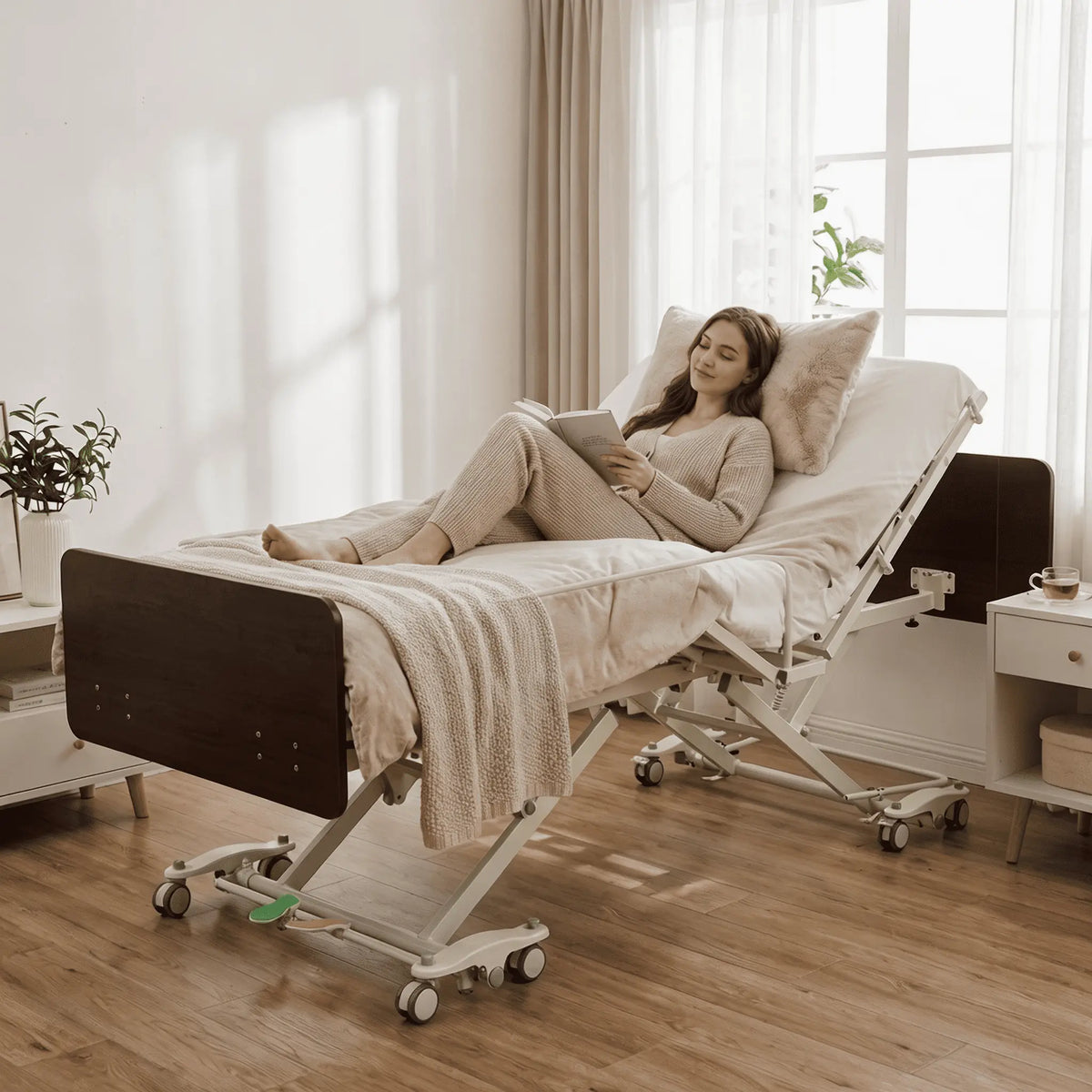
The Oasis 52300 is the expandable option. Its deck adjusts from 36 to 48 inches in width and from 80 to 88 inches in length, all within a single integrated frame. For families who are not certain which size the care situation will eventually require, or for patients whose body size or care plan needs are expected to change, the Oasis 52300 adapts without requiring a frame replacement.
Key Specs:
- Deck Width: 36", 42", 48" (integrated expansion)
- Deck Length: 80", 84", 88" (integrated expansion)
- Height Range: 7" to 30"
- Weight Capacity: 550 lbs
- Functions: Hi-low, Auto Contour, Heel Lift Extension, Mobility at Any Height, Central Locking, Under Bed Lighting, Safety Stop, Bumper Guard, 8-function hand control
- Included: Headboard, footboard, free rails (upgrade option available)
- Processing Time: 48 hours
The 7 to 30-inch height range is the widest in this guide. The expandable deck eliminates the need to purchase a second, wider bed as care needs intensify. For families planning for the full care arc rather than just the immediate situation, this is the most cost-effective long-term choice.
🎯 CHOOSE THIS IF: The patient's size or care needs may change significantly, or you want a single frame that covers both standard and bariatric width configurations without replacement.
Transfer Master Night Rider HD: 750 lb Bariatric Capacity in Standard Bed Sizes

The Night Rider HD addresses the situation where the patient's weight exceeds standard capacity but the home's room dimensions cannot accommodate a wider bariatric frame. It delivers 750 lb capacity in Twin, Full, and Queen sizes, the same familiar footprint as standard residential furniture, with full electric adjustability and optional Trendelenburg positioning.
Key Specs:
- Height Range: 12.75" to 24.75"
- Weight Capacity: 750 lbs (evenly distributed)
- Sizes: Twin 80, Twin 84, Full 80, Full 84, Queen 80, Queen 84
- Functions: Head (60°), foot (35°), hi-low; optional Trendelenburg/Reverse Trendelenburg with 5-Function Hand Pendant
- Deck: Seamless 3DL — water-resistant, scratch-resistant, easy to clean
- Casters: 5" locking
- Warranty: 36-month frame and welds
- Construction: Made in USA
- Mattresses: Geo-Mattress Atlas Bariatric, Ascent Firm, Soft Touch Cooling Memory Foam
- Add-Ons: Half rails, bamboo rail covers, headboards/footboards (standard or cherry), battery backup, catheter hook
Queen size fits through most residential hallways and doorways without modification, an important practical advantage for homes that cannot accommodate wider specialty frames.
Dementia note: The 3-Function Hand Pendant is recommended for patients with dementia. Trendelenburg and Reverse Trendelenburg features of the 5-Function pendant are generally avoided in dementia care because dramatic tilts can worsen cerebral perfusion and increase confusion or agitation.
🎯 CHOOSE THIS IF: The patient's weight exceeds standard capacity (up to 750 lbs) and you need bariatric performance in a standard Twin, Full, or Queen bed size that fits through standard residential doorways.
How to Choose the Right Size: A Practical Framework
Use these four questions in order before selecting a bed size:
1. What is the patient's weight and height? Under 400 lbs and under 6'2": standard 36 to 38-inch, 80-inch bed. Over 400 lbs: bariatric-rated frame required. Over 6'2": consider 84 or 88-inch length option.
2. What are the room dimensions? Measure the room and calculate clearance on each side of the bed's footprint. Standard 36 to 38-inch beds leave the most clearance in a standard bedroom. Wider bariatric beds reduce that clearance proportionally.
3. What are the doorway widths? Measure every doorway between the entrance and the bedroom. Standard 36-inch beds deliver in sections through 30-inch doorways. Wider frames may require wider doorways or professional delivery logistics.
4. What are the care plan requirements? Fall prevention (ultra-low height), clinical positioning (Trendelenburg), Hoyer lift access (under-bed clearance), and pressure injury management (expandable width for wedges) all affect which size and configuration is appropriate beyond the basic footprint decision.
Call 833-499-4450 to confirm dimensions and delivery logistics before ordering.
Frequently Asked Questions
What size are home hospital beds?
The standard home hospital bed is 36 inches wide by 80 inches long, the same footprint as a Twin XL mattress. Some models measure 38 inches wide and still fall within the standard footprint for home use. Bariatric models are available in 42, 48, and wider configurations for patients requiring greater width or weight capacity.
Is a hospital bed the same size as a Twin XL?
A standard hospital bed (36"x80") is very close to a Twin XL mattress (38"x80") in overall footprint. The mattress dimensions are nearly identical. The main visible difference in a bedroom is the extended base frame, casters, and hand pendant, not the mattress surface dimensions.
Will a hospital bed fit in a standard bedroom?
Yes. A standard 36 to 38-inch hospital bed is narrower than a Full or Queen residential mattress and typically occupies less floor width than the bed it replaces. The more important question is whether adequate caregiver clearance, at least 36 inches on the primary working side, is available once the bed is positioned.
How much space should surround a hospital bed?
A minimum of 36 inches of clearance on the caregiver's primary working side for wound care, hygiene, and repositioning. At least 24 inches on the other side for patient-assisted transfers and emergency access. Additional clearance is needed if a Hoyer lift or power wheelchair is part of the care plan.
Can a hospital bed fit through standard doorways?
Yes. Standard 36 to 38-inch hospital beds are delivered in sections and assembled in the room, passing through standard 30 to 32-inch interior doorways. Wider bariatric frames (42 inches and above) may require wider doorways or split-frame designs. Measure every doorway between the entrance and the bedroom before ordering.
What is the longest home hospital bed available?
The Emerald Oasis 52300 integrates length expansion from 80 to 88 inches within a single frame. The Transfer Master Night Rider HD and Supernal 3 are also available in 84-inch lengths. For patients over 6 feet 2 inches, a 84 or 88-inch option is recommended.
What is a bariatric hospital bed size?
Bariatric hospital beds are available in 42, 48, and 54-inch widths with weight capacities ranging from 450 lbs to 1,000 lbs depending on the model. The Night Rider HD provides 750 lb bariatric capacity in standard Twin, Full, and Queen sizes without requiring a wider frame. For a full overview of bariatric bed sizes and selection guidance, visit our Bariatric Beds collection.
Do I need to measure my room before ordering a hospital bed?
Yes. Measure the room dimensions, the doorway widths between the entrance and the bedroom, and the clearance available on each side of the planned bed position. This prevents delivery problems and ensures the care environment around the bed is safe and functional.
Featured collection


$3,444.77
-
$6,889.54
$3,444.77
-
$6,889.54
Current price
$3,444.77
Original price
$3,444.77
-
Original price
$6,889.54
Original price
Luxury Electric Hospital Bed - Hospital Functions Without the Hospital Look | TransferMaster Supernal 3
TransferMaster
In stock
Ships Next Day
$3,444.77
-
$6,889.54
$3,444.77
-
$6,889.54
Current price
$3,444.77
Original price
$3,444.77
-
Original price
$6,889.54
Original price
$3,444.77
-
$6,889.54
$3,444.77
-
$6,889.54
Current price
$3,444.77
Original price
$3,444.77
-
Original price
$6,889.54
Original price


$2,383.00
$2,383.00
-
$2,383.00
Current price
$2,383.00
Original price
$2,383.00
-
Original price
$2,383.00
Original price
Fully Electric Expandable Hospital Bed with Rails - Hi Low Adjustable Bed | Emerald Oasis
Emerald
Only 1 left!
Ships Next Day
$2,383.00
$2,383.00
-
$2,383.00
Current price
$2,383.00
Original price
$2,383.00
-
Original price
$2,383.00
Original price
$2,383.00
$2,383.00
-
$2,383.00
Current price
$2,383.00
Original price
$2,383.00
-
Original price
$2,383.00
Original price


Current price
$1,999.00
$1,999.00
-
$1,999.00
Current price
$1,999.00
Original price
$2,250.00
Original price
$2,250.00
-
Original price
$2,250.00
Original price
$2,250.00
Ultra Low Adjustable Electric Hospital Bed with Extendable Length for Fall Prevention | Medacure ULB7/30
Medacure
Only 1 left!
Ships Next Day
Current price
$1,999.00
$1,999.00
-
$1,999.00
Current price
$1,999.00
Original price
$2,250.00
Original price
$2,250.00
-
Original price
$2,250.00
Original price
$2,250.00
Current price
$1,999.00
$1,999.00
-
$1,999.00
Current price
$1,999.00
Original price
$2,250.00
Original price
$2,250.00
-
Original price
$2,250.00
Original price
$2,250.00
You save $251.00 (11%)


Current price
$2,399.00
$2,399.00
-
$2,399.00
Current price
$2,399.00
Original price
$2,750.00
Original price
$2,750.00
-
Original price
$2,750.00
Original price
$2,750.00
Value Bariatric Bed for Long Term Care and Home Care | ULB48-X-7/30
Medacure
In stock
Ships Next Day
Current price
$2,399.00
$2,399.00
-
$2,399.00
Current price
$2,399.00
Original price
$2,750.00
Original price
$2,750.00
-
Original price
$2,750.00
Original price
$2,750.00
Current price
$2,399.00
$2,399.00
-
$2,399.00
Current price
$2,399.00
Original price
$2,750.00
Original price
$2,750.00
-
Original price
$2,750.00
Original price
$2,750.00
You save $351.00 (13%)


$2,357.67
$2,357.67
-
$2,357.67
Current price
$2,357.67
Original price
$2,357.67
-
Original price
$2,357.67
Original price
High Low Electric Hospital Bed - Prius Descend Ultra | 36" x 80" | 2.7" Low
Prius Healthcare USA
In stock
Ships Next Day
$2,357.67
$2,357.67
-
$2,357.67
Current price
$2,357.67
Original price
$2,357.67
-
Original price
$2,357.67
Original price
$2,357.67
$2,357.67
-
$2,357.67
Current price
$2,357.67
Original price
$2,357.67
-
Original price
$2,357.67
Original price