📋 KEY TAKEAWAYS
- We carry hospital beds from multiple manufacturers, not just one, so this hospital bed comparison is genuinely neutral. Each bed below solves a different problem.
- There's no single "best" pick. The right one depends on whether your priority is safety, weight capacity, looks, or clinical positioning.
- Every bed here is a full electric hospital bed. Specs like height range and weight capacity vary a lot between them.
- Browse the full lineup: Hospital Beds for Sale
-
Top picks by need:
Hospital Bed Comparison at a Glance
| Bed |
Best For |
Height Range |
Weight Capacity |
Key Functions |
| Emerald Oasis 52300 |
General home care |
7" – 30" |
550 lbs |
Auto contour, integrated width/length expansion |
| Medacure ULB 3.9 |
Fall prevention / low bed |
3.9" – 25" |
450 lbs |
Trendelenburg, Reverse Trendelenburg, auto contour |
| Emerald Infinity 54000 |
Bariatric users |
7" – 30" |
650 lbs |
Comfort chair position, auto contour, under-bed lighting |
| TransferMaster Supernal 3 |
Premium, residential look |
10.5" – 20.5" |
400–500 lbs |
Wall hugging, European-style head tilt, massage |
| iCare IC333 |
Advanced clinical positioning |
9" – 26" |
440–660 lbs |
Trendelenburg, Reverse Trendelenburg, knee break |
Note: Trendelenburg and Reverse Trendelenburg are clinical positioning functions. They should be used under the direction of a physician or other qualified provider, not as routine daily settings.
Not sure which category fits your situation? Our complete guide to types of hospital beds breaks down the differences in more depth.
The 5 Hospital Beds, and Why We'd Recommend Each One
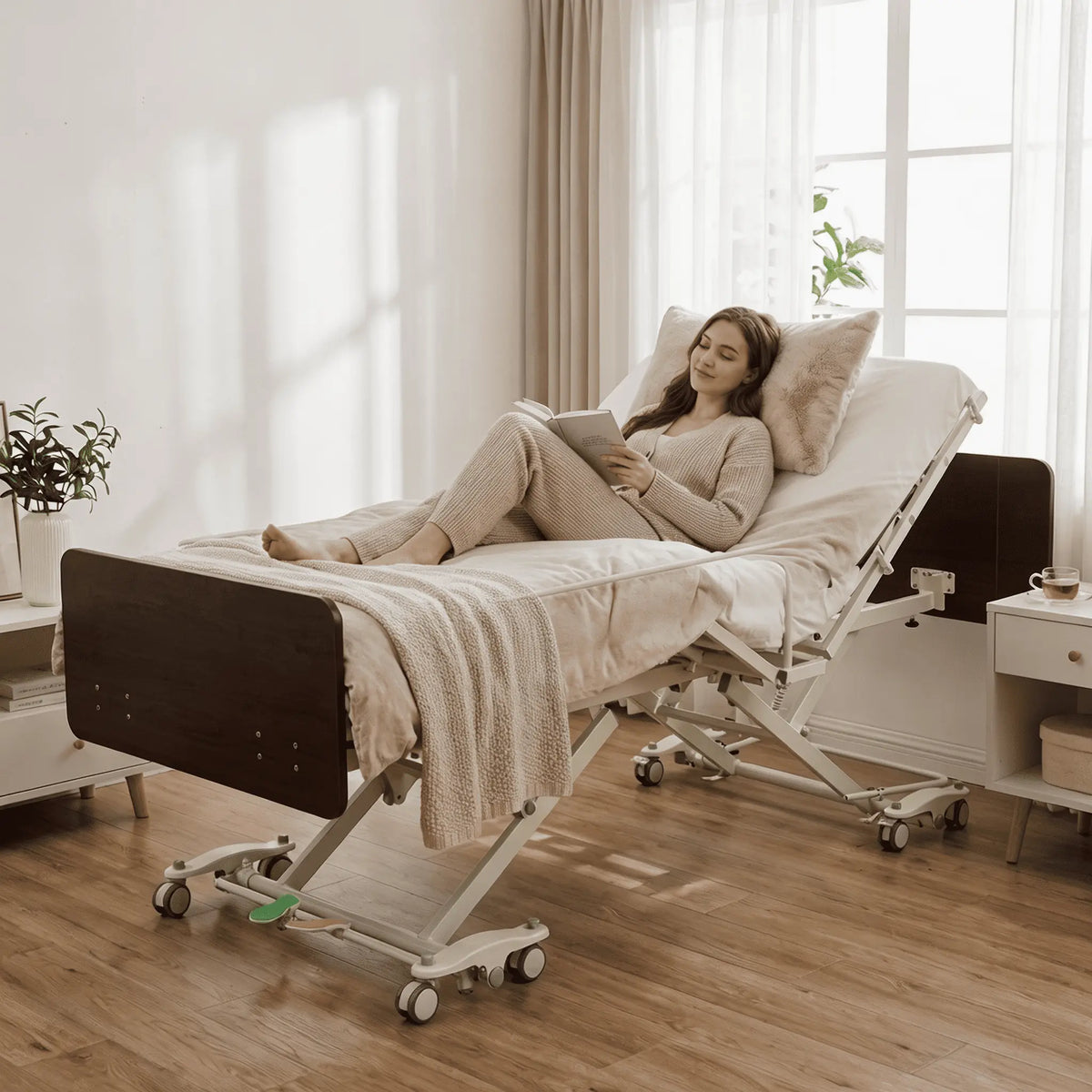
1. Emerald Oasis 52300: Best for General Home Care
Why we'd recommend it: it covers the core functions most home care situations actually need (height adjustment, contour support, integrated width and length expansion) without paying for specialized features like Trendelenburg or bariatric-level capacity you may not use.
Key Specs:
-
Height Range: 7" to 30"
-
Adjustability/Functions: Hi-Low, auto contour, heel lift extension, central locking system, 8-function hand control
-
Weight Capacity: 550 lbs
-
Sizes: Deck width 36", 42", or 48"; deck length 80", 84", or 88" (fully expandable)
-
Mattress Options: Not listed
-
Smart Features: Not listed
-
Warranty: 15 years on welds/frame, 5 years on electrical and mechanical components, 1 year on all other components
Biggest advantage: The expandable deck width and length let one bed frame adjust to fit a wider range of body sizes without buying a different model.
Biggest tradeoff: No Trendelenburg or Reverse Trendelenburg positioning, so it's not built for the more advanced clinical needs some patients require.
Who should not buy this: Anyone who specifically needs Trendelenburg positioning, bariatric-level (650+ lb) capacity, or a non-institutional residential look.
Get this if you want a reliable, full-featured hospital bed for everyday home care without paying for functions you won't use.
See Price & Details

2.Medacure ULB 3.9: Best Low Bed for Fall Prevention
Why we'd recommend it: at 3.9 inches off the floor, it's built specifically to reduce fall injury risk for people who are confused, unsteady, or prone to rolling or climbing out of bed at night.
Falls are a serious concern for this population. According to the CDC, over 14 million older adults, roughly 1 in 4, report falling each year, and a low bed is one of the few interventions that can reduce injury severity even when the fall itself can't be prevented.
Key Specs:
-
Height Range: 3.9" (lowest) to 25" (highest)
-
Adjustability/Functions: 10-function electric: Hi/Lo, Head, Foot, Trendelenburg, Reverse Trendelenburg, Auto Contour
-
Weight Capacity: 450 lbs
-
Sizes: 36" x 80" (a 42" bariatric-width option is also available separately)
-
Other Features: LINAK actuators, split-frame design folds for transport (36"L x 20"W x 48.5"H), 4 locking casters, two patient assist bars, side rails compatible (sold separately)
-
Mattress Options: Protekt 500, Icare IC30 ActiveX, PROEX 3-Tiered System, Protekt Supreme Support, Prius Rhythm Turn
-
Warranty: 15 years frame, 3 years electronics, 1 year pendant, lifetime support
Biggest advantage: The 3.9-inch low position is one of the lowest available on an electric hospital bed, which matters most for dementia, Alzheimer's, and high fall-risk situations.
Biggest tradeoff: The split-frame, portable design that makes it easy to move also means it's a narrower fixed-width bed (36" or 42"), not an expandable deck like the Oasis or Infinity.
Who should not buy this: Anyone needing a wider adjustable deck, bariatric-level capacity over 450 lbs, or a bed styled to look like residential furniture.
Get this if fall prevention is the primary concern and you need the lowest sleeping surface available without giving up full electric positioning.
See Price & Details
3.Emerald Infinity 54000: Best Hospital Bed for Bariatric Users
Why we'd recommend it: a 650 lb weight capacity paired with an expandable deck (up to 48" wide, 88" long) makes this one of the more accommodating full electric hospital beds we carry for larger patients.
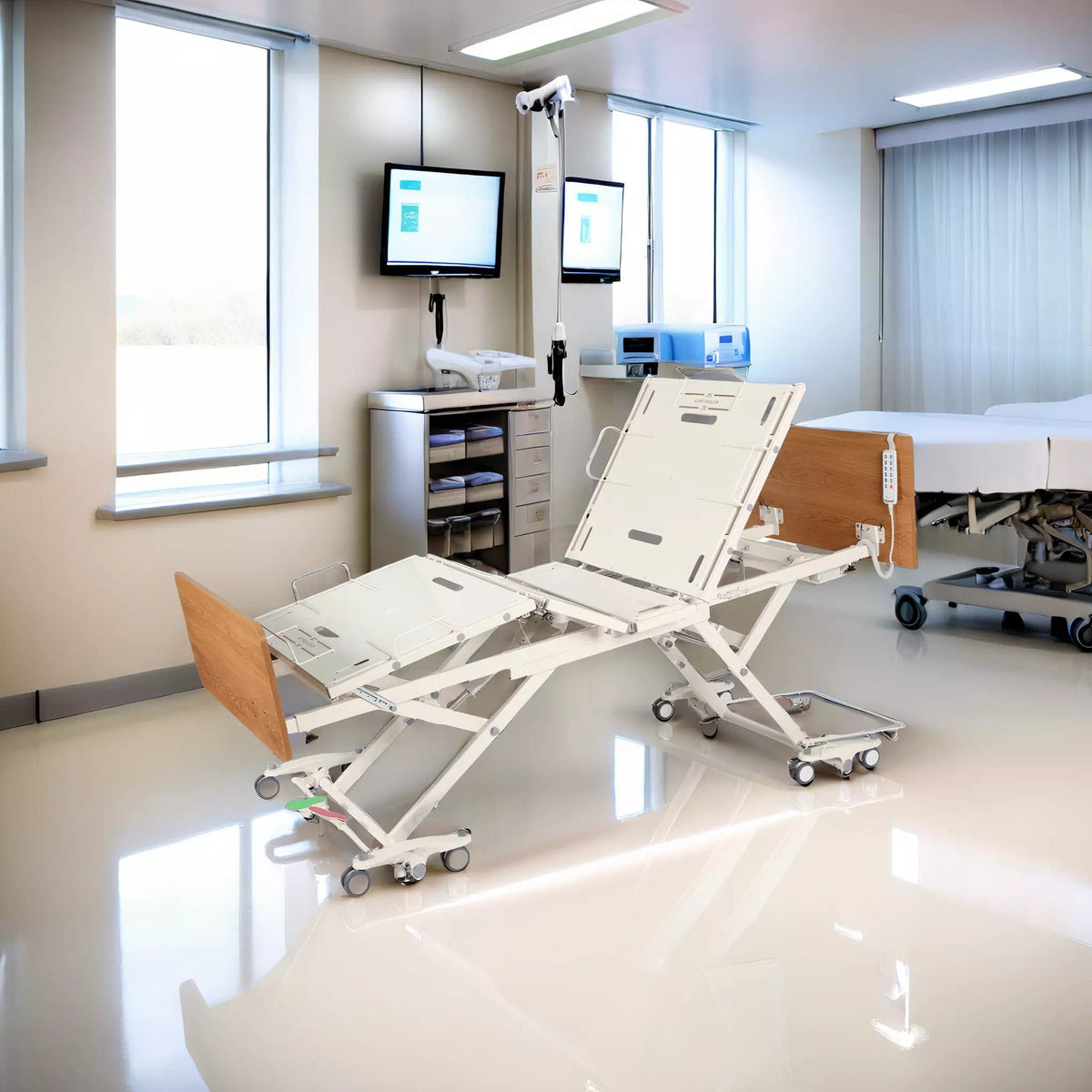
Key Specs:
-
Height Range: 7" to 30"
-
Adjustability/Functions: Hi-Low, integrated width and length expansion, comfort chair position, auto contour, central locking system, safety stop, heel lift extension
-
Weight Capacity: 650 lbs
-
Sizes: Deck width 36", 42", or 48"; deck length 80" to 88"
-
Smart Features: Under-bed lighting, battery backup
-
Mattress Options: Pressure redistribution mattresses, low air loss systems, lateral turn mattresses
-
Warranty: 15 years welds/frame, 5 years electrical/mechanical components, 1 year all other components
Biggest advantage: The combination of 650 lb capacity and a fully expandable deck means the bed can be widened as needed rather than requiring a separate specialty frame.
Biggest tradeoff: No Trendelenburg or Reverse Trendelenburg function, so patients who need those clinical positions will need a different model.
Who should not buy this: Anyone under 300 lbs who doesn't need the wider deck, or anyone requiring Trendelenburg positioning.
Get this if you're outfitting a bed for a bariatric patient and want expandable width and length built in rather than added on.
See Price & Details
4.TransferMaster Supernal 3: Best for a Residential, Non-Clinical Look
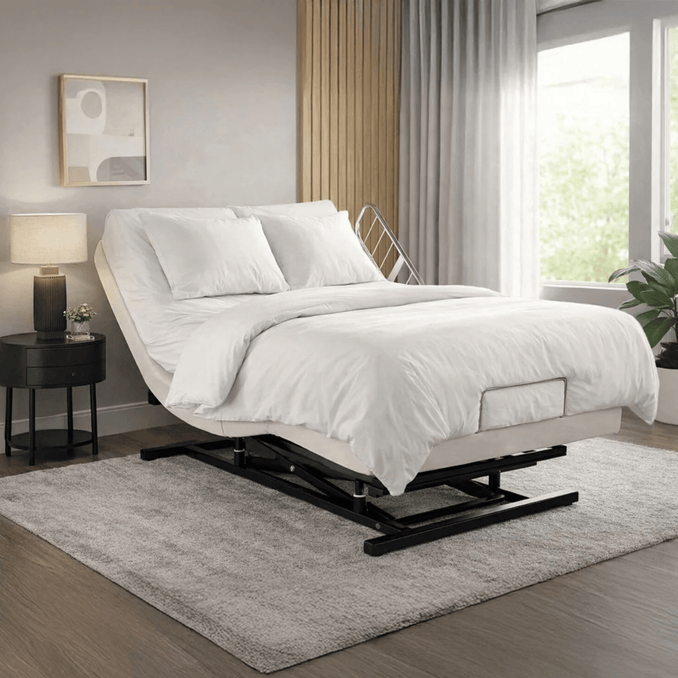
Why we'd recommend it: it delivers real hospital bed functions (independent head and foot adjustment, hi-low, wall-hugging technology) in a frame designed to look like home furniture rather than medical equipment.
Key Specs:
-
Height Range: 10.5" to 20.5" (without mattress)
-
Adjustability/Functions: Independent head (65°) and foot (35°) adjustment, hi-low, wall-hugging technology, European-style head tilt, massage chair setting
-
Weight Capacity: 400 lbs (Twin), 500 lbs (Full, Queen)
-
Sizes: Twin 80", Full 80", Queen, Dual King (two synchronized Twin systems)
-
Smart Features: Wireless illuminated remote
-
Mattress Options: Ascent Mattress, Soft Touch Mattress, PressureGuard Span-Care Convertible Mattress
-
Warranty: 5-year frame, 3-year electronic components
Biggest advantage: Wall-hugging technology keeps the patient close to the nightstand as the head elevates, and the hidden electronics mean it doesn't visually announce itself as medical equipment.
Biggest tradeoff: No Trendelenburg or Reverse Trendelenburg on this model. Anyone who needs that function has to step up to the Supernal 5.
Who should not buy this: Anyone who specifically needs Trendelenburg positioning, or anyone prioritizing maximum weight capacity over appearance.
Get this if you want full hospital bed functionality in a bedroom that doesn't look or feel like a care facility.
See Price & Details
5.iCare IC333: Best for Advanced Clinical Positioning
Why we'd recommend it: between the 9" ultra-low transfer height, Trendelenburg and Reverse Trendelenburg functions, and a 660 lb capacity on double and queen sizes, this is the most clinically capable bed on this list while still looking like upscale furniture.
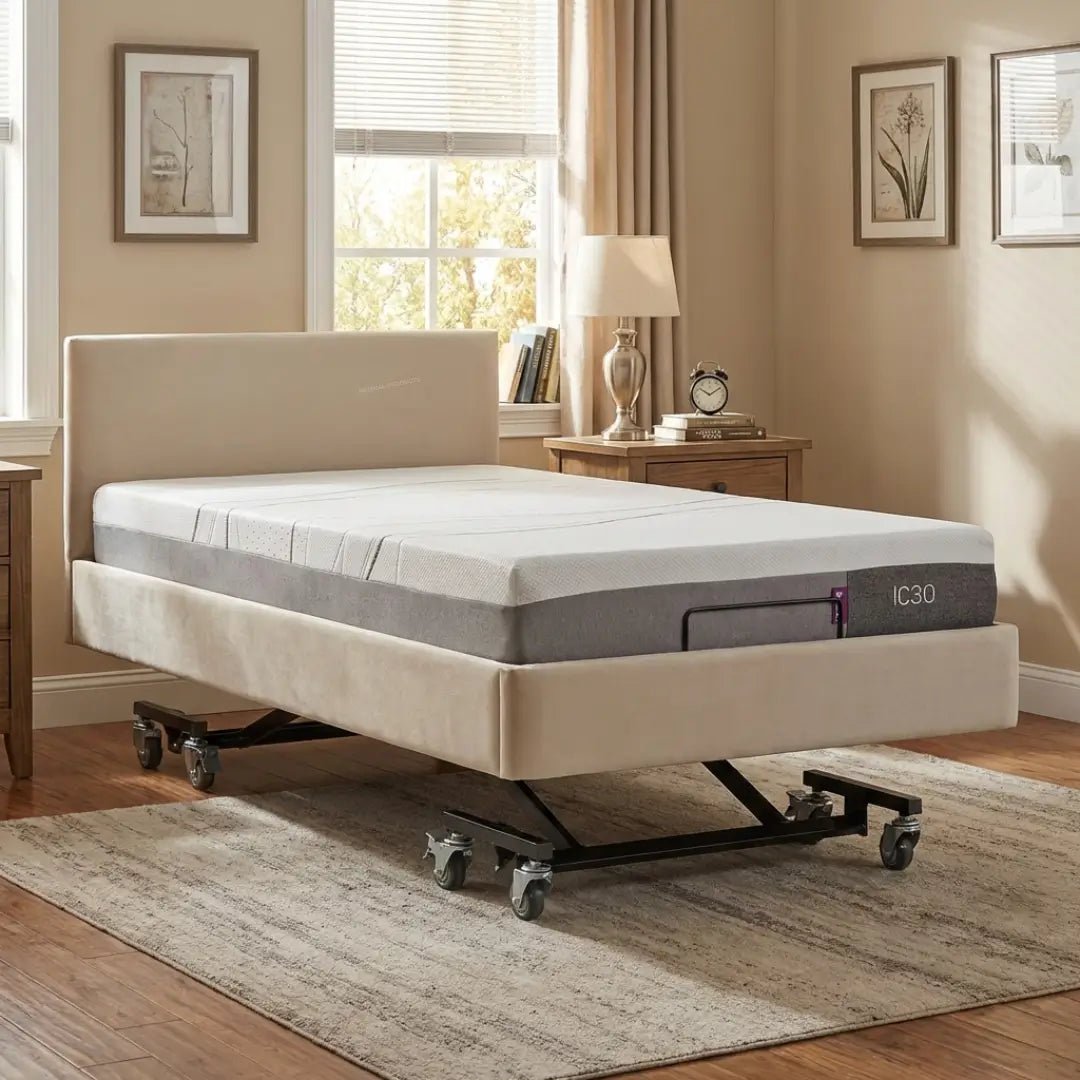
Key Specs:
-
Height Range: 9" to 26"
-
Adjustability/Functions: 4-function electric: head lift/back raise (62°), knee break (42°), hi-lo, Trendelenburg and Reverse Trendelenburg
-
Weight Capacity: 440 lbs on Long Single and King Single sizes; 660 lbs on Double and Queen sizes
-
Sizes: Long Single, King Single, Double, Queen
-
Smart Features: Not listed
-
Other Features: Backlit wired hand control, unlimited under-bed clearance, 8 heavy-duty locking casters, Hoyer lift compatible with 7" clearance
-
Mattress Options: IC15, IC20, IC30
-
Warranty: 10-year limited warranty on steel frame; 2-year limited warranty on actuators, control box, castor wheels, hand piece, and upholstered surround/fabric
Every iCare bed, including the IC333, has a 2-week production lead time because every bed is manufactured to order with custom fabric as standard. This applies to all orders regardless of fabric selection, not just custom upgrades.
Biggest advantage: It's the only bed on this list combining Trendelenburg, Reverse Trendelenburg, an ultra-low 9" transfer height, and Hoyer lift compatibility in one frame.
Biggest tradeoff: The 2-week production lead time is longer than most in-stock beds, and it's not the right fit if you need something shipped immediately.
Who should not buy this: Anyone who needs a bed shipped right away, or anyone who doesn't need Trendelenburg-level clinical positioning and would be better served by a simpler, faster-shipping model.
Get this if you need genuine clinical positioning capability (Trendelenburg included) in a bed that doesn't look institutional, and you can plan around the lead time.
See Price & Details
Which of These Hospital Beds Is Right for You?
Start with the need that matters most, not the feature list. If safety and fall prevention come first, the ULB 3.9's ultra-low height is hard to match. If weight capacity is the priority, the Emerald Infinity 54000 is built for it. If appearance matters as much as function, the Supernal 3 is designed around that tradeoff. And if a physician has recommended Trendelenburg-style positioning specifically, the ULB 3.9 or IC333 are the two options here built for it, though that positioning should always be used under medical guidance.
For a broader breakdown of bed categories and how they differ, our types of hospital beds guide (linked above) goes deeper than this comparison.
Frequently Asked Questions
What is the best hospital bed for general home care?
For most general home care situations, the Emerald Oasis 52300 covers hi-low positioning, contour support, and a 550-lb capacity without the added cost of specialized functions like Trendelenburg.
What is the lowest hospital bed for fall prevention?
The Medacure ULB 3.9 lowers to 3.9 inches from the floor, making it one of the lowest full electric hospital beds available for reducing fall injury risk.
Which hospital bed works best for bariatric patients?
The Emerald Infinity 54000 has a 650 lb weight capacity and an expandable deck up to 48" wide and 88" long, built specifically for bariatric support.
Is there a hospital bed that doesn't look like medical equipment?
The TransferMaster Supernal 3 is designed with hidden electronics and a furniture-style frame so it blends into a home bedroom while still offering full head, foot, and hi-lo adjustment.
Which hospital bed offers Trendelenburg positioning at home?
Both the Medacure ULB 3.9 and the iCare IC333 include Trendelenburg and Reverse Trendelenburg functions. These should only be used under a physician's direction.
How long does it take to receive an iCare hospital bed?
All iCare beds, including the IC333, have a 2-week production lead time because every bed is custom-manufactured with fabric selection as a standard part of the build, not an optional upgrade.


