📋 KEY TAKEAWAYS
-
Yes, many doctors do recommend adjustable beds for seniors, but the recommendation is condition-specific, not a blanket yes for everyone. It depends on the person's health, mobility, sleeping habits, and specific needs.
- An adjustable bed is not the same thing as a medical hospital bed. If caregiver access, transfers, or clinical positioning are involved, that's a different conversation. See our Adjustable Bed vs Hospital Bed guide for that distinction.
- Fall risk, bed height, mattress compatibility, and safe use of the remote all matter before buying. Talk to a healthcare professional before changing a senior's sleep setup if there's an existing diagnosed condition.
See Adjustable Beds for Seniors: Adjustable Beds for Seniors
Featured Options:
Bottom Line: Adjustable beds genuinely help many seniors, but "good for seniors" isn't a universal label. The right answer depends on the specific person, and a doctor's input matters most when a diagnosed condition is involved.
Fixed Height vs Semi Electric Hospital Bed: What Actually Separates Them
Are Adjustable Beds Good for Seniors? The Short Answer
Yes, in many cases. Doctors commonly recommend adjustable beds for seniors managing things like acid reflux, mild back pain, positional snoring, poor circulation, or a general need for safer, easier movement in and out of bed. These are situations where changing the body's angle produces a real, physical benefit.
But this isn't a universal recommendation. A doctor isn't going to tell every senior they need one, because the actual benefit depends heavily on what that specific person is dealing with. An adjustable bed is also a mechanical positioning tool, not a treatment for a diagnosed medical condition. It supports comfort and function. It doesn't replace medical care.
What Determines Whether a Doctor Recommends One
Whether an adjustable bed makes sense for a particular senior comes down to a few practical factors, not a general "it's good for you" opinion:
-
Overall health. Existing heart, lung, spine, or circulatory conditions change whether elevation or positioning actually helps.
-
Current mobility. A senior who's mobile and sleeps flat without issue has a different need than one who struggles to sit up or stand.
-
Sleeping habits. Nighttime reflux, snoring, or restlessness point toward different features than general comfort alone.
-
The specific problem being solved. Reflux at night, difficulty getting out of bed in the morning, or general positioning comfort each lead to a different answer.
A caregiver shopping for a parent gets further by identifying which of these is the actual daily struggle before looking at any specific bed or feature list.
4 Potential Benefits of Adjustable Beds for Seniors
There are several specific, well-supported benefits behind why adjustable beds get recommended.
1.Easier repositioning. Being able to shift position without needing full-body effort matters for seniors with limited mobility or strength. A case series published in the Journal of Spinal Cord Medicine looked at real-world experiences using a hospital bed alternative at home, and found that easier repositioning was a meaningful part of how patients and caregivers experienced day-to-day use.
2.Head and upper-body elevation. Raising the head and upper body is one of the most studied uses of an adjustable bed. A systematic review on head-of-bed elevation for gastroesophageal reflux symptoms found that elevating the upper body during sleep can help reduce nighttime reflux symptoms for people managing GERD.
3.Easier getting in and out of bed. For seniors with joint pain, balance concerns, or general frailty, being able to raise the head and shoulders toward a seated position before standing reduces the physical strain of that transition, compared to pushing up from completely flat.
4.Comfort and circulation support. Leg elevation is a commonly recommended way to help reduce swelling in the lower legs and feet, according to Cleveland Clinic. An adjustable bed makes that elevation easy to maintain consistently through the night, rather than relying on stacked pillows that shift or collapse.
Potential Limitations and Safety Concerns
An adjustable bed isn't risk-free, and it isn't the right fit for every situation.
It doesn't treat or cure a diagnosed condition. It's a mechanical aid, not a medical intervention. It also doesn't replace a hospital bed when caregiver access, safe transfers, or clinical positioning are genuinely needed. And like any powered furniture, it introduces a few new things to think about that a standard bed doesn't: moving parts, a remote control, gaps between components, and a fixed base height that may or may not suit the person using it.
None of that makes an adjustable bed unsafe. It just means a few specific things are worth checking before buying one for a senior.
Safety Guidance Before You Buy
A few practical safety points matter more for seniors than for a general adjustable bed buyer.
-
Fall risk. Falls are the leading cause of injury among adults 65 and older, and more than one in four older adults falls each year, according to the CDC. An adjustable bed with a lower base height can make getting in and out safer, but it isn't a substitute for addressing an existing fall risk with a doctor or physical therapist.
-
Bed height. The bed should let the person sit with feet flat on the floor and knees at roughly a 90-degree angle without straining. Too high, and getting out becomes harder and riskier. Too low, and standing up becomes harder on the knees and hips.
-
Mattress compatibility. Not every mattress works safely on an adjustable base. A traditional innerspring mattress that isn't designed to flex can be damaged by repeated articulation, and a mattress that isn't rated for the base can shift or gap during use.
-
Getting trapped between components. Gaps can open between the mattress edge and the bed frame, or around the head and foot articulation points, as the bed moves. This is worth checking directly, especially for a senior with reduced sensation or limited ability to reposition themselves if a limb gets caught.
-
Safe use of the remote or control system. A senior with limited dexterity, memory changes, or vision difficulty may struggle with a small, complex remote. Look for large, clearly labeled buttons, and make sure the remote can't be triggered accidentally, for example, by rolling onto it during sleep.
Adjustable Bed or Hospital Bed? Know the Difference
An adjustable bed and a hospital bed are often confused, and the difference matters for safety, not just price.
A residential adjustable bed is built around comfort. It raises the head and foot, but the base typically stays at one fixed height, and it's designed to look and feel like normal bedroom furniture. A hospital bed goes further. It raises and lowers the entire bed frame, which is what allows a caregiver to work at a safe height and lets a patient exit the bed at a lower, safer level. Hospital beds are also more likely to support side rails and specialized medical mattresses.
If the situation involves a caregiver regularly assisting with transfers, a documented fall risk, or a medical condition requiring specific positioning, that's a strong signal to look at a hospital bed rather than a residential adjustable bed. Our full breakdown in Adjustable Bed vs Hospital Bed: Which Is Better for Elderly at Home? walks through that decision in more detail.
When to Talk to a Healthcare Professional First
Talk to a doctor before changing a senior's sleep setup if there's a diagnosed condition involved, especially one related to the heart, lungs, spine, or circulation, or if there's been a recent surgery, fall, or hospitalization.
A doctor or physical therapist can confirm whether a specific elevation angle, positioning need, or bed height actually fits the person's condition, rather than guessing based on general product marketing. This matters just as much when a caregiver is choosing the bed on a parent's behalf as it does for the senior themselves. If in doubt, bring the specific daily struggle to the appointment. A doctor can respond to "they have trouble getting out of bed in the morning" far more precisely than to "should we get an adjustable bed."
If You Do Choose an Adjustable Bed
For seniors whose needs point toward a residential adjustable bed rather than a hospital bed, these 2 options illustrate two different priorities.
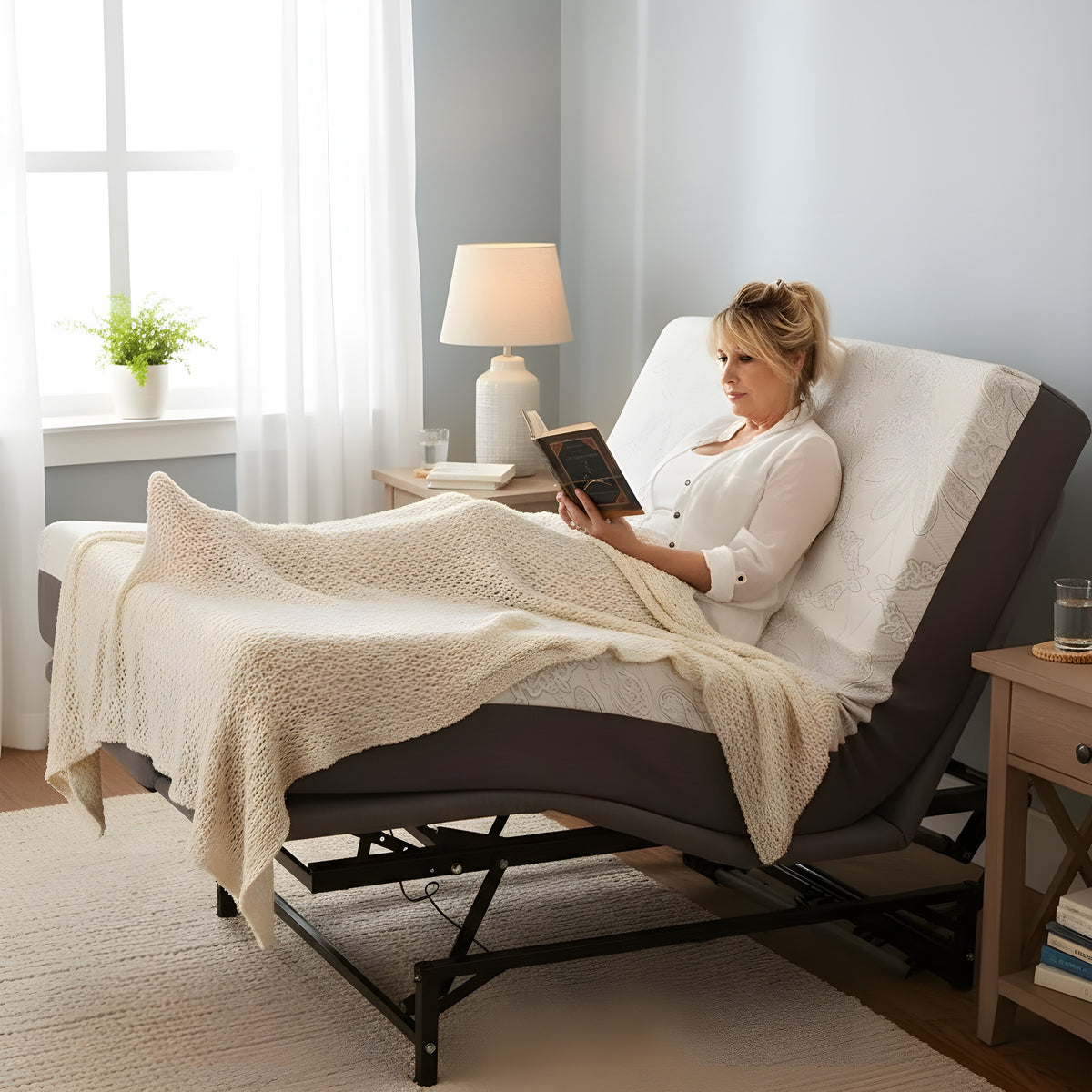
1.Flexabed Hi-Low: Hi-Low Height Adjustment With a Genuine Home Mattress
Key Specs:
-
Height Range: 11" to 18.5" without casters (fully lowered with leg pads to fully raised), 13.25" to 20.75" with casters
-
Adjustability/Functions: Full motorized hi-low base adjustment; head raises to about 70 degrees, foot to about 40 degrees
-
Weight Capacity: 400 lbs single occupant, 700 lbs split occupant (no single person over 400 lbs)
-
Sizes: Twin, Full, Queen, Split King, with length options of 74", 80", and 84"
-
Mattress Options: Traditional innerspring (soft, medium, firm), low profile, gel memory foam, innerspring/memory foam combo
-
Smart Features: Optional underbed lighting, massage, voice activation, wireless phone and USB charging, Bluetooth connectivity (wireless remote required)
-
Warranty: Lifetime limited warranty on frame and mechanics
GET THIS IF getting the entire bed height right for safe entry and exit matters, and a genuine home mattress feel is a priority.
See Price & Details

2.UPbed Independence: Rotation and Sit-to-Stand Support
Key Specs:
-
Height Range: Height to mattress surface is 23" (Twin) or 25" (Twin XL). The bed tilts and rotates rather than raising or lowering the full platform.
-
Adjustability/Functions: 90-degree rotation, sit-to-stand lift assist, independent head, foot, and seat adjustment, with four positions (Sleep, TV/Reading, Chair, Lift Assist)
-
Weight Capacity: 500 lbs (Twin and Twin XL)
-
Sizes: Twin (38"W x 75"L) and Twin XL (38"W x 80"L)
-
Mattress Options: Integrated 6" premium memory foam mattress, included as part of the platform
-
Smart Features: Hard-wired remote with handrail clip, dual USB ports, motion-activated underbed lighting, emergency battery backup, configurable left or right rotation
-
Warranty: 10-year limited warranty. Year 1 covers parts and labor in-home. Years 2 to 3 cover parts only. Years 4 to 10 cover the frame and non-electric mechanisms only.
GET THIS IF the main struggle is standing up and rotating toward a walker or wheelchair, rather than overall bed height.
See Price & Details
Frequently Asked Questions
Are adjustable beds good for seniors?
For many seniors, yes, particularly those managing reflux, mild back pain, circulation issues, or difficulty getting in and out of bed. It's not a universal recommendation, and the right fit depends on the individual's health and needs.
Do doctors actually recommend adjustable beds?
Many do, but the recommendation is typically tied to a specific issue, such as nighttime reflux or positioning support, rather than a general suggestion for every senior.
Can an adjustable bed treat a medical condition?
No. It's a mechanical positioning tool that can support comfort and reduce strain during certain activities. It does not diagnose, treat, or cure any medical condition.
Is an adjustable bed the same as a hospital bed?
No. A residential adjustable bed typically has a fixed base height and is built for comfort. A hospital bed raises and lowers the entire frame and is built around caregiver access and clinical positioning.
What safety features matter most for a senior using an adjustable bed?
Correct bed height for safe entry and exit, a mattress rated for use on an adjustable base, no entrapment gaps at the frame or articulation points, and a remote control that's easy to use and hard to trigger accidentally.
When should I talk to a doctor before getting an adjustable bed?
Before making the purchase if there's a diagnosed heart, lung, spine, or circulatory condition, or a recent surgery, fall, or hospitalization involved. A doctor can confirm what positioning actually fits the person's situation.


