📋 Key Takeaways
-
Portable patient monitors range from compact single-purpose vital sign checkers to full multi-parameter systems that track ECG, blood pressure, SpO2, temperature, and respiration together. The right one depends entirely on where and how your team will use it.
- No portable monitor measures every vital sign. Always check the specific parameters a model supports before you buy, since standard and optional features vary by device.
- Screen size, battery life, data storage, and networking capability differ widely between clinic-based monitors and transport-focused ones.
- Compare the full lineup in our Patient Monitors collection or jump straight to our top picks below:
Bottom Line: A portable patient monitor is only as useful as its match to your clinical environment. Match the parameters, screen, and connectivity to how the device will actually be used, not the other way around.
What Do Portable Patient Monitors Measure?
A portable patient monitor is a compact, multi-parameter device that tracks a patient's vital signs at the bedside, in a clinic, or during transport. Depending on the model, that can include SpO2, pulse rate, blood pressure, temperature, and ECG. Browse the full range in our Patient Monitors collection to compare parameters side by side.
Each of these measurements tells clinicians something different. SpO2 estimates how much oxygen the blood is carrying, using a sensor typically clipped to a fingertip. Pulse rate counts heartbeats per minute and is often read from that same sensor or from the ECG. Blood pressure is measured non-invasively (NIBP) with an inflatable cuff that captures systolic and diastolic pressure. Temperature and respiration rate round out the basic vital signs, while ECG tracks the heart's electrical activity and can flag an arrhythmia when the monitor supports continuous ECG review.
Not every device on the market measures the same things. A compact monitor built for outpatient checks may cover the basics: SpO2, pulse rate, blood pressure, temperature, and respiration. A higher-acuity monitor built for the ICU or operating room typically adds arrhythmia detection, ST-segment analysis, and options like end-tidal CO2 (EtCO2), invasive blood pressure (IBP), cardiac output, or anesthesia gas analysis. Always confirm which parameters are standard versus optional on the specific model you're considering, since assuming a feature is included when it isn't can create a real gap in patient care.
9 Factors to Consider Before Buying a Portable Patient Monitor
The right portable vital signs monitor comes down to matching the device's capabilities to your actual care setting. These are the factors that matter most.
-
Parameters measured. Confirm which vital signs are standard and which require an optional module. A monitor that only measures NIBP and SpO2 won't cover a unit that needs continuous ECG.
-
Screen and readability. Larger touchscreens are easier to read at a glance across a busy floor, while smaller displays keep the unit lighter and easier to carry between rooms.
-
Battery life. Transport and EMS use call for a monitor that can run for a meaningful stretch away from an outlet, not just a quick spot check.
-
Portability. A monitor moved room to room or facility to facility needs a form factor that's easy to carry or mount on a rolling stand.
-
Alarm functionality. Audio and visual alarms with adjustable limits let staff catch a changing condition without staring at the screen constantly.
-
Data storage and connectivity. Hours of stored trend data, plus Ethernet, RS-232, and HL7 compatibility, determine how well the monitor fits into an existing hospital information system.
-
Cuff, probe, and accessory compatibility. Confirm which sensors, cuffs, and modules are compatible before assuming a monitor can be expanded later.
-
Ease of cleaning. Touchscreens and housings that hold up to routine disinfection matter in any setting where the same unit sees multiple patients.
-
Intended clinical environment. A monitor built for spot-checking in a clinic is a different tool than one built to move with a patient from the floor to the operating room.
Portable Patient Monitors for Every Care Setting
These four monitors cover distinct clinical settings, from compact outpatient and EMS use up to full high-acuity ICU and OR monitoring.
1. Omni Express: Compact Monitoring for Clinics, Outpatient Care, and EMS
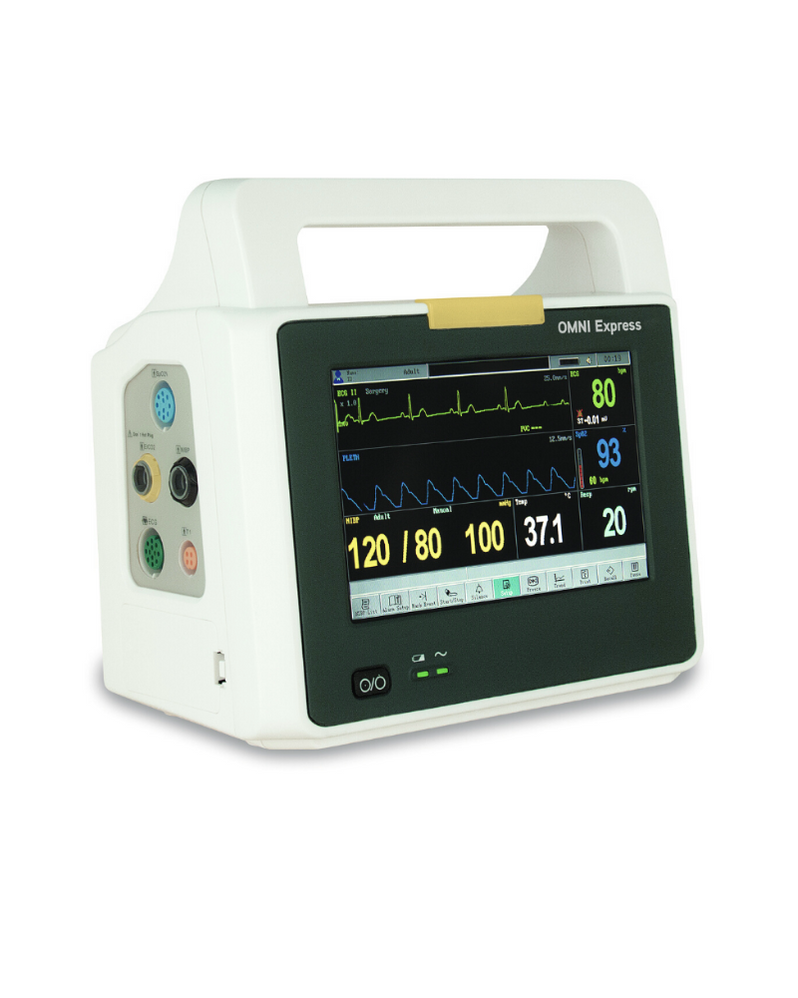
The Omni Express is built for outpatient checks, fast-paced clinics, and EMS or mobile care teams that need a light, easy-to-carry unit. It covers standard monitoring of ECG, NIBP, SpO2, temperature, and respiration, with multi-lead ECG support for up to three simultaneous waveforms. Its rechargeable lithium-ion battery and 120-hour trend storage make it practical for spot checks and patient monitors for emergency room or transport use alike.
Key Specs:
-
Display: 7-inch touchscreen
-
Standard Parameters: ECG, NIBP, SpO2, Temperature, Respiration
-
Optional Parameters: EtCO2
-
SpO2 Options: Not listed
-
Data Storage: Up to 120 hours
-
Battery: Rechargeable lithium-ion, up to 3 hours
-
Connectivity: Ethernet, RS-232, HL7 compliant
-
Central Station: Compatible with Infinium Omniview (supports up to 32 monitors)
-
Field Upgradable: Yes
-
Warranty: Not listed
-
Certification: CE Certified
GET THIS IF you need a compact, budget-friendly monitor for outpatient checks, clinic use, or EMS and transport, and you don't require continuous high-acuity parameters.
See Price & Details
2. Omni K: Continuity from Home Care and the General Floor to the OR

The Omni K is built for home care and general hospital floor monitoring where a patient's condition can change quickly enough to require a move to the operating room without switching devices. It offers a larger 10.5-inch display than the Omni Express, field-upgradable modules for expanding acuity level on-site, and a 5-year manufacturer warranty for long-term reliability.
Key Specs:
-
Display: 10.5-inch touchscreen
-
Standard Parameters: ECG, NIBP, SpO2, Temperature, Respiration, Arrhythmia, ST Analysis, OxyCrg, Drug Dose Calculation
-
Optional Parameters: EtCO2, Invasive Blood Pressure (IBP), 5-Agent Anesthesia Analysis
-
SpO2 Options: Not listed
-
Data Storage: Up to 72 hours
-
Battery: Not listed
-
Connectivity: Ethernet, RS-232, HL7 compliant
-
Central Station: Compatible with Infinium Omniview (supports up to 32 monitors)
-
Field Upgradable: Yes
-
Warranty: 5-Year Manufacturer Warranty
-
Certification: Not listed
GET THIS IF you want one monitor that can follow a patient from home care or the general floor to the operating room, backed by a longer warranty for peace of mind.
See Price & Details
3. Omni II: A Larger Display with Expanded SpO2 Options for Bedside Use

Hospital patient monitors used continuously at the bedside need a larger display and more advanced sensor options to keep up with a changing patient population. The Omni II offers a 12.1-inch display with standard ECG, NIBP, SpO2, dual temperature, respiration, arrhythmia detection, ST analysis, and drug dose calculation, plus a choice of standard, Masimo SET, or Nellcor SpO2 technology and central station networking for up to 64 monitors.
Key Specs:
-
Display: 12.1-inch touchscreen
-
Standard Parameters: ECG, NIBP, SpO2, Dual Temperature, Respiration, Arrhythmia, ST Analysis, OxyCrg, Drug Dose Calculation
-
Optional Parameters: EtCO2, Dual IBP, 5-Agent Anesthesia Analysis, FiO2
-
SpO2 Options: Standard, Masimo SET, Nellcor
-
Data Storage: Up to 72 hours
-
Battery: Not listed
-
Connectivity: Ethernet, RS-232, HL7 compliant
-
Central Station: Compatible with Infinium Omniview (supports up to 64 monitors)
-
Field Upgradable: Yes
-
Warranty: Not listed
-
Certification: Not listed
GET THIS IF you want a larger bedside display, expanded SpO2 sensor options, and the ability to network up to 64 monitors on one central station.
See Price & Details
4. Omni III: High-Acuity Monitoring for the ICU and Operating Room

For intensive care units, operating rooms, or any care plan involving cardiac output tracking or anesthesia depth monitoring, the Omni III steps up further with a 15-inch display and cascading ECG with advanced arrhythmia detection. Optional modules extend it to EtCO2, invasive blood pressure, 5-agent anesthesia analysis, cardiac output, and BIS monitoring for the highest-acuity patients.
Key Specs:
-
Display: 15-inch touchscreen
-
Standard Parameters: Cascading ECG with arrhythmia detection, NIBP, SpO2, Temperature, Respiration, ST Analysis, OxyCrg, Drug Dose Calculation
-
Optional Parameters: EtCO2, IBP, 5-Agent Anesthesia Analysis, Cardiac Output, BIS Monitoring
-
SpO2 Options: Standard, with optional Masimo SET available on inquiry
-
Data Storage: Not listed
-
Battery: Not listed
-
Connectivity: Ethernet, RS-232, HL7 compliant
-
Central Station: Compatible with Infinium Omniview (supports up to 32 monitors)
-
Field Upgradable: Yes
-
Warranty: Not listed
-
Certification: Not listed
GET THIS IF the care plan includes high-acuity monitoring, such as an ICU or OR setting, or requires cardiac output or BIS tracking.
See Price & Details
A Note on Accuracy and Diagnosis
Portable patient monitors are monitoring tools, not diagnostic devices, and their readings should always be interpreted alongside a clinician's broader assessment of the patient. SpO2 readings in particular can vary based on factors like skin pigmentation, motion, and poor circulation, a limitation the FDA has flagged in its guidance on pulse oximeter performance (FDA: Pulse Oximeter Basics). Staff should treat any single vital sign reading as one piece of a larger clinical picture rather than a stand-alone diagnostic result.
Financing a Portable Patient Monitor
Most facilities don't need to pay the full cost of new medical patient monitors upfront. MedShop Direct partners with DoctorsLoans to offer financing options on portable patient monitors. Call 833-499-4450 to know what's available for your facility.
The Bottom Line on Portable Patient Monitors
There's no single best portable patient monitor, only the one that fits how your facility actually works. A compact clinic monitor like the Omni Express covers the essentials without unnecessary complexity, while the Omni K, Omni II, and Omni III each add capability as acuity and continuity needs increase. Matching parameters, screen size, battery life, and connectivity to your setting is what turns a portable monitor into a tool your staff can rely on every shift.
Frequently Asked Questions
What is a portable patient monitor?
A portable patient monitor is a compact, multi-parameter device used to track vital signs such as ECG, blood pressure, SpO2, temperature, and respiration. Models like the Infinium Omni Express are built to move easily between patients, rooms, or care settings.
Do all portable patient monitors measure the same vital signs?
No. Standard parameters vary by model, and advanced features like EtCO2, cardiac output, or anesthesia gas analysis are typically optional add-ons rather than standard features. Always confirm the specific parameters before purchasing.
What is the difference between a portable monitor and a bedside monitor?
Portable monitors are designed to move with the patient or between rooms, while dedicated bedside monitors typically stay fixed in one location. Some models, like the Omni K, are built to work in both roles as a patient moves from the floor to the operating room.
How long does the battery last on a portable patient monitor?
Battery life varies by model. The Omni Express, for example, offers up to 3 hours on its rechargeable lithium-ion battery, which is enough for transport and spot-check use between charges.
Can a portable patient monitor be used for EMS or transport?
Yes. Compact models with strong battery life and durable displays, such as the Omni Express, are commonly used by EMS and mobile care teams in addition to clinics and outpatient facilities.
Are portable patient monitors accurate enough to rely on for diagnosis?
Portable patient monitors are monitoring devices meant to support clinical decisions, not replace them. Readings such as SpO2 can be affected by outside factors, so they should be considered alongside a full clinical assessment.


