📋 KEY TAKEAWAYS
A fluid resistant hospital bed mattress does one thing a regular home mattress cannot: it keeps bodily fluids on the surface so they can be wiped away, rather than letting them soak into the foam core where they become a permanent infection risk.
- Fluid resistant covers are essential for anyone managing incontinence, wound drainage, or excessive perspiration during bed rest. Without one, the mattress foam itself becomes contaminated and cannot be cleaned.
- The FDA and CDC both recognize the hospital mattress as a potential reservoir for bacteria and healthcare-associated infections. A functioning fluid resistant cover is the primary barrier.
- Fluid resistant is not the same as fully waterproof. Understanding the difference helps you choose correctly.
- Cleaning and disinfecting the cover properly, and inspecting it regularly for damage, is as important as having one.
- Browse our full hospital bed mattress collection for mattresses from brands like Wellell, Span America, Joerns, Emerald Supply, Transfer Master, and more.
Top Picks:
Bottom Line: A fluid resistant mattress cover is not a luxury feature. It is a basic infection control requirement for anyone receiving ongoing care in a bed.
When someone is receiving care at home, in hospice, or in a long-term care facility, the mattress they sleep on is in regular contact with urine, wound drainage, sweat, and other bodily fluids. A standard home mattress absorbs all of it. A fluid resistant hospital bed mattress is built so that none of it gets in.
What Is a Fluid Resistant Mattress Cover?
A fluid resistant mattress cover is a protective enclosure, either integrated into the mattress or removable, that prevents bodily fluids from penetrating the foam core beneath. The cover sits directly against the patient and is made from materials that can be wiped down or disinfected without degrading.
The FDA defines hospital bed mattress covers as providing "outer protection to a mattress by preventing blood and other body fluids from entering the inside (inner core) of the mattress." Without this barrier, fluids that enter the foam core during one patient's use can leak back out during the next patient's use, creating a direct route for infection.
Fluid resistant covers may also be coated with antimicrobial solutions that inhibit bacterial growth on the surface itself.
Fluid Resistant vs Waterproof: What Is the Difference?
These two terms are often used interchangeably but they are technically different, and the FDA distinguishes between them.
Fluid resistant means the cover keeps liquid away from the material surface under normal conditions. It reduces fluid penetration but may allow some permeation under sustained pressure or prolonged exposure.
Waterproof means the cover fully prevents liquid from entering the material. No permeation under any conditions.
Water repellent is a third category that combines both: liquid stays away from the surface and cannot enter the material.
In practice, most quality medical mattress covers are described as fluid resistant and perform adequately for the full range of home care and long-term care scenarios. The critical factor is not just the rating but the integrity of the cover over time. A cover that was waterproof when new but has developed a small tear or abrasion offers no protection at all at that breach point.
How Fluid Resistant Covers Protect the Foam Core
Hospital bed mattresses are built with therapeutic foam layers designed to redistribute pressure, support positioning, and prevent pressure injuries. Those foam layers are the functional, expensive part of the mattress. Once fluids penetrate the cover and reach the foam, the foam becomes contaminated in a way that cannot be reversed.
Research into hospital mattress contamination has shown that damaged mattress covers allow bodily fluids to seep into the mattress core, and once contaminated, standard terminal cleaning procedures are not sufficient to eliminate the pathogens embedded in the foam. The foam itself is not a cleanable surface.
Studies have found that between 20 and 47 percent of patient mattresses in acute care settings have damaged or worn covers, and in 2013 the FDA issued a safety communication warning that damaged mattress covers pose a risk of cross-contamination and patient infection. The FDA recommended regular inspections for tears, cuts, punctures, abrasions, or staining.
A functioning cover keeps all of this outside the mattress where standard disinfection can address it. This is why a fluid resistant cover is not a comfort upgrade. It is a functional requirement.
The Three Fluid Sources That Make Covers Essential
Incontinence
Urinary and fecal incontinence are among the most common challenges in home care and long-term care settings. Urine is particularly damaging because it is acidic, breaks down foam over time, and creates a persistent odor if it penetrates the cover. A fluid resistant cover allows urine to be wiped from the surface immediately without any absorption into the mattress below.
Patients with incontinence are also at elevated risk of incontinence-associated dermatitis, a breakdown of the skin around the perineum caused by sustained moisture exposure. A fluid resistant cover that allows rapid surface cleanup reduces the time the patient's skin is in contact with wet material.
Wound Drainage
Patients recovering from surgery or managing chronic wounds produce exudate, blood, and drainage materials that can contaminate the sleep surface. For home hospice and post-surgical recovery patients especially, this is a daily reality. Without a fluid resistant cover, wound drainage reaches the foam core within the first incident.
Sweat and Perspiration
Excessive sweating during sleep is common in patients with fever, certain medications, hormonal changes, or high body mass. Persistent moisture against the mattress surface degrades standard fabric and eventually compromises even intact covers over time through repeated saturation. Fluid resistant covers made from 70 denier nylon or polyurethane fabrics handle this far better than standard fabric because the surface does not absorb.
Cleaning and Disinfecting a Fluid Resistant Hospital Mattress
The cover protects the foam. Proper cleaning of the cover is what protects the patient.
CDC guidelines for environmental infection control state that mattress covers should be replaced when torn, and that mattresses should be replaced if visibly stained. The CDC also notes that wet mattresses can be a substantial environmental source of microorganisms, with documented infections and colonizations caused by Acinetobacter, MRSA, and Pseudomonas aeruginosa.
For routine cleaning of a fluid resistant hospital mattress cover, the following approach applies:
-
Remove surface fluid promptly. Wipe visible fluid from the cover as quickly as possible using a clean cloth or disposable wipe.
-
Clean with a detergent solution. Wipe the entire cover surface with a detergent appropriate for healthcare surfaces to remove organic material.
-
Disinfect with an EPA-registered hospital disinfectant. Apply a disinfectant compatible with the cover material. Compatibility matters: incompatible disinfectants can degrade nylon or polyurethane coatings and compromise the cover's fluid resistance over time.
-
Allow adequate contact time. Follow the disinfectant manufacturer's dwell time instructions before wiping or allowing the patient to return to bed.
-
Allow to dry. Do not return the patient to the bed while the cover is still wet from disinfectant.
-
Inspect the cover. After cleaning, check for any visible tears, punctures, staining, or deformation that indicates the cover's integrity has been compromised.
A cover that passes fluid during the inspection step must be replaced. The FDA has stated that when mattress covers wear out and no longer prevent body fluids from entering the inner core, the mattress presents a risk of infection and should not be returned to use until the cover is replaced.
Vinyl vs Polyurethane Covers: Which Is Better?
Two cover materials dominate medical mattresses: vinyl (PVC) and nylon with polyurethane or PVC backing.
Vinyl covers are the older standard. They are highly fluid resistant, durable, and easy to wipe down. They are also less breathable, which means heat and moisture can build up between the patient's skin and the mattress surface. For patients with night sweats, obesity, or pressure injury risk, this microclimate effect can accelerate skin breakdown.
Nylon with polyurethane or PVC backing offers improved breathability while maintaining fluid resistance. The 70 denier nylon used in the Medacure Proex, for example, provides a surface that is waterproof, anti-shear, and flame retardant while the nylon weave allows more airflow than solid vinyl. This matters for patients spending extended time in bed.
Breathability is a clinically meaningful property. A mattress cover that traps heat and moisture against the skin raises the local skin temperature and increases sweating, both of which increase pressure injury risk. A cover that manages moisture vapor while blocking fluid penetration provides better outcomes for long-term users.
The practical guidance: for short-term use or where cost is the primary concern, vinyl is adequate. For long-term home care, hospice, or bariatric use where skin health is an ongoing priority, nylon with a breathable backing is the better choice.
Why Regular Home Mattresses Fail in Care Settings
Standard home mattresses are not designed for incontinence, wound care, or daily disinfection. A typical home mattress uses fabric ticking with no fluid barrier. The first incontinence event saturates the mattress permanently. The fabric cannot be disinfected, and the foam beneath cannot be dried or cleaned effectively.
Beyond hygiene, home mattresses are also not designed for the therapeutic load of extended bed rest. A healthy person who sleeps on their mattress for 8 hours and moves freely throughout the day creates far less compressive load than a patient who is immobile or semi-immobile for 20 or more hours a day. Home mattresses compress and bottom out under these conditions, removing the pressure redistribution benefit entirely.
A hospital-grade mattress with a fluid resistant cover is designed for exactly the patient population described above. It holds its structure, resists contamination, and can be cleaned and disinfected repeatedly without degrading.
Who Needs a Fluid Resistant Hospital Bed Mattress?
Hospice and Palliative Care Patients
End-of-life patients are often immobile, incontinent, and receiving wound care simultaneously. The combination of these factors means a mattress without a fluid resistant cover will be contaminated within days and impossible to maintain hygienically. For hospice providers managing multiple patients, a mattress that can be cleaned and returned to use is a basic operational requirement.
Home Care Patients and Family Caregivers
Family caregivers managing a loved one's care at home often underestimate how quickly a standard mattress becomes unusable. Incontinence alone will render a standard mattress irreparable within weeks. A fluid resistant hospital mattress extends the usable life of the sleep surface, reduces odor, and makes the caregiver's infection control tasks manageable.
Nursing Homes and Long-Term Care Facilities
Facilities managing multiple residents on shared equipment face the highest risk from inadequate mattress protection. Research published in peer-reviewed literature has documented hospital mattresses as vectors for healthcare-associated infections, with MRSA, Pseudomonas aeruginosa, and antibiotic-resistant strains of Acinetobacter all isolated from foam mattresses during facility outbreaks. A fluid resistant cover that is properly maintained and inspected between residents is the primary defense.
Bariatric Patients
Bariatric patients produce more heat, more perspiration, and place more compressive load on the mattress surface than standard-weight patients. Standard mattress covers that perform adequately at lower weights may fail to maintain their surface integrity under sustained bariatric load. Mattresses rated for bariatric use, like the Proex at 550 lbs in bariatric widths and the Protekt 500 at 500 lbs across all widths, are built with covers designed for these conditions.
Pressure Ulcer Prevention and Treatment
Pressure injuries begin when sustained compression reduces blood flow to skin tissue. Moisture trapped between the skin and the mattress surface accelerates this process by softening the skin and increasing friction. A fluid resistant cover that wicks moisture away from the contact surface and maintains a drier microclimate directly supports pressure injury prevention alongside the therapeutic foam layers beneath it.
Featured Products
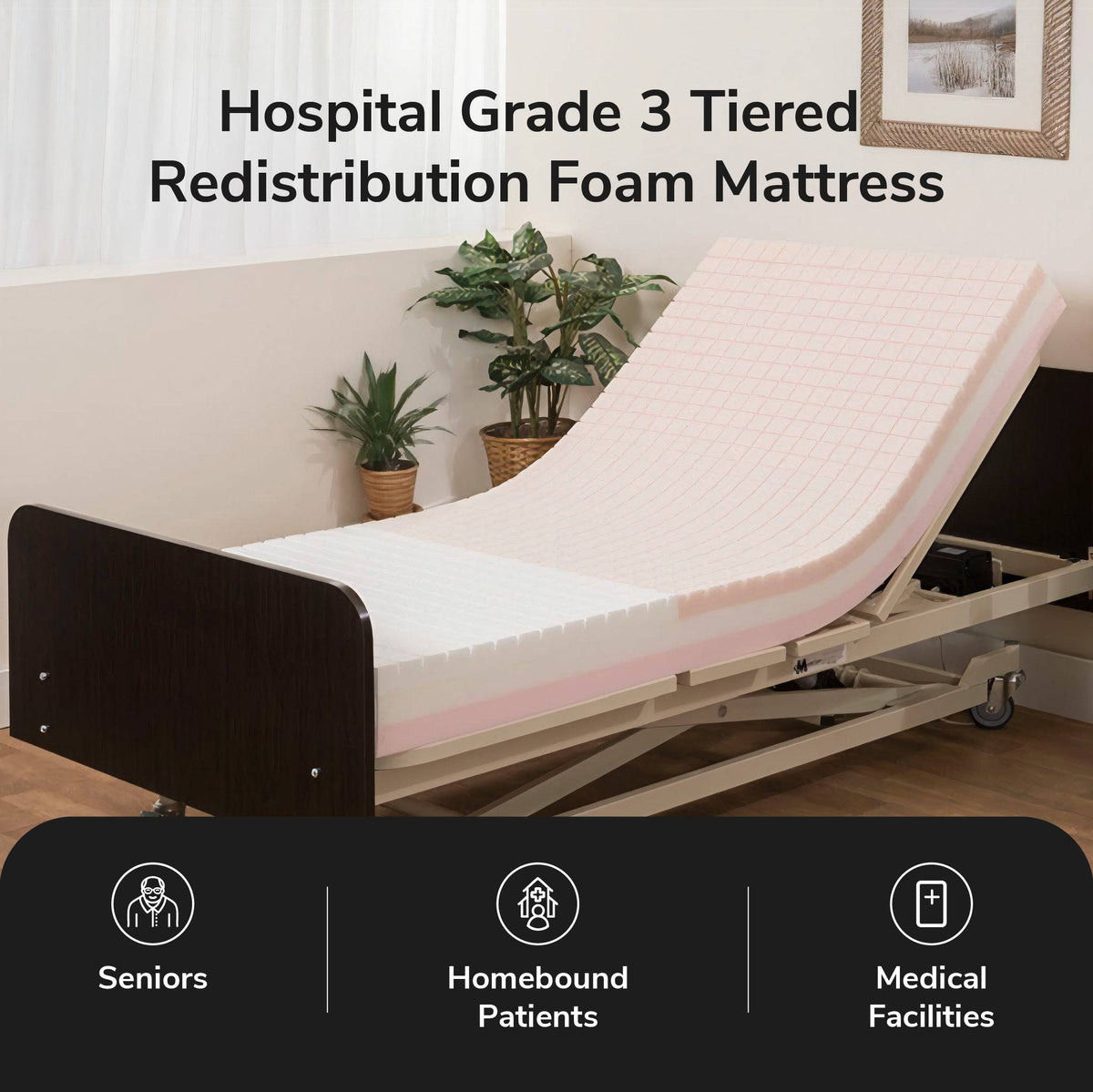
1.Medacure Proex
The Medacure Proex is a 3-tiered European high-density foam mattress with an integrated fluid resistant cover designed for long-term care. The three foam layers are structured progressively: firmest at the base, softening toward the top, with a convoluted memory foam layer and a dedicated heel slope section featuring visco-elastic memory foam.
The cover is 70 denier nylon with PVC backing. It includes a protected zipper on three sides, anti-slip base coating, elastic straps to keep the mattress secure on the frame, and anti-shear surface properties. It meets CFR 16 Part 1633 fire code. The heel slope is available with or without visco-elastic memory foam in the heel section.
Available in standard width (36") and bariatric widths (42" and 48"), as well as an 84-inch extended length for patients over 6 feet tall.
Key Specs:
-
Sizes: 36"x80", 42"x80", 48"x80", 84" length (available in 36", 42", 48" widths)
-
Thickness: 6"
-
Foam: 3-tiered laminate progressive, high-density European foam
-
Heel Slope: 1/2" with visco-elastic memory foam
-
Cover: 70 denier nylon, PVC backing, zipper 3 sides, waterproof, anti-slip base, anti-shear, flame retardant
-
Fire Rating: CFR 16 Part 1633
-
Weight Capacity: 450 lbs (36" width); 550 lbs (42" and 48" widths)
-
Treatment: Effective through Stage II
-
Warranty: 7-year limited
Choose this if you need a long-term care grade foam mattress with a durable nylon cover, heel protection, and a 7-year warranty, and want bariatric width or extra-length options.
See Price & Details
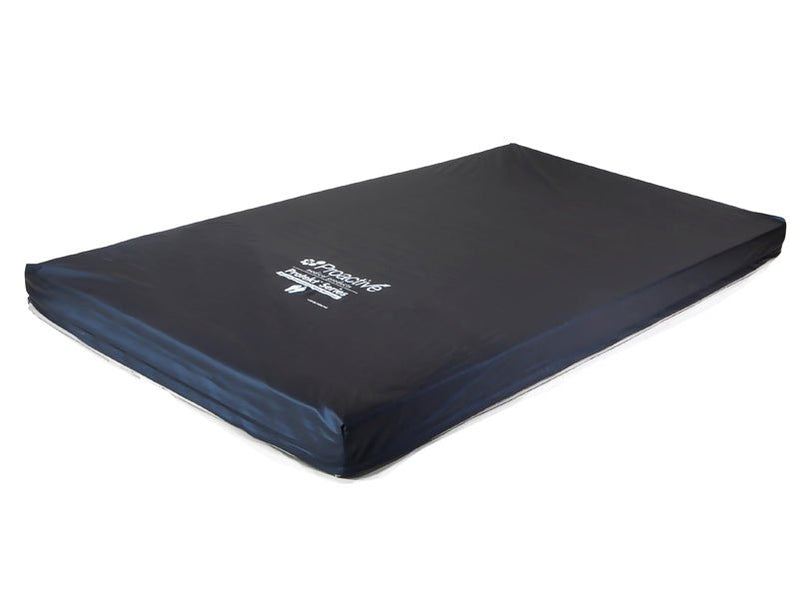
2.Proactive Medical Protekt 500
The Proactive Medical Protekt 500 is a gel-infused foam mattress using VGPT (Visco Gel Polymer Technology) to manage heat and moisture alongside pressure redistribution. The gel-infused core channels heat away from the body faster than standard foam, which directly reduces the moisture buildup that degrades skin integrity during extended bed rest.
The top cover is antimicrobial stretch nylon with a low shear and friction surface. The bottom is triple laminate vinyl with fire retardant properties. It also includes the PTSS Rail System, which provides firm edge support for transfers and seated positioning at the mattress edge.
The 30-degree heel slope redistributes pressure away from the heel across the entire leg. Optional raised rails are available for added fall prevention.
Available in five widths: 36"x76", 36"x80", 42"x80", 48"x80", and 54"x80" (Full XL).
Key Specs:
-
Sizes: 36"x76"x6", 36"x80"x6", 42"x80"x6", 48"x80"x6", 54"x80"x6"
-
Thickness: 6"
-
Foam: VGPT Visco Gel Polymer Technology
-
Heel Slope: 30-degree integrated
-
Edge System: PTSS Rail System
-
Cover: Antimicrobial stretch nylon top (low shear/friction), triple laminate vinyl bottom (fire retardant)
-
Fire Rating: CFR 16 Part 1633
-
Weight Capacity: 500 lbs (all widths)
-
Treatment: Stage I-II prevention and treatment
-
Warranty: 15-year non-prorated core; 2-year cover
-
Optional: Raised rails available
Choose this if you need a gel-foam mattress with superior heat and moisture management, a 15-year core warranty, and the widest range of size options including the 54-inch Full XL for larger patients.
See Price & Details
Frequently Asked Questions
What is a fluid resistant hospital bed mattress?
A fluid resistant hospital bed mattress is a medical mattress with a protective cover that prevents bodily fluids from penetrating the foam core. The cover can be wiped down and disinfected repeatedly without the fluid reaching the foam beneath. This is essential for anyone managing incontinence, wound drainage, or excessive perspiration during extended bed rest.
Is fluid resistant the same as waterproof?
No. The FDA distinguishes three terms: fluid resistant keeps liquid away from the material surface, waterproof fully prevents liquid from entering the material, and water repellent combines both. In practice, quality medical mattress covers rated as fluid resistant perform adequately for home care and long-term care use, but the cover's integrity must be maintained. A damaged fluid resistant cover offers no protection at the breach point.
Can a regular home mattress be used for someone who is incontinent?
No. A standard home mattress has no fluid barrier. The first incontinence event will saturate the foam permanently. The mattress cannot be disinfected and will become a source of persistent odor and bacteria. A fluid resistant hospital mattress is the correct solution for any patient managing incontinence during extended bed rest.
How do you clean a fluid resistant hospital mattress cover?
Remove surface fluid promptly, clean the entire cover with a detergent solution, apply an EPA-registered hospital disinfectant compatible with the cover material, allow the required dwell time, and let the cover dry completely before returning the patient to bed. After each cleaning, inspect the cover for tears, punctures, or staining that indicates the barrier has been compromised.
How often should a hospital mattress cover be replaced?
The CDC recommends replacing mattress covers when torn and replacing the mattress entirely if visibly stained. The FDA issued guidance that damaged covers which allow fluid penetration must not be returned to use until the cover is replaced. For home care use, inspect the cover monthly or after any incident involving large fluid exposure.
What is the difference between vinyl and nylon covers on hospital mattresses?
Vinyl covers are durable and highly fluid resistant but less breathable, which can trap heat and moisture against the patient's skin. Nylon covers with polyurethane or PVC backing offer improved breathability while maintaining fluid resistance, making them better suited for long-term users and patients at elevated pressure injury risk. The Medacure Proex uses 70 denier nylon with PVC backing. The Protekt 500 uses antimicrobial stretch nylon with a low-friction surface.
Which hospital mattress is best for incontinence?
Both the Medacure Proex and the Proactive Medical Protekt 500 include fluid resistant covers designed for incontinence management. The Proex offers a 70 denier nylon cover with zipper access on three sides for easy cover removal and cleaning. The Protekt 500 offers an antimicrobial stretch nylon cover with a low-shear, low-friction surface that reduces skin irritation for incontinent patients. Both are available in multiple widths for standard and bariatric patients.


