📋 KEY TAKEAWAYS
The Icare IC333 homecare bed offers 5 distinct adjustable positions, each designed for a specific clinical or comfort purpose, all controlled from a single backlit handpiece without calling for help.
- The IC333 positions include head lift, knee break, hi-low height adjustment, Trendelenburg, and Reverse Trendelenburg, covering the full range most homecare patients need daily.
- Head lift reaches 62º and knee break reaches 42º, both driven by independent 6,000-newton actuators for smooth, quiet adjustment.
- Hi-low adjustability runs from 9" to 26", one of the widest height ranges available in a residential-looking homecare bed.
- Trendelenburg and Reverse Trendelenburg are fully electric and included as standard, not an upgrade.
- Every IC333 is manufactured to order with a custom fabric color, with a 2-week production lead time on all orders.
- Browse the Icare Medical Group Hospital Beds collection to compare sizes and configurations.
-
Top Pick: The Icare IC333 is the benchmark for fully electric homecare positioning.
Bottom Line: If you want a homecare bed that covers every clinical position without looking like hospital equipment, the IC333 delivers all five functions from one backlit handpiece, in a frame that fits any bedroom.
IC333 Positions Overview: What This Bed Can Do
The Icare IC333 is a fully electric homecare bed with five adjustable positions: head lift to 62º, knee break to 42º, hi-low height adjustment from 9" to 26", Trendelenburg, and Reverse Trendelenburg. Every position is controlled from a single backlit wipeable handpiece, with no manual cranks and no caregiver required for routine adjustments.
The IC333 functions as a four-function electric bed with two specialized clinical positions built in as standard. Most homecare beds offer head and foot adjustment at best. The IC333 adds full height range and both Trendelenburg angles, making it one of the most complete positioning systems available outside of a hospital setting.
Each position serves a specific purpose, and understanding what each one does, and when to use it, is the difference between a bed that sits in the corner and one that actively supports recovery and daily care. The sections below cover each position individually, including the angle or range, what it does for the body, and who it is most useful for.
Position 1: Head Lift (Back Raise) Up to 62º
The head lift raises the upper section of the mattress platform, bringing the user's head, shoulders, and upper back into an elevated position. On the IC333, this reaches a maximum of 62º, which is high enough for a fully upright seated posture.
This is the position most people use daily. It supports comfortable eating and drinking without choking risk, reading, watching television, having a conversation, and taking medications that need to be swallowed upright. For users with GERD or acid reflux, keeping the head elevated after meals reduces the chance of stomach acid moving upward. For respiratory conditions, a raised head position opens the airway and reduces the effort of breathing, particularly at night.
The 62º range also means the IC333 can replicate a near-seated position without the user needing to transfer out of bed, which is especially useful for long-term care, stroke recovery, or anyone with limited trunk control.
Position 2: Knee Break Up to 42º
The knee break raises the lower section of the mattress platform beneath the knees, creating a gentle bend at the knee and hip joints. On the IC333, this reaches 42º.
The primary purpose of the knee break is to reduce lower back strain. When the legs are flat, the lower back tends to arch, which places sustained pressure on the lumbar spine. Bending the knees takes that tension off. This is why knee break is commonly used for back pain management, post-surgical recovery, and anyone who spends extended periods in bed.
The knee break also reduces the tendency to slide down the mattress during head lift, which is a common problem with flat bed surfaces at elevated angles. Used together, head lift and knee break create a stable, supported seated posture that keeps the user positioned correctly without constant readjustment. For users with circulation issues in the lower legs, the elevated knee position supports venous return and reduces swelling.
Position 3: Hi-Low Height Adjustment (9" to 26")
The hi-low function raises or lowers the entire bed frame, from a minimum of 9" off the floor to a maximum of 26". This is a full-frame height adjustment, not just a mattress angle change.
At 9", the bed is low enough for wheelchair transfers without a caregiver needing to bridge a significant height gap between the chair seat and the mattress. It also reduces the distance to the floor for fall-risk patients, limiting injury if a fall does occur. At 26", the bed is raised to a working height that allows caregivers to perform personal care, wound dressing, or repositioning tasks without bending over for extended periods, which is one of the leading causes of caregiver back injury.
The 9" to 26" range on the IC333 is one of the widest available in a homecare bed at this price point. For households managing daily caregiver tasks alongside a user who needs regular transfers, this range alone justifies the investment.
Position 4: Trendelenburg
Trendelenburg position tilts the entire bed so the head end is lower than the foot end, placing the user in a head-down incline. On the IC333, this is fully electric and controlled from the handpiece.
This position is used when venous return to the heart and brain needs support. It is commonly indicated following certain surgical procedures, for managing orthostatic hypotension, and in situations where blood pressure drops and circulation to the upper body needs assistance. In some wound care protocols, Trendelenburg is used to shift fluid and relieve pressure on specific areas of the body.
For a full breakdown of when Trendelenburg is appropriate and how to use it correctly on the IC333, see our dedicated guide to IC333 Trendelenburg and Reverse Trendelenburg positioning. This position should always be used under medical guidance, particularly for users with cardiac, respiratory, or neurological conditions.
Position 5: Reverse Trendelenburg
Reverse Trendelenburg tilts the bed in the opposite direction, raising the head end above the foot end so the user is on a head-up incline with the whole body angled rather than just the upper mattress section.
This is distinct from a standard head lift. In a head lift, only the upper mattress section rises. In Reverse Trendelenburg, the entire frame tilts, keeping the spine in a neutral alignment along the incline. This matters for certain post-surgical protocols, facial or upper body swelling reduction, aspiration prevention in tube-fed patients, and situations where a full-body angle is clinically preferable to a localized back raise.
According to NIH research on patient positioning in clinical care, correct body positioning plays a direct role in managing aspiration risk, pressure injury development, and circulatory outcomes in bedridden patients. Reverse Trendelenburg addresses several of these risks simultaneously. As with Trendelenburg, always confirm the appropriate use with the treating physician. More detail is available in our IC333 Trendelenburg and Reverse Trendelenburg guide.
How All Five Positions Work Together
The real clinical value of the IC333 is not any single position but the ability to combine and transition between all five throughout the day and night. A typical care day might involve:
-
Morning: Hi-low raised to caregiver height for personal care, then head lift for breakfast
-
Midday: Head lift and knee break combined for a supported seated posture during visits or therapy
-
Evening: Knee break alone or with mild head lift for comfortable resting without lumbar strain
-
Night: Reverse Trendelenburg for aspiration prevention, or a low head lift for respiratory support
All transitions happen from the handpiece, without assistance and without repositioning. The backlit display makes nighttime adjustments manageable without turning on a room light.
The Handpiece: One Control for All Five Positions
Every IC333 ships with a backlit wipeable handpiece on a wired stretch cord. The buttons are clearly labeled and large enough for users with limited fine motor control. The cord stretches to reach the user without strain and hooks onto the bedrail when not in use.
The handpiece controls all five positions independently. There are no separate remotes for different functions and no app required. For users who need to adjust positions frequently throughout the day, this simplicity is as important as the functions themselves.
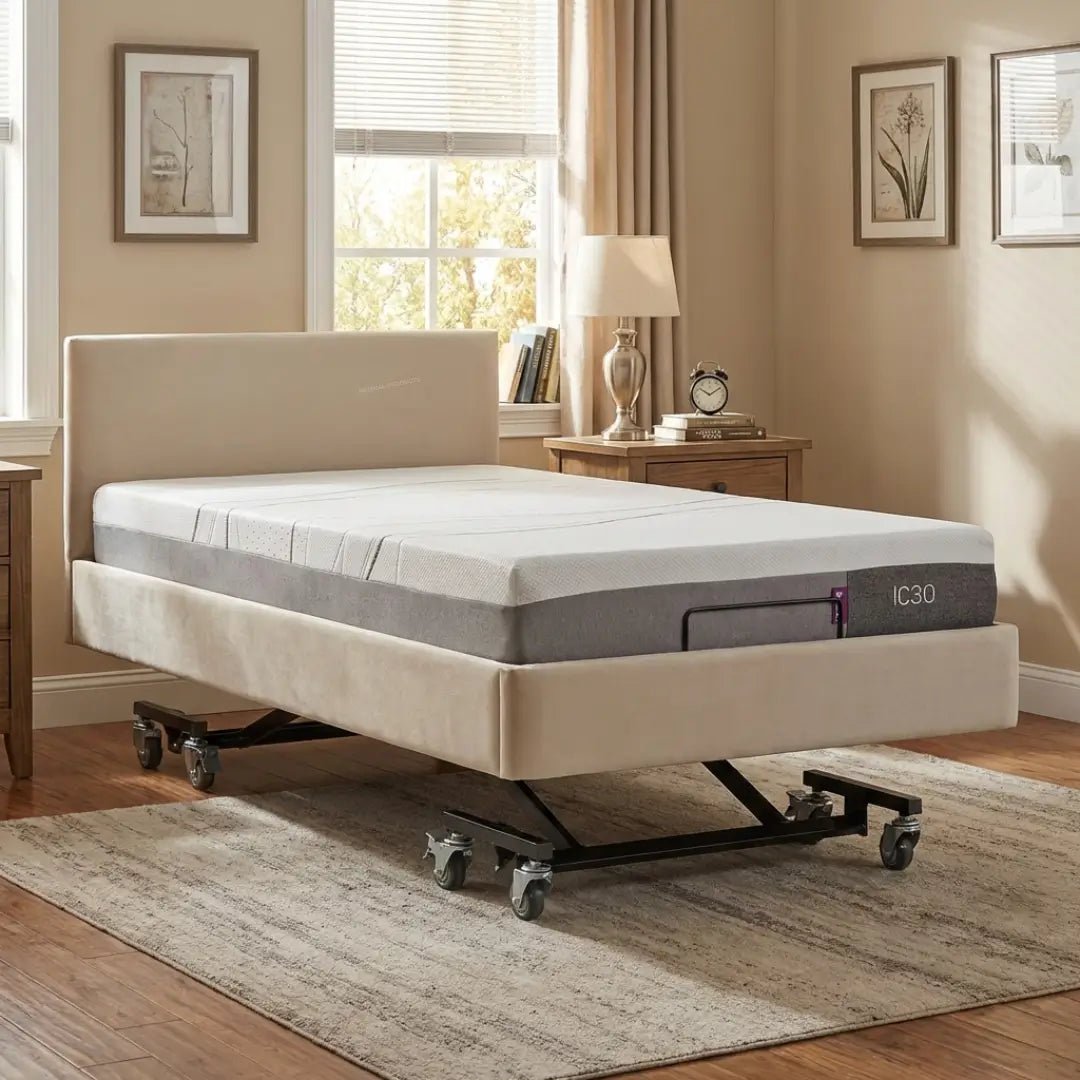
Key Specs: Icare IC333
-
Height Range: 9" to 26" (floor to top of mattress platform)
-
Head Lift Angle: 62º
-
Knee Break Angle: 42º
-
Adjustability/Functions: Head lift, knee break, hi-low height adjustment, Trendelenburg, Reverse Trendelenburg
-
Weight Capacity: 440 lbs on Twin XL sizes; 660 lbs on Full XL and Queen sizes
-
Sizes: Twin XL, Full XL, Queen, Dual King
-
Fabric Options: Six custom colors (Silver, Stone, Smoke, Onyx in fabric; Dove and Ebony in wipeable vinyl)
-
Actuators: 1x 6,000-newton head actuator; 1x 6,000-newton knee actuator; 2x 6,000-newton height actuators (2x 8,000-newton on Full XL and Queen)
-
Handpiece: Backlit, wipeable, wired stretch cord with hook attachment
-
Mattress Surface: Strong metal mesh platform for airflow
-
Underbed Clearance: Unlimited (Hoyer compatible, 7" clearance)
-
Casters: 8 heavy-duty swivel castors, lockable at each corner
-
Warranty: 10-year frame warranty, 2-year component warranty
-
Lead Time: 2-week production lead time on all orders. Every IC333 is manufactured to order with custom fabric as standard. This applies to all orders regardless of fabric selection.
-
Accessories Available: High side rails, low side rails, U-Assist rail, over-bed pole, headboard and footboard, slide-out side rail, over-bed tables, bedside folding shelf, bedside tables, blanket cradle, external rechargeable battery backup
Choose this if you are researching the IC333 and want to understand exactly what each position does before ordering. Every function listed above is standard, fully electric, and controlled from a single handpiece.
See Full Details
Frequently Asked Questions
What are the IC333 positions and functions?
The IC333 has five adjustable positions: head lift to 62º, knee break to 42º, hi-low height adjustment from 9" to 26", Trendelenburg, and Reverse Trendelenburg. All are fully electric and controlled from the backlit handpiece.
What is the head lift angle on the IC333 homecare bed?
The IC333 head lift reaches a maximum of 62º, which is high enough for a fully upright seated posture. It is driven by a dedicated 6,000-newton actuator.
What does the knee break function do?
The knee break raises the lower mattress section to 42º, bending the knees to relieve lumbar strain, prevent sliding during head lift, and support lower leg circulation.
What is the hi-low height range on the IC333?
The IC333 adjusts from 9" minimum to 26" maximum, measured from the floor to the top of the mattress platform. This range supports wheelchair transfers at the low end and caregiver access at the high end.
Is Trendelenburg standard on the IC333 or an upgrade?
It is standard. Both Trendelenburg and Reverse Trendelenburg are included on every IC333 as part of the fully electric four-function system, with no upgrade required.
How long does it take for the IC333 to ship?
Every IC333 has a 2-week production lead time because every bed is manufactured to order with custom fabric as standard. This applies to all orders regardless of fabric selection.
What sizes does the IC333 come in?
The IC333 is available in Twin XL, Full XL, Queen, and Dual King. Weight capacity is 440 lbs on Twin XL sizes and 660 lbs on Full XL and Queen sizes.


