📋 KEY TAKEAWAYS
Getting hospital bed height right is one of the most overlooked factors in home care safety. Set too high or too low, a bed creates fall risk at every transition. Set correctly, it protects the patient, protects the caregiver, and makes every transfer more manageable.
- The ideal transfer height puts feet flat on the floor with knees at roughly 90 degrees. That angle gives the patient a stable base to push up from and reduces the chance of losing balance during the sit-to-stand movement.
- Bed height is not one setting. It should change based on whether the patient is sleeping, standing, receiving caregiver care, or transferring to a wheelchair.
- A fixed-height bed can never be optimized for all four situations. A hi-low hospital bed can.
- Common mistakes like setting the bed too high, too low, or forgetting to lower it back after care put patients at risk for the very falls caregivers are trying to prevent.
- Browse our full range of hi-low hospital beds to find the right fit.
Top Picks:
Bottom Line: A bed set at the wrong height is not a neutral choice. It is an active risk. Hi-low adjustment turns bed height from a fixed problem into a manageable variable.
Falls are the leading cause of injury among older adults, and the bed is where many of them happen. Not because someone tripped on a rug or misjudged a step, but because the surface they were sitting on or standing up from was simply at the wrong height. Hospital bed height is a clinical variable that directly affects transfer safety, caregiver strain, and fall injury severity. Getting it right matters more than most people realize.
Why Bed Height Matters
Every transfer into or out of bed involves a moment where balance, strength, and leverage must align. That moment is the sit-to-stand movement: pushing from a seated position at the edge of the mattress up to a fully standing position. If the bed is too high, the patient's feet dangle before they can reach the floor, removing the stable base they need. If the bed is too low, standing requires deep knee and hip flexion that many patients cannot manage safely.
Research published through the British Geriatrics Society studied bed-related falls in long-term care residents and found that individualized bed height assessment, based on keeping the patient's hip and knee angle just above 90 degrees with feet flat on the floor, directly reduced fall incidents. The key finding was that a single universal bed height policy does not work. Height must be matched to the individual.
Bed height also affects caregiver safety. When a caregiver bends over a low bed to provide care, dress a wound, or reposition a patient, the mechanical load on their spine increases significantly. Raising the bed to elbow height for care tasks reduces that load and helps prevent the caregiver injuries that lead to burnout and unsustainable home care situations.
If you are supporting a loved one through transfers or daily care routines, our guide on how to prevent patient falls covers a broader set of strategies that work alongside proper bed height.
What Is the Ideal Transfer Height?
The ideal safe transfer height is the point where the patient can sit at the edge of the mattress with:
Feet Flat on the Floor
When sitting at the edge of the bed, the patient's feet should rest flat on the floor without straining to reach down or being pushed up on tiptoe. Dangling feet eliminate the stable base needed for a safe sit-to-stand movement. Without floor contact, the patient must rely entirely on upper body and core strength to stand, which most fall-risk patients do not have reliably.
Knees at Around 90 Degrees
With feet flat and body seated at the mattress edge, the knee joint should be at roughly a right angle, with the thigh parallel to the floor. This position loads the quadriceps and glutes in the most mechanically efficient way for standing. When the bed is too low, the knee bends sharply past 90 degrees, making it difficult for patients with arthritis, joint replacements, or muscle weakness to generate enough force to rise. A biomechanical study published in ScienceDirect examining optimal bed height for ingress and egress confirmed that height directly affects the forces and balance demands placed on patients during transfers.
Bed Slightly Higher Than the Wheelchair
For wheelchair users, the bed height for transfer should be set just slightly above the wheelchair seat height. This creates a gentle downhill angle from the bed to the chair, making lateral transfers easier and reducing the muscular effort required. Matching the bed exactly to the chair height or setting it lower creates an uphill transfer that significantly increases fall risk. Wheelchair seat height including the cushion is typically between 18 and 23 inches, so the target bed height for wheelchair transfers is generally in that same range, slightly above.
Different Heights for Different Tasks
One of the most important principles of hospital bed fall prevention is that no single height is right for every situation. The same bed needs to serve multiple functions throughout the day, and the correct height for each function is different.
Sleeping Height
During sleep, the goal is to lower the bed as close to the floor as possible. A patient who rolls out of bed or attempts to get up disoriented during the night will fall a shorter distance from a low bed, and any fall from very low height is far less likely to cause a serious injury. Ultra-low beds that reach 3.9 inches from the floor provide near-floor-level protection for high-risk patients. This is especially important for patients with dementia, confusion, or a history of nighttime wandering.
Standing Transfer Height
For any transfer that involves standing, the bed should be raised to the individual's optimal transfer height: feet flat, knees at 90 degrees, a stable push-up position. This is typically measured against the patient's popliteal height, the distance from the floor to the back of the knee while seated. Getting this measurement right and recording it means every caregiver knows exactly where to set the bed before each standing transfer.
Caregiver Care Height
When the caregiver is performing wound care, bathing, repositioning, or any task that requires bending over or working at the bedside, the bed should be raised to the caregiver's elbow height. With the caregiver standing upright and elbows bent at 90 degrees, the distance from the floor to the forearm is the target mattress height. For most caregivers this is between 30 and 36 inches. Working at this height keeps the spine in a neutral position and prevents the cumulative back strain that leads to injury over time.
Wheelchair Transfer Height
As described above, the bed should be set just above the wheelchair seat height for lateral transfers. The patient slides or pivots from the higher surface to the lower one, which requires less effort and maintains better control throughout the movement. Confirm the transfer height with the specific wheelchair and cushion combination in use, since seat height varies.
Common Bed Height Mistakes That Increase Fall Risk
Understanding what not to do is as important as knowing the right target heights.
Bed Too Low for Transfers
Setting the bed very low and leaving it there throughout the day is a well-intentioned but counterproductive approach. While a low bed reduces fall injury severity during a nighttime roll-out, it makes every intentional transfer more dangerous. A patient trying to stand from an extremely low surface must generate significantly more force through compromised joints to rise. Falls during that effort, or from giving up partway through, are common. Low bed position during sleep is protective. Low bed position during transfer is a hazard.
Bed Too High for the Patient
A bed set too high for the patient's leg length leaves feet dangling when they sit at the edge. Without floor contact, the patient loses the stable base needed for standing and must instead slide or lurch forward to reach the ground, which commonly results in a fall. Any patient whose feet do not comfortably reach the floor when seated at the mattress edge is using a bed that is too high for them.
Lowering Only One Side of the Bed
Some caregivers lower the head section or raise the foot section thinking this reduces fall risk, while leaving the overall frame height unchanged. Adjusting head and foot elevation changes sleeping or comfort positioning. It does not change how far the patient falls if they exit the bed, and it does not bring the mattress to a safe transfer height. Full frame hi-low adjustment is what affects fall safety. Head and foot articulation serve a different purpose entirely.
Forgetting to Adjust After Caregiver Care
One of the most common and preventable errors in home care is raising the bed for a task and forgetting to lower it before leaving the room. A patient who wakes from sleep, or attempts a transfer during a moment when the caregiver steps out, will face a bed at caregiver care height rather than sleep or transfer height. Falls from elevated bed heights are among the most serious. Every care task adjustment should end with returning the bed to the appropriate safe position before leaving the patient.
Assuming One Height Fits All Patients
Universal bed height policies, whether a facility default or a caregiver habit, consistently produce mismatches. A patient who is 5'0" and a patient who is 6'2" have dramatically different popliteal heights and require different transfer heights. The British Geriatrics Society research emphasized that individualized assessment is essential, and that posting the correct height at the bedside ensures consistency across all caregivers on a shift.
A fixed-height bed can only be at one height. It cannot be optimized for sleep, transfers, caregiver tasks, and wheelchair access simultaneously. Pillows under the mattress, bed risers, and manual adjustments are workarounds that introduce their own stability and safety risks.
A hi-low hospital bed solves this with electric height adjustment through a hand control. The caregiver or patient presses a button to raise the bed for standing transfers, lowers it for sleep, raises it again for wound care, and returns it to sleep height when the task is done. This takes seconds and removes the friction that causes caregivers to skip adjustments, which is the behavior that leads to preventable falls.
2 Beds That Put Safety at the Right Height

1.Medacure ULB 3.9
The Medacure ULB 3.9 is the lowest hi-low hospital bed available, reaching 3.9 inches from the floor at its minimum position. At that height, a nighttime fall is the functional equivalent of rolling off a floor mat. For patients with dementia, nighttime wandering, or a high fall-injury risk, this is the defining feature. It raises to 25 inches for transfers and caregiver care, covering the full functional range most home care situations require.
It comes with a split frame design that folds for transport through doorways and into tight spaces, which matters for home care setups where a standard bed delivery is not feasible. Patient assist bars are included. Rails are sold separately and must be evaluated for entrapment risk before use.
Key Specs:
-
Height Range: 3.9" to 25"
-
Functions: 10-function electric: hi/lo, head, foot, Trendelenburg, Reverse Trendelenburg, auto contour
-
Weight Capacity: 450 lbs
-
Sizes: 36" x 80" (42" bariatric option available separately)
-
Casters: 4 x 3" locking
-
Included: Patient assist bars, mattress retainers
-
Rails: Sold separately
-
Actuators: LINAK
Choose this if the patient is at high risk of nighttime falls, has dementia or confusion, or needs the absolute lowest sleeping surface available for safety.
See Price & Details
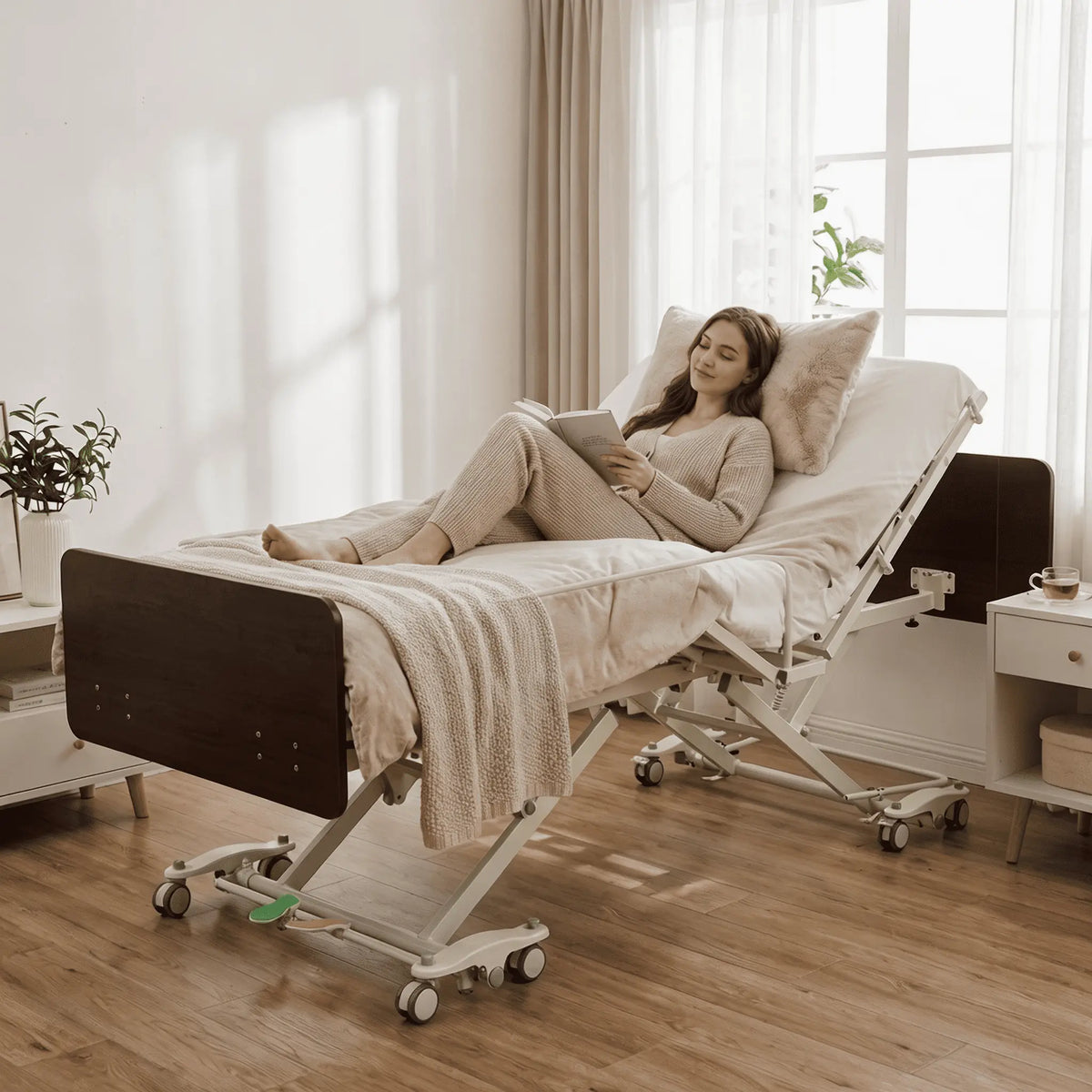
2.Emerald Oasis 52300
The Emerald Oasis 52300 offers a 7"–30" height range, which covers ultra-low sleep positioning through full caregiver-working height and beyond. The 30" maximum is notably higher than many home care beds, which makes it a strong choice for taller caregivers or patients who need a higher standing transfer position.
The integrated width expansion from 36" to 48" and length expansion from 80" to 88" means the sleep surface can be adapted to the patient's body size without needing a different bed frame. Rails are included free, with an upgrade option. Headboard and footboard are also included. Emerald Supply takes 48 hours to process orders.
Key Specs:
-
Height Range: 7" to 30"
-
Functions: 8-function hand control, auto contour, central locking system, bumper guard, heel lift extension
-
Weight Capacity: 550 lbs
-
Deck Width Range: Integrated 36", 42", 48"
-
Deck Length Range: Integrated 80", 84", 88"
-
Included: Headboard, footboard, free rails (upgrade option available)
-
Processing Time: 48 hours (Emerald Supply)
-
Smart Features: Central locking system, bumper guard, mobility at any height
Choose this if the care situation requires a wide height range, an expandable sleep surface for a larger patient, or a bed that comes equipped with rails and headboard as part of the package.
See Price & Details
Frequently Asked Questions
What is the ideal hospital bed height for transfers?
The ideal transfer height puts the patient's feet flat on the floor with knees at approximately 90 degrees when sitting at the edge of the mattress. This is typically matched to the patient's popliteal height, the distance from the floor to the back of the knee while seated. For wheelchair transfers, the bed should be set just slightly above the wheelchair seat height to create a gentle downhill slide toward the chair.
Should a hospital bed be low or high for fall prevention?
Both, depending on the situation. The bed should be as low as possible during sleep to minimize injury if the patient rolls out or attempts to get up unsupported. It should be raised to the patient's optimal transfer height during any intentional standing or transfer activity. A hi-low hospital bed handles both requirements with one piece of equipment.
What is the safest bed height for elderly patients?
There is no single number because safest height depends on the individual's leg length, mobility, and care needs. The British Geriatrics Society research recommends matching height to a position where the hip and knee angle is just above 90 degrees with feet flat on the floor. This should be assessed individually and recorded at the bedside so all caregivers use the same setting.
Why does caregiver back pain happen during bed care?
Most caregiver back injuries during bed care result from working at a bed that is too low. Bending over a low bed to perform wound care, repositioning, or bathing loads the lower spine in a position it cannot sustain repeatedly. Raising the bed to the caregiver's elbow height keeps the spine neutral and dramatically reduces injury risk.
What is a hi-low hospital bed?
A hi-low hospital bed is an electric bed whose entire frame raises and lowers through a hand control. This allows one bed to serve as an ultra-low sleep surface, an optimal transfer height, and a caregiver working height, simply by pressing a button. Hi-low adjustment is the most important feature for patients and caregivers who need to change bed height throughout the day for different tasks.
Can bed height alone prevent falls?
Bed height is one important factor, not the only one. Fall prevention also involves rail assessment, transfer technique, patient footwear, lighting, room layout, medication review, and caregiver training. For a more complete overview of fall prevention strategies in home care, see our guide on how to prevent patient falls.


