📋 KEY TAKEAWAYS
- Trying to figure out if your loved one needs a homecare hospital bed or something more like a regular bed that adjusts? You're not alone. Most families land on this question after a hospital discharge, a new diagnosis, or a caregiver saying "you might want to look into a different bed."
- A homecare hospital bed is built around medical positioning and caregiver access first, appearance second.
- A Flexabed is a residential adjustable bed built around comfort and home aesthetics first, with some of the positioning benefits of a hospital bed layered in.
- Neither is universally "better." The right pick depends on what the bed needs to do for the person sleeping in it and the person caring for them.
-
Recommended picks:
-
Flexabed Hi-Low — the only Flexabed model with full motorized height adjustment for easier transfers
-
Flexabed Premier — the most customizable option, built for long-term comfort and evolving needs
-
Flexabed Value-Flex — essential head and foot positioning at the most accessible price
Bottom Line: If safe transfers and full-range height adjustment are your main concern, lean toward a homecare hospital bed or the Flexabed Hi-Low. If comfort and a bedroom-appropriate look matter most, the Premier or Value-Flex is likely the better fi
Homecare Hospital Bed vs Adjustable Bed: The Key Difference
The core difference comes down to what each bed was designed to solve. A homecare hospital bed is engineered around clinical needs: precise positioning, caregiver access from either side, and features that support transfers, wound care, or recovery. It's built to function like the beds used in hospitals and skilled nursing facilities, just sized and finished for a home setting.
A Flexabed is a residential adjustable bed. It's designed to look and feel like regular bedroom furniture first, with adjustability layered on for comfort, reading, circulation, and in some cases transfer support. It uses a home mattress rather than a standard hospital mattress, and it's meant to blend into a bedroom rather than announce itself as medical equipment.
Neither approach is inherently more capable. They're built for different priorities, and the right one depends on what matters most in your specific situation.
Homecare Hospital Bed vs Flexabed Adjustable Bed: Side-by-Side Comparison
This homecare hospital bed vs adjustable bed comparison focuses on the factors that actually affect daily use and caregiving. Homecare hospital bed figures below reflect common features across the category. The Flexabed column reflects the three models in this article, and the Recommended picks link above will take you to full specs for each.
| Factor |
Homecare Hospital Bed |
Flexabed Adjustable Bed |
| Height adjustment |
Motorized, full-frame height adjustment is a standard feature of the category |
Only the Hi-Low adjusts the full base height (11" to 18.5", or 13.25" to 20.75" with casters). Premier and Value-Flex use fixed heights with optional 2" to 7" leg extensions |
| Head/foot positioning |
Standard on most models, often paired with additional articulation options |
Yes on all three models. Hi-Low and Premier raise the head to about 70 degrees and the foot to about 40 degrees. Value-Flex offers independent head and foot control via wired remote |
| Trendelenburg/Reverse Trendelenburg |
Available on many clinical models |
Not listed on any Flexabed model in the current lineup |
| Side rails |
Commonly available, often required for certain care levels |
Optional on all three models (not compatible with Split Queen configurations) |
| Mattress compatibility |
Standard hospital bed mattress sizes and specialty pressure-relief options |
Proprietary Flexabed mattresses only: innerspring, low profile, gel memory foam, innerspring/memory foam combo (Value-Flex adds latex) |
| Weight capacity |
Varies widely by model, often with bariatric options available |
Hi-Low: 400 lbs single/700 lbs split occupant. Premier and Value-Flex: 300 lbs standard, 400 lbs with the Heavy Duty Reinforcement upgrade |
| Caregiver accessibility |
Designed around caregiver access from both sides at multiple heights |
Hi-Low supports caregiver-height transfers through full base adjustment. Premier and Value-Flex rely on head/foot articulation and leg extensions rather than full-range height access |
| Getting in/out of bed |
Height range is typically built for safe seated transfers |
Depends on model. Hi-Low can lower close to floor level. Premier and Value-Flex sit at a more fixed height, adjustable within a smaller range using leg extensions |
| Appearance |
Institutional or clinical look is common, even in home-styled versions |
Designed to resemble residential bedroom furniture and attach to existing headboards |
| Mobility |
Locking casters are common for stability during care |
Locking casters standard on all three models |
| Medical vs. residential use |
Positioned as medical equipment |
Positioned as a residential adjustable bed, described by the manufacturer as an alternative to a hospital bed for home use |
Choose a Homecare Hospital Bed If You...
- Need precise positioning beyond what head/foot articulation alone provides, such as full-range height adjustment for multiple caregivers of different heights
- Require compatibility with specialty pressure-relief mattresses sized for hospital bed frames
- Are managing a condition where a clinician has specifically recommended hospital bed features
- Need side rails and accessories that meet clinical care standards
- Are working with a caregiver team that needs the bed to lower close to floor level for safe transfers
Choose a Flexabed If You...
- Want adjustability and comfort without the institutional look of medical equipment
- Are furnishing a bedroom where appearance matters as much as function
- Need head and foot positioning for reading, circulation, or general comfort rather than a specific clinical protocol
- Want a bed that can attach to an existing headboard and use a standard-style home mattress
- Are budget-conscious and want essential adjustability with a lifetime warranty, without paying for features you won't use
Positioning Needs vs Comfort: Which Matters More to Your Situation
Some people need a bed primarily for positioning and caregiver support. If getting a family member safely in and out of bed is the main daily challenge, features like full-range height adjustment matter more than mattress feel or bedroom aesthetics. That's where a homecare hospital bed, or the Flexabed Hi-Low with its full motorized base, tends to fit better.
Other people are primarily looking for adjustability and comfort. Head elevation for reading or breathing comfort, foot elevation for circulation, and a bed that still looks like a bed in the room are the priority. Elevating the head of the bed is a commonly recommended non-drug approach for nighttime reflux symptoms, according to MedlinePlus, which is one reason adjustable positioning appeals to people managing everyday comfort issues rather than acute medical needs.
This isn't a medical recommendation for any specific condition. If a doctor or care team has prescribed particular bed features for a diagnosed condition, follow that guidance directly rather than choosing based on general comfort preferences.
The 3 Featured Beds
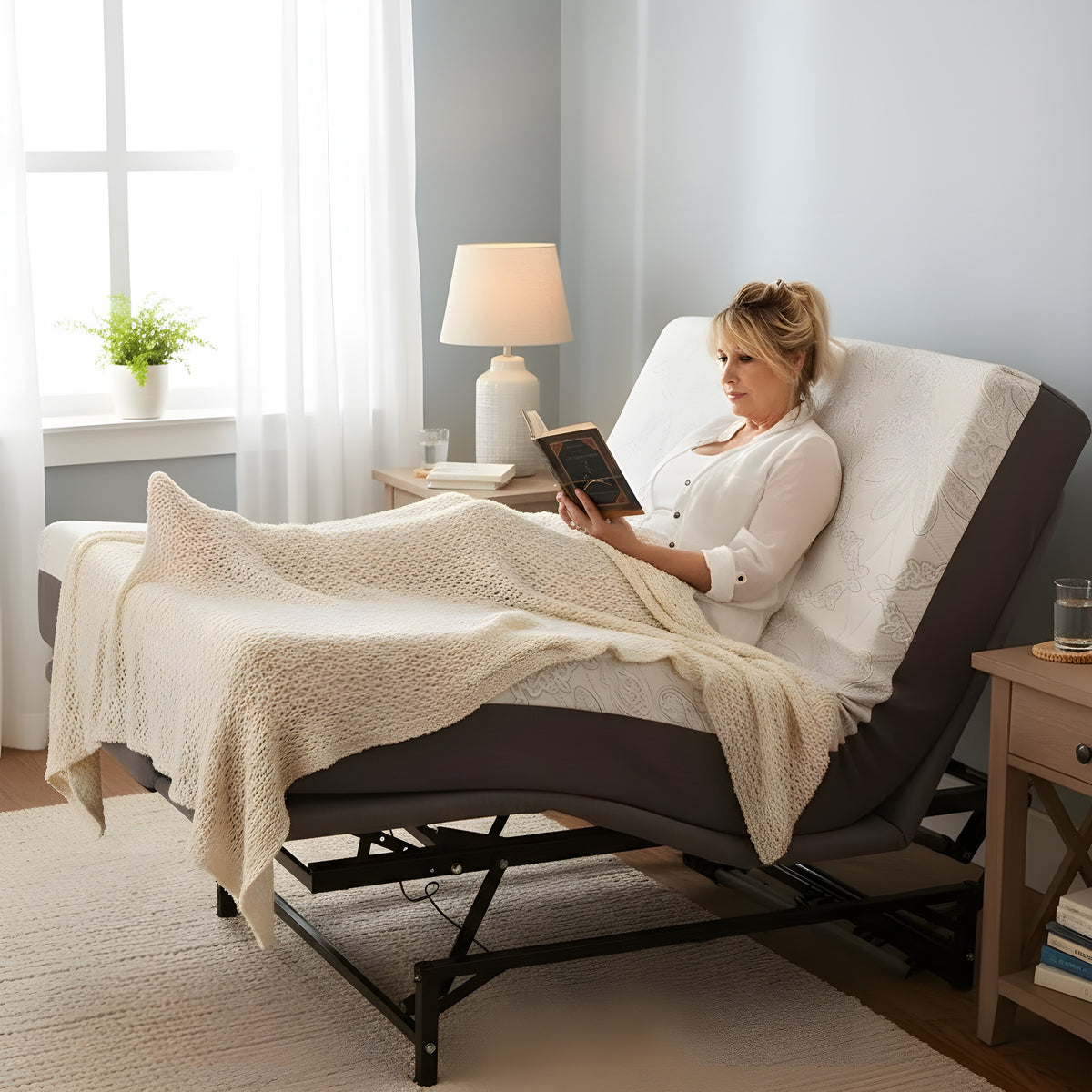
1.Flexabed Hi-Low: The Only Flexabed With Full Motorized Height Adjustment
The Hi-Low is the model built to close the gap between a homecare hospital bed and a residential adjustable bed. It's the only Flexabed in the lineup with full base height adjustment, moving from close to floor level up to caregiver height. That makes transfers safer for both the patient and whoever is helping them, without sacrificing the look of home furniture.
Key Specs:
-
Height Range: 11" to 18.5" without casters (fully lowered with leg pads to fully raised); 13.25" to 20.75" with casters
-
Adjustability/Functions: Full motorized hi-low base adjustment; head raises to about 70 degrees, foot to about 40 degrees
-
Weight Capacity: 400 lbs single occupant, 700 lbs split occupant (no single person over 400 lbs)
-
Sizes: Twin, Full, Queen, Split King; length options of 74", 80", and 84"
-
Mattress Options: Traditional innerspring (soft, medium, firm), low profile, gel memory foam, innerspring/memory foam combo
-
Smart Features: Optional underbed lighting, massage, voice activation, wireless phone/USB charging, Bluetooth connectivity (wireless remote required)
-
Warranty: Lifetime limited warranty on frame and mechanics
-
Trendelenburg/Reverse Trendelenburg: Not listed
GET THIS IF you need the full bed to raise and lower for safer, easier transfers, but you also want a real home mattress and furniture-style appearance instead of a clinical-looking bed.
See Price & Details

2.Flexabed Premier: The Fully Customizable Flexabed for Home Comfort
The Premier is built for people who want maximum control over sizing, mattress feel, and features, and who don't need the entire base to raise and lower. It uses independent head and foot articulation instead, paired with leg extensions for height flexibility.
Key Specs:
-
Height Range: Base only, 11" with pads and 13.25" with casters, up to base with gel mattress, 21" with pads and 23.25" with casters; leg extensions add 2" to 7"
-
Adjustability/Functions: Independent head and foot adjustability, head to about 70 degrees and foot to about 40 degrees. No full motorized base height adjustment (Flexabed recommends the Hi-Low for that function)
-
Weight Capacity: 300 lbs standard; 400 lbs with the Heavy Duty Reinforcement upgrade
-
Sizes: Twin, Full, Queen, Split Queen, King, Split King; length options of 74", 80", and 84"
-
Mattress Options: Traditional innerspring, low profile, gel memory foam, innerspring/memory foam combo
-
Smart Features: Optional massage, voice activation, underbed lighting, Bluetooth connectivity with SmartBed app, bed alarms (wireless remote required)
-
Warranty: Lifetime limited warranty on frame and mechanics
-
Trendelenburg/Reverse Trendelenburg: Not listed
GET THIS IF you want a highly customizable adjustable bed for long-term comfort, with head and foot positioning and smart features, and you don't need the entire bed to move up and down for transfers.
See Price & Details
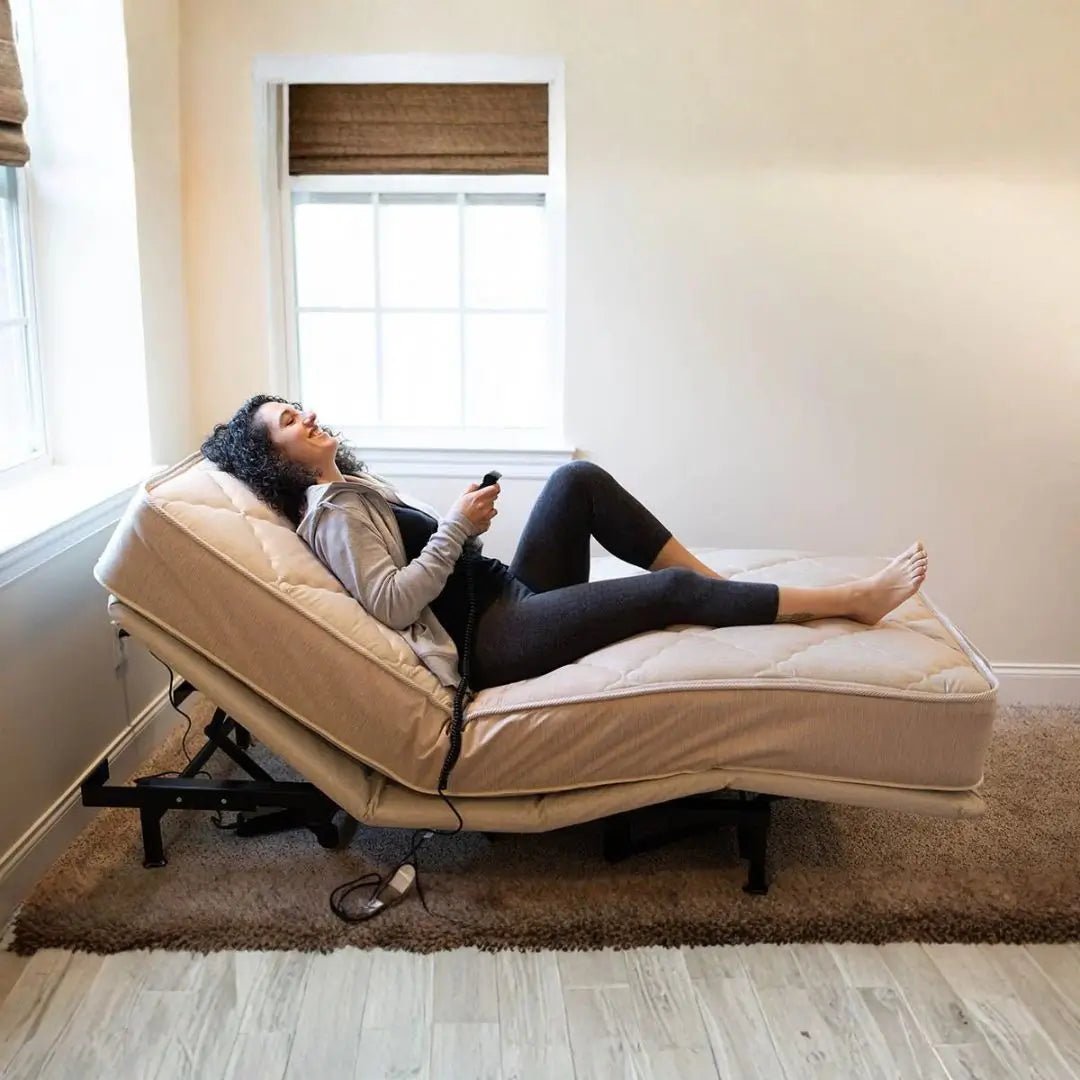
3.Flexabed Value-Flex: The Budget-Friendly Flexabed With Essential Positioning
The Value-Flex strips things down to core functionality. It's built for families who want dependable head and foot positioning and a lifetime warranty without paying for premium smart features they won't use.
Key Specs:
-
Height Range: Standard height of 22" (21" without casters); leg extensions add 2" to 7"
-
Adjustability/Functions: Independent head and foot positioning via one-touch wired remote. No full motorized base height adjustment
-
Weight Capacity: 300 lbs standard; 400 lbs with the Heavy Duty Reinforcement upgrade
-
Sizes: Twin, Full, Queen, Split Queen, Split King; length options of 74", 80", and 84"
-
Mattress Options: Innerspring, visco memory foam, gel-infused, latex; firmness in soft, medium, or firm
-
Smart Features: Not listed. Optional accessories include side rails, reinforced frame, and battery backup
-
Warranty: Lifetime limited warranty on frame and mechanics
-
Trendelenburg/Reverse Trendelenburg: Not listed
GET THIS IF you need reliable head and foot positioning at the most accessible price point, with a lifetime warranty, and don't need wireless smart features or full base height adjustment.
For a closer look at how these three models stack up against each other in more detail, see our Flexabed reviews.
See Price & Details
Homecare Hospital Bed vs Adjustable Bed: Making the Right Call
There's no single right answer to the homecare hospital bed vs adjustable bed question. It comes down to what the bed needs to accomplish. If caregiver transfers, full-range height adjustment, or clinician-recommended features are the priority, a homecare hospital bed is the better fit. If comfort, positioning for everyday relief, and a bedroom-appropriate appearance matter most, a Flexabed adjustable bed is worth a closer look, with the Hi-Low as the model that bridges both worlds most directly.
Frequently Asked Questions
Do I need a homecare hospital bed or an adjustable bed like a Flexabed?
It depends on your priorities. Choose a homecare hospital bed if you need full-range height adjustment, clinical positioning, or specialty mattress compatibility. Choose a Flexabed if you want comfort-focused adjustability with a residential appearance, and consider the Flexabed Hi-Low specifically if you also need the bed to raise and lower for transfers.
Is a Flexabed the same as a hospital bed?
No. A Flexabed is a residential adjustable bed designed to look and function like bedroom furniture. It offers head and foot positioning, and the Hi-Low model adds full base height adjustment, but it is not marketed or built as clinical medical equipment.
Can a Flexabed replace a hospital bed for home care?
For some people, yes. It depends on what positioning and access the person needs. If the main requirement is head and foot articulation with a comfortable, home-style setup, a Flexabed can work well. If a clinician has recommended specific hospital bed features, follow that guidance directly.
Which Flexabed model is closest to a hospital bed in function?
The Flexabed Hi-Low, since it's the only model with full motorized base height adjustment from near floor level to caregiver height, in addition to head and foot articulation.
Do Flexabeds have Trendelenburg positioning?
No. None of the current Flexabed models, including the Hi-Low, Premier, and Value-Flex, list Trendelenburg or reverse Trendelenburg positioning.


