📋 KEY TAKEAWAYS
Most hospital beds use a 36" x 80" mattress, but bariatric and extended-length beds require specialized sizes. Always measure your bed frame before ordering a replacement mattress.
- The standard hospital bed mattress is 36 inches wide by 80 inches long, the size that fits most home hospital beds, nursing facility beds, and clinical beds.
- Bariatric beds require wider mattresses: 42", 48", 54", or 60" wide depending on the patient's size and weight.
- Tall patients over 6 feet benefit from an 84-inch length option, which eliminates foot-hanging and the heel pressure ulcers that come with it.
- Mattress thickness matters: 6-inch mattresses are standard for most hospital beds and keep transfers and side rails functioning correctly. Thicker mattresses can interfere with both.
- A regular twin mattress (38" x 75") does not fit a hospital bed (36" x 80"), the dimensions are different in both width and length.
- Browse the Hospital Bed Mattress collection and the Bariatric Mattress collection to find the right fit.
Top Picks:
Bottom Line: Hospital bed mattress sizing is not the same as residential bedding. Getting the right size protects the patient, keeps rails and transfers safe, and ensures the mattress performs as designed.
Hospital Bed Mattress Sizes at a Glance
Before reading further, here is the quick reference most people are looking for:
| Bed Type |
Mattress Size |
| Standard Hospital Bed |
36" x 80" |
| Extended Length |
36" x 84" |
| Bariatric |
42", 48", 54" x 80" |
| Pediatric |
Varies |
Most hospital beds use a 36" x 80" mattress, but bariatric and extended-length beds require specialized sizes. Always measure your bed frame before ordering.
Common Hospital Bed Mattress Sizes Explained
Standard Hospital Bed Dimensions
The standard hospital bed mattress measures 36 inches wide by 80 inches long. This is the configuration used in the vast majority of home hospital beds, long-term care facilities, and clinical settings. If you are replacing a mattress on a hospital bed without specific information about the frame, this is almost certainly the size you need.
The 36-inch width is narrower than a standard residential twin mattress (which is 38 inches wide) and longer (80 inches versus the typical 75-inch twin). This matters because a regular twin mattress will not fit correctly, it will be too wide by 2 inches and too short by 5 inches. Those gaps are not cosmetic issues. A mattress that overhangs the frame creates entrapment risk. A mattress that falls short of the frame leaves the patient's feet unsupported.
Extended Length: 36" x 84"
The 84-inch length option was designed for patients over 6 feet tall. On a standard 80-inch mattress, a 6'2" patient's feet extend past the mattress surface, a condition that causes sustained heel pressure within days of bed rest, which is one of the fastest pathways to Stage 3 and 4 heel ulcers.
The extra 4 inches of length eliminates this problem entirely. Both the Medacure Proex and the Protekt 500 are available in 84-inch length for this reason.
Bariatric Mattress Sizes
Bariatric mattress widths exist on a spectrum that matches different patient sizes and weight capacities:
-
42" x 80", appropriate for patients who need additional surface area and feel confined on a 36-inch mattress. The Medacure Proex 42" and Protekt 500 42" both support 500 lbs and 550 lbs respectively.
-
48" x 80", for larger bariatric patients where 42 inches is insufficient. Both the Proex 48" (550 lbs) and Protekt 500 48" (500 lbs) cover this width.
-
54" x 80", matches the width of a residential Full/Full XL mattress. The Protekt 500 is available at this size with a 500 lb capacity and 15-year core warranty.
-
60" x 80", the widest bariatric mattress available. The Protekt 600 at this size supports up to 1,000 lbs for patients requiring maximum surface area.
Can You Use a Regular Twin Mattress on a Hospital Bed?
No. A standard twin mattress is 38 inches wide and typically 75 inches long. A hospital bed mattress is 36 inches wide and 80 inches long. The width difference means the twin mattress overhangs the frame on each side, creating a gap that can trap limbs or shift during patient repositioning. The length difference means the foot of the bed is unsupported.
For patients who want a hospital bed but prefer a full-size or queen sleeping surface, adjustable hospital beds like those in our Hospital Beds for Sale collection are available in Full, Queen, and Dual King configurations with compatible mattresses, but the frame and mattress must be matched, not mixed with residential bedding.
How to Measure for a Hospital Bed Mattress
3 Measurements You Need Before Ordering
Getting the right replacement mattress requires three numbers: length, width, and thickness. All three must match the bed frame to avoid safety gaps, rail interference, and pressure redistribution failures.
-
Length, Measure the interior of the bed frame from head to foot. Most hospital beds are 80 inches internally. If you have a taller patient or a longer frame, confirm whether you need the 84-inch option.
-
Width, Measure the interior width of the frame. For standard beds, this will be 36 inches. For bariatric frames, measure carefully, 42, 48, and 54-inch widths all exist and are not interchangeable.
-
Thickness, Most hospital bed frames are engineered for a 6-inch mattress. Measure the clearance between the top of the frame platform and the bottom of the side rail when locked in the down position. This tells you the maximum mattress height that will not compromise rail effectiveness.
Understanding Bed Frame Compatibility
Hospital bed frames use specific deck configurations, spring decks, pan decks, or solid platforms, that affect how a mattress sits and flexes. Mattresses sold specifically for hospital beds, like the Medacure Proex and Protekt 500, are designed to flex with articulating bed sections (head elevation, knee break) without buckling or creating pressure points at the joints.
A residential foam mattress placed on a hospital bed frame will resist articulation and create localized pressure at the bending points, the opposite of what a therapeutic mattress is designed to do.
If you are unsure which mattress is compatible with your specific hospital bed frame, contact MedShopDirect at 833-499-4450. We match mattresses to bed frames regularly and can confirm compatibility before you order.
Hospital Mattress Thickness: What You Need to Know
4 Reasons Thickness Matters Beyond Comfort
Mattress thickness in a hospital bed is not just a comfort consideration. It directly affects four clinical and safety outcomes:
-
Side rail effectiveness. Hospital bed side rails are engineered to a specific height above the mattress surface. A mattress that is too thick raises the patient closer to the rail top, reducing the protective height the rail provides and increasing the risk of rolling over or through the rail. Standard 6-inch mattresses maintain the correct clearance.
-
Transfer safety. A thicker mattress raises the patient's sleeping surface higher, which can make pivot transfers and sit-to-stand movements more difficult, particularly for patients with limited lower extremity strength. A standard 6-inch mattress keeps the patient at the intended transfer height for the frame.
-
Pressure redistribution performance. Therapeutic mattresses are engineered to redistribute pressure at a specific foam density and thickness. A mattress that is too thin may bottom out under a patient's weight at bony prominences. A mattress that is unnecessarily thick may not compress appropriately to allow weight redistribution to occur.
-
Head and knee elevation clearance. When the head or knee section of an adjustable hospital bed articulates, a very thick mattress can restrict the range of motion or create bunching at the joints that creates pressure points.
The standard recommendation for most hospital bed frames is a 6-inch mattress. Both the Medacure Proex and Protekt 500 are 6 inches thick, the dimension that balances therapeutic performance with frame and rail compatibility.
Choosing the Right Size for Specific Patient Needs
For Standard Adult Patients
A 36" x 80" x 6" mattress covers the needs of most adult patients in home care, nursing facilities, and clinical settings. Both the Medacure Proex and the Protekt 500 are available at this size.
The choice between them depends on the patient's specific needs. The Proex uses 3-tiered progressive European foam with a heel slope for pressure ulcer prevention through Stage II, ideal for patients who need passive pressure redistribution without powered systems. The Protekt 500 adds VGPT gel-infused foam technology that channels heat away from the body, making it the better choice for hot sleepers, patients prone to perspiration, and those with Stage I-II pressure ulcers who also experience skin breakdown from moisture.
For Tall Patients
Patients over 6 feet tall should consider the 84-inch extended length option. Both the Medacure Proex and Protekt 500 are available at 36" x 84" x 6". The extra 4 inches keeps feet fully supported on the mattress surface, eliminating the heel ulcer risk that develops when feet hang off a standard-length mattress.
For Bariatric Patients
Bariatric mattress selection involves two decisions: width and weight capacity.
Width should be chosen based on the patient's body dimensions, not just weight. A patient may be within the weight limit of a 36-inch mattress but too wide for comfortable positioning on that surface. In that case, moving to a 42 or 48-inch width improves both comfort and care outcomes even if the standard weight capacity was technically sufficient.
Weight capacity must be confirmed as a hard requirement. The Medacure Proex at 42" and 48" supports 550 lbs. The Protekt 500 at 42", 48", and 54" supports 500 lbs. The Protekt 600 at 60" supports 1,000 lbs. Using a mattress above its rated capacity is a safety issue, not a preference.
Mattress Measurement Tips for Nursing Facilities
Nursing facilities managing multiple beds benefit from a consistent measurement and documentation protocol. The checklist below covers the essential steps, and the status column is designed to be completed room by room rather than as a general exercise:
Facility Mattress Measurement Checklist
- Measure the interior bed frame length, width, and deck-to-rail clearance for each room
- Document the mattress model and size currently in use for each bed
- Note any bariatric or extended-length beds requiring non-standard sizing
- Verify weight capacity rating matches the highest-weight patient currently assigned to that bed
- Confirm mattress cover integrity and seal, protected zipper and fluid-resistant surface
- Note pressure ulcer risk level per resident and confirm mattress therapeutic level matches
- Record mattress installation date to track against expected replacement timeline
- Flag any beds where the current mattress and frame dimensions do not match
For facilities standardizing on a single mattress model, the Medacure Proex is a practical choice: it is available in 36", 42", and 48" widths plus the 84" extended length, carries a 7-year warranty with lifetime support, and meets CFR 16 Part 1633 fire compliance. This means one product handles the full range of standard and bariatric rooms without introducing a separate SKU.
For facilities purchasing in volume, contact MedShopDirect directly at 833-499-4450 for bulk pricing and quote requests.
Product Recommendations by Size
Medacure Proex, Available in 36", 42", 48", and 84"
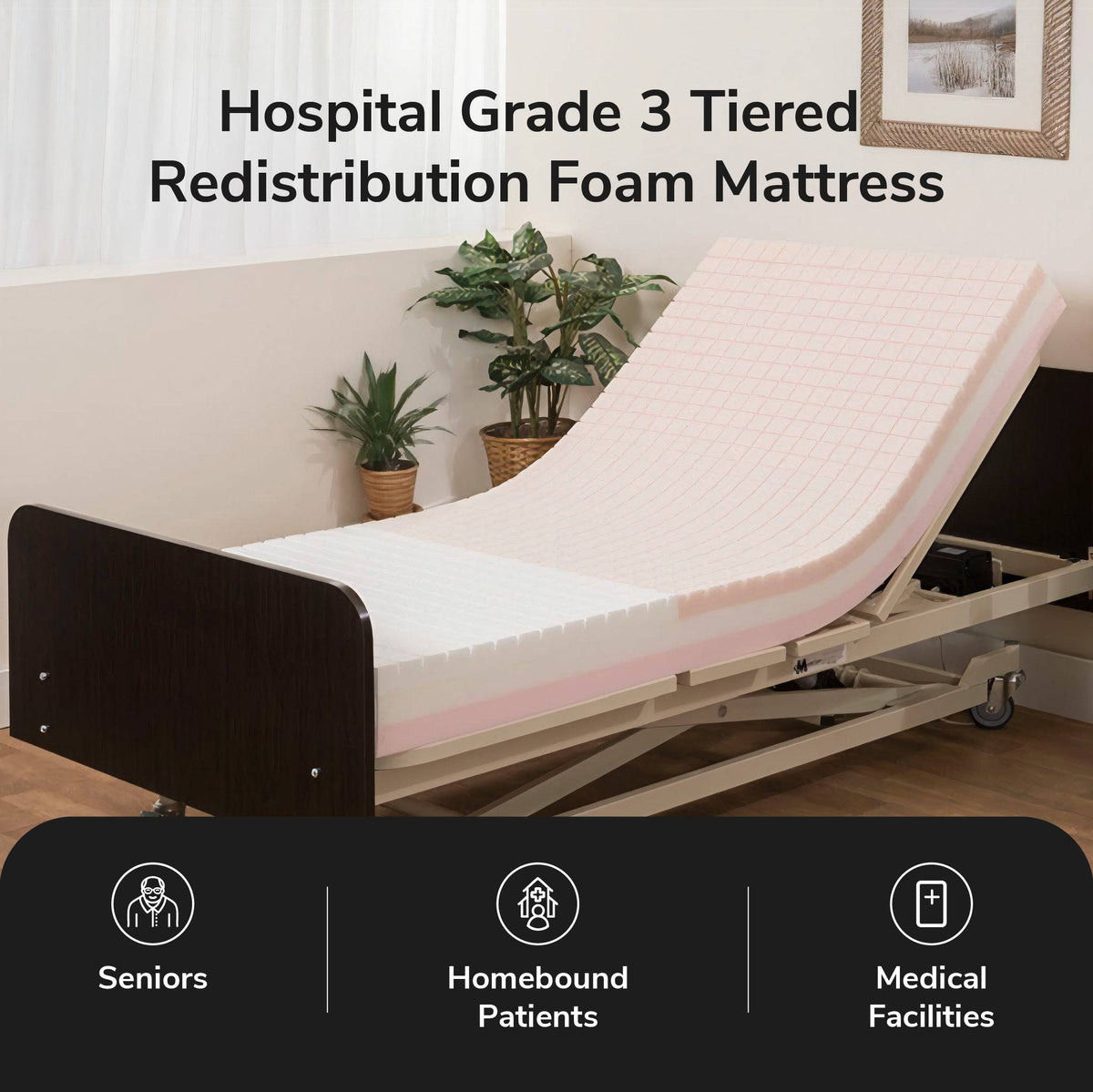
The Proex is a 3-tiered progressive foam mattress with high-density European foam. The base is firmest, progressing to convoluted memory foam at the top. A 1/2-inch heel slope with visco elastic memory foam offloads heel pressure, one of the highest-risk areas for immobile patients. The hospital-grade cover is 70 denier nylon with PVC backing, protected zipper, waterproof, anti-slip base, and elastic straps. Fire rated to CFR 16 Part 1633.
Warranty: 7-year limited with lifetime support | Stage: Effective through Stage II | Fire rating: CFR 16 Part 1633
Protekt 500, Available in 36", 42", 48", 54", and 84"
The Protekt 500 uses VGPT Visco Gel Polymer Technology, gel-infused foam that channels heat away from the body significantly faster than traditional foam. This makes it the right choice for hot sleepers, patients with excessive perspiration, and any care situation where moisture management at the skin surface is a clinical priority alongside pressure redistribution.
Warranty: 15-year core warranty on bariatric widths | Stage: I-II | Technology: VGPT gel-infused foam
The Protekt 600 is the maximum-width option in the lineup, designed for super obese patients who cannot be safely or comfortably supported on narrower bariatric mattresses. At 60 inches wide and 1,000 lbs capacity, it addresses the clinical and dignity needs of the largest patients in home care and specialized facility environments.
Dual-density construction: gel-infused top layer for pressure redistribution and skin protection, ultra-dense bottom layer to prevent bottoming out at extreme weights. Triple laminate vinyl bottom cover, fluid resistant, antimicrobial, and fire rated to CFR 16 Part 1633. No powered systems required.
Warranty: 1-year non-prorated on core and cover | Fire rating: CFR 16 Part 1633
Frequently Asked Questions
Where can I find the right hospital bed mattress size for my bed?
MedShopDirect carries hospital bed mattresses in every standard and bariatric size, 36", 42", 48", 54", and 60" wide, in both 80" and 84" lengths. Browse the Hospital Bed Mattress collection or call 833-499-4450 and our team will match the correct mattress to your bed frame.
What size mattress fits a standard hospital bed?
A standard hospital bed takes a 36" x 80" mattress. This is the most common size for home hospital beds, nursing facility beds, and clinical beds. Always measure the interior of the bed frame before ordering.
Can you use a regular twin mattress on a hospital bed?
No. A standard twin mattress is 38" wide and typically 75" long. A hospital bed mattress is 36" wide and 80" long. The dimensions are different in both width and length, and a residential twin will overhang the frame or fall short of the foot end.
Will this mattress fit my hospital bed?
If your bed frame is a standard home hospital bed, a 36" x 80" mattress will fit. For bariatric frames, measure the interior width carefully, 42", 48", and 54" are all different and not interchangeable. Contact MedShopDirect if you need help confirming compatibility.
What thickness mattress is best for a hospital bed?
A 6-inch mattress is the standard and recommended thickness for most hospital bed frames. It maintains correct side rail clearance, supports safe patient transfers at the intended height, and flexes properly with articulating bed sections. Both the Medacure Proex and Protekt 500 are 6 inches thick.
Can a thick mattress interfere with side rails?
Yes. Hospital bed side rails are designed to provide a specific protective height above the mattress surface. A mattress that is too thick reduces that clearance, which can compromise rail effectiveness and patient safety. A 6-inch mattress is the safe standard for most frames.
What is the largest bariatric hospital bed mattress available?
The Protekt 600 at 60" x 80" with a 1,000 lb weight capacity is the widest bariatric hospital bed mattress available. For comparison, the Medacure Proex and Protekt 500 top out at 48" and 54" widths respectively.
What mattress is best for tall patients?
The 84-inch extended length option is available in both the Medacure Proex and Protekt 500. This provides 4 extra inches beyond the standard 80-inch length, keeping the feet fully supported and eliminating heel pressure from foot-hanging.